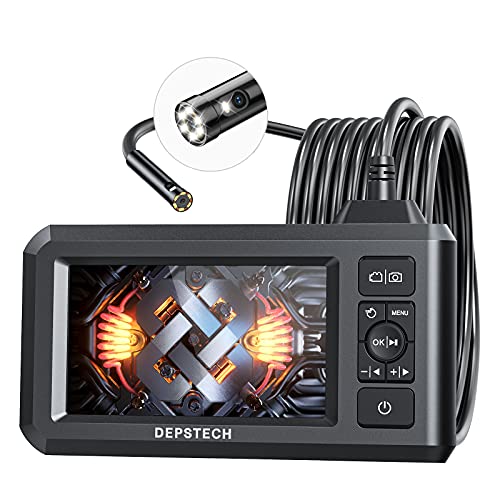
Best Borescopes for Home Inspection: Picks for Wall Cavities, Attics and Crawl Spaces
A home inspector uses a borescope to confirm a finding rather than to make one: a cold stripe on the thermal image becomes a view of a missing batt, a stain becomes a view of the pipe behind it. That puts probe size, reach into a cavity and the ability to record for the report ahead of everything else. Picks are sorted on those figures from manufacturer listings.
As an Amazon Associate, Akermin earns from qualifying purchases. Product links on this page are affiliate links.
Our Top Picks
These borescopes were compared for home inspection on probe size for a small drilled hole, cable reach into a cavity, display and recording for reports, lighting, waterproof rating and battery, all from manufacturer listings. We did not run laboratory tests or inspect a house with the tools; figures are the manufacturers' own and gaps are marked Not stated.
Best Overall
Teslong NTS500 Dual Lens Borescope With 5-Inch Monitor
0.21 in dual lens probe through a small drilled hole, 9.8 ft reach, IP67.
0.21 in (5.5 mm) probe; the listing describes drilling a small hole to view inside a wall without destroying it
Front and side cameras switched by one button; side camera has its own LED
9.8 ft probe on a 5-inch 1280 x 720 IPS screen with a 3500 mAh battery
IP67 probe for damp cavities; six adjustable front LEDs; flashlight and backlight buttons
All figures come from the manufacturers' Amazon listings at the time of research. Not stated means the listing gives no value. Recording capability is listed exactly as the manufacturer describes it; two listings state that the unit cannot record.
How to Choose a Borescope for Home Inspection
Four checks decide it:
Hole Size the Owner Will Accept
A 0.21 in tip needs a hole that a dab of spackle hides. A camera that needs 1-1/8 in is for existing openings, register cutouts and access panels.
Reach Into the Cavity
5 ft covers a stud bay; 16.5 ft crosses a ceiling or runs a chase. A fish rod mount on the ET30 turns reach into whatever rod you carry.
Recording for the Report
The DS300, DS620, ET30, ET21 and NIDAGE wireless state recording. The TGJOR states it cannot. The NTS500 does not say.
Wet Cavities
Leaks are why you are looking. IP67 on the probe is stated by most; the ET30 listing gives no rating.
How big a hole do I need to drill to get a borescope into a finished wall?
Just larger than the probe tip. The Teslong NTS500 states a 0.21 in tip and describes drilling a small hole to look inside a wall; a 1/4 in bit covers it and the hole disappears under spackle. The Klein ET30 states it fits a 1-1/8 in hole, which is a register cutout or an access hole rather than a pinhole. Several DEPSTECH and TGJOR listings do not state the diameter, so confirm before promising a small hole to a homeowner.
Can a borescope confirm mold or moisture inside a wall?
It can show staining, discoloration, wet-looking surfaces and water tracks, which is evidence, but it cannot measure moisture content and cannot identify mold by species. Pair it with a moisture meter for the reading and, where required, a sample for a lab. The borescope is the confirmation step after a thermal camera or meter flags an area, not the measurement.
Which of these borescopes record images for an inspection report?
The DEPSTECH DS300 and DS620 state 2 MP photos and 1080P video to a microSD card that is not included; the Klein ET30 and ET21 and the NIDAGE wireless save through their phone apps. The TGJOR 5-inch states that it cannot take pictures or video, and the Teslong NTS500 listing does not mention recording. If the image has to go into a report, choose from the first group or plan to photograph the screen.
What does fish rod compatibility on the Klein ET30 add?
Reach without a long floppy cable. Klein states the camera threads onto any Klein fish rod and, with the included adapter, onto other brands, so it can be pushed across an attic bay, up a chase or along a soffit on a stiff rod while the picture streams to the phone. The always-up image keeps the view upright as the rod turns. It is the practical answer for spaces you cannot crawl into.
Does a wireless borescope work in a crawl space with no cell signal?
Yes. The Klein ET21 and ET30 and the NIDAGE wireless create their own Wi-Fi link directly between the camera and the phone; Klein states up to 30 ft on the ET21. No internet or cell service is involved. The phone does need to stay connected to the camera network rather than a home router while you work.
Reviews
Teslong NTS500 Dual Lens Borescope With 5-Inch Monitor Best Overall
The NTS500 leads because it enters a wall through the smallest hole an owner will accept. Teslong states a 0.21 in probe and describes the home inspection use directly: drill a hole in the wall, put the camera in, see inside without destroying the wall. Two complete cameras at the tip, one forward and one to the side, mean the stud bay wall, the back of the drywall and the pipe running through it can each be viewed square-on by pressing a button rather than by twisting the cable.
The 9.8 ft cable reaches most of a stud bay, across a ceiling cavity or down into a floor space, and the 5-inch 1280 x 720 IPS screen is large enough to read in a dim basement. The probe is IP67 with six adjustable front LEDs and a separate side LED.
The listing does not state photo or video recording or battery runtime in hours, which matters for a report; the DS300 states both. For an inspector who photographs the screen, the slim tip is the reason to buy it.
Klein Tools ET30 Wireless Inspection Camera Best Wireless Screen-Free
The ET30 is the pick for the reach problem a stiff cable cannot solve: an attic bay you cannot crawl into, a soffit run, a duct chase above a ceiling. Klein states that the camera threads onto any Klein fish rod, and onto other brands with the included threaded adapter, so the reach is whatever rod you carry. Two other stated features suit a rod: an always-up image that stays oriented as the camera rotates, and auto focus.
The picture is 1080P over Wi-Fi to an app for iOS and Android that views, captures and shares photos and video, which is the report step. Klein states the camera fits a 1-1/8 in hole without the collar and a 1-1/2 in hole with the collar and attachments, a larger opening than the NTS500 needs, so it suits existing openings rather than a pinhole in finished drywall.
The listing does not state a waterproof rating, a cable length or a battery figure. Keep it out of standing water until the manual confirms a rating.
DEPSTECH DS300 Dual Lens Inspection Borescope, 16.5 ft Best Value
The DS300 is the value pick because it records and reaches. DEPSTECH states 2 MP photos and 1080P video saved to a microSD card, a 16.5 ft semi-rigid cable that bends and holds its shape across a ceiling cavity or down a chase, and front and side cameras with a split-screen mode that puts both views on the 4.3-inch IPS screen at once. The stated focal ranges, 1.2 to 3.1 in on the front camera and 0.8 to 2.4 in on the side camera, are the working distances inside a stud bay.
The probe is IP67 with seven adjustable LEDs at three levels, the battery is stated at about 4 hours and a 180-degree camera rotation puts an upside-down image right. The microSD card is not in the box, so buy one with the unit.
The probe diameter is not stated, which is the gap for finished-wall work: it may need a larger hole than the NTS500's 0.21 in tip. For attics, crawl spaces, duct runs and any cavity with an existing opening, it does the job and documents it at the lowest tier here.
Short answer: the Teslong NTS500 is the home inspection borescope for finished walls, with a 0.21 in dual lens probe that enters through a hole a dab of spackle will hide, a 9.8 ft cable and an IP67 tip; the Klein ET30 is the wireless pick for attics and chases you cannot crawl into, a 1080P auto-focus camera that threads onto a fish rod and streams to the phone; and the DEPSTECH DS300 is the value unit that reaches 16.5 ft, shows front and side views at once and records 1080P for the report.
Where a borescope fits in a home inspection
The order of tools on a home inspection is usually thermal camera, moisture meter, then borescope. The camera finds the cold stripe or the cool patch, the meter says whether it is wet, and the borescope confirms what is behind the surface: a missing batt, a disconnected duct, a leaking supply line, a rodent nest, a rotted sill. It is a line-of-sight camera, so it needs an opening and a cavity with some air in it, and it shows surfaces rather than measuring them. The home inspection tool guide sets out how the three tools divide the work; the home inspection thermal camera guide covers the first step. This page is about the last one.
Hole size: the figure the homeowner cares about
On a finished wall the probe diameter decides whether the owner agrees to the look. The Teslong NTS500 states a 0.21 in tip and describes the use in its own words, drill a hole in the wall and view inside without destroying it; a 1/4 in bit does it and the hole vanishes under spackle. The Klein ET21 states a 5.5 mm camera, the same class. The NIDAGE wireless states 3.9 mm, the smallest here. The Klein ET30 states that it fits a 1-1/8 in hole without its collar, which is a register cutout, an access hole or the gap behind a removed switch plate rather than a pinhole. The DEPSTECH DS300, DS620 and TGJOR listings do not state a diameter, so do not promise a small hole with those until the manual confirms it.
Reach into the cavity: cable versus rod
Inside a stud bay the distance is short and any 5 ft cable covers it. Across a ceiling cavity, down a plumbing chase or along a duct run the 16.5 ft cables on the DEPSTECH DS300 and DS620 and the 16.4 ft TGJOR earn their length, and the NTS500’s 9.8 ft sits between. All of those state semi-rigid construction that holds a bend so you can shape the cable to clear a joist. The Klein ET30 takes a different approach: it threads onto any Klein fish rod, and with the included adapter onto other brands, so the reach is the rod’s reach, and the always-up image and auto focus that Klein states are what make a camera on the end of a spinning rod usable. For an attic bay behind a knee wall or a soffit that cannot be reached from a hatch, that is often the only way to get a picture.
Recording for the report
An inspection finding has to be documented, and the listings differ sharply here. The DEPSTECH DS300 and DS620 state 2 MP photos and 1080P video recorded to a microSD card, with the card not included. The Klein ET30 and ET21 and the NIDAGE wireless save through their phone apps, which puts the file in the phone gallery ready for the report software. The TGJOR 5-inch states in its own bullet that it cannot take pictures or video, and the Teslong NTS500 listing does not mention recording at all. An inspector who needs the NTS500 image in the report should confirm recording with the manufacturer or photograph the screen.
Lenses, light and focus in a wall bay
Inside a stud bay the thing you want to see is the back of the drywall, the face of the stud and whatever runs through the bay, and all of those are beside the probe rather than ahead of it. A side camera views them square-on: the NTS500, DS300, DS620 and TGJOR all state a side lens, the DS300 shows both views at once on a split screen, and the DS620 adds a third lens. The Klein and NIDAGE units are single forward cameras, which is fine on a rod where you can turn the whole head. Light matters in a cavity that has none: the NTS500 states six adjustable front LEDs and a separate side LED, the DS300 seven at three levels, the DS620 ten, the TGJOR eight, and the NIDAGE six. Focus is close on all of these fixed-focus cameras, the DS300 states 1.2 to 3.1 in front and 0.8 to 2.4 in side and the NIDAGE 3 to 10 cm, so the sharp view is of what is within a few inches of the tip; the ET30’s auto focus is the exception.
Wet cavities, waterproofing and what the picture cannot tell you
Leaks are the usual reason for the look, so the probe will meet water. The NTS500, DS300, DS620, TGJOR, ET21 and NIDAGE all state IP67 probes; the Klein ET30 listing gives no rating, so keep it out of standing water until the manual says otherwise. The rating covers the probe, not the handset or the phone. Then there is the limit of the tool itself: a borescope shows staining, wet-looking surfaces, water tracks and discoloration, but it does not measure moisture content and it cannot identify mold. The picture is evidence that sends you back to the moisture meter for a number, and where the report needs a mold finding, to a sample and a lab. Can a moisture meter detect mold covers that boundary.
Related guides
The main borescope guide compares the same units for engines and ducts as well as walls; the plumbing and drain guide covers the wet jobs, and the wireless guide compares the phone-based units in detail.
How We Research
Borescopes were compared on manufacturer listing text: probe size and the opening it needs, cable length, display type, recording, lens arrangement, waterproof rating, lighting, focal range, battery and mounting options such as fish rod threads. Owner feedback was reviewed for recurring comments on image clarity inside walls and app reliability. We did not run laboratory tests, did not inspect a property with the tools and publish no measurements of our own. Amazon data supplies images, availability and links only.
A handheld thermal camera with a 160 by 120 infrared detector, a 320 by 240 enhanced image, 40 mK sensitivity, a focus free 40 by 30 degree field of view, a 25 Hz refresh rate and still JPG image capture.
A non contact infrared thermometer for electrical, mechanical, HVAC and automotive surfaces, with dual rotating lasers that mark the edges of the measurement area, minimum, maximum, difference and average readings, and an IP54 rating.
A pinless non invasive moisture meter that reads up to three quarters of an inch into a surface, with scales of 0 to 53 percent for softwood, 0 to 35 percent for hardwood and relative readings on wallboard, drywall and masonry.