As an Amazon Associate, Akermin earns from qualifying purchases. Product links on this page are affiliate links.
For a home gym, pick the SAF Aranet4 if you want a set-and-forget unit you can mount on the wall and read from across the room, the AIRNERGY Portable CO2 Monitor if you want the fastest refresh and the widest alerting options, and the INKBIRD IAM-O2 if you want a low-cost screen with a simple traffic-light system. The SAF Aranet4 wins the overall slot because its e-ink display stays legible in a bright garage and its battery life means you are not running a cable to a wall outlet that your rack is already using. The AIRNERGY Portable CO2 Monitor is the pick for anyone who trains in short, hard intervals and wants the number to move as fast as their heart rate does. The INKBIRD IAM-O2 is the value pick for a single-user setup where a green, yellow or red light is enough. The two remaining products in this batch, the Airthings View Battery and the Dienmern 5-in-1, are not gym picks for reasons explained below, and the Airthings View Battery in particular is a different class of instrument.
Why a home gym breaks the usual CO2 advice
Most CO2 guidance is written for seated people in offices. A home gym violates nearly every assumption in it. You are producing CO2 faster because you are breathing harder, the room is often small and sealed for noise or climate reasons, and the air is warmer and more humid than any office. A garage gym in summer can sit above 30 degrees Celsius with relative humidity in the seventies, which is outside the comfortable operating range of some consumer sensors and well outside the range where a cheap display stays accurate.
The practical consequence is that placement and sensor speed matter more than the absolute accuracy figure on the box. A monitor that refreshes every five seconds will miss the peak of a heavy set. A monitor sitting on a shelf at knee height will read lower than the air you are actually breathing, because CO2 is slightly denser than air and exhaled breath is warm and rises. Mount the unit at chest height, away from the direct breath plume of the treadmill or bike, and give it a clear line of sight to the room.
If your gym is in a basement, the same logic applies with an added twist: basements hold moisture and often have poor air exchange with the rest of the house. The basement air quality monitor guide covers the humidity side of that problem in more detail.
Comparison table, using only what the listings publish
The table below uses only figures the manufacturer listings state. Where a listing is silent, the cell says so. Nothing here is estimated.
| Product | CO2 sensor type | Stated CO2 accuracy | Refresh rate | Battery life | Display | Alerts |
|---|---|---|---|---|---|---|
| SAF Aranet4 | NDIR (implied by category, not named in bullets) | Not stated in the listing bullets | Not stated in the listing bullets | Up to 4 years | E-ink, colour coded | Optional buzzer |
| AIRNERGY | NDIR | plus or minus 50 ppm | 1 second | Not stated in the listing bullets | Not stated in the listing bullets | Beep, screen flash, app notification |
| INKBIRD IAM-O2 | NDIR, Swedish sensor | Not stated in the listing bullets | Not stated in the listing bullets | 3 to 6 months per charge | Backlit LCD with green, yellow, red | Sound and indicator light |
The table shows the trade-off clearly. The AIRNERGY Portable CO2 Monitor publishes the accuracy and speed figures; the SAF Aranet4 and the INKBIRD IAM-O2 do not. That does not make the SAF Aranet4 and the INKBIRD IAM-O2 worse instruments, but it means you are buying on the strength of other features, and you should read the rest of this page with that in mind. If a published accuracy figure is a hard requirement for you, the AIRNERGY Portable CO2 Monitor is the only one of the three that gives you one.
The three home gym picks
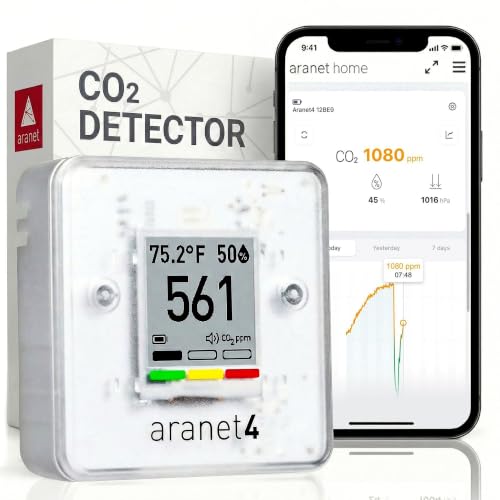
SAF Aranet4
Overall pick: e-ink display readable in a bright garage, up to four years on one set of batteries, and a free app that keeps 90 days of history for spotting which sessions push CO2 highest.
AIRNERGY Portable CO2 Monitor
Fastest pick: a one-second refresh rate and a stated accuracy of plus or minus 50 ppm, with three alert modes you can set from the app, which suits interval training where CO2 climbs and falls quickly.
INKBIRD IAM-O2
Value pick: a backlit LCD with green, yellow and red indicators, three to six months per charge, and a stated CO2 range up to 9999 ppm that covers even a packed garage session.
Placement, sweat and the maintenance nobody mentions
Every one of these monitors is a consumer-grade NDIR device, and NDIR sensors drift over time. The listing for the AIRNERGY Portable CO2 Monitor states an accuracy of plus or minus 50 ppm, which is a reasonable figure for this class. The SAF Aranet4 and the INKBIRD IAM-O2 do not publish an accuracy figure at all, so you should treat their numbers as useful for trends rather than as reference measurements. That is fine for a gym: what you actually need to know is whether CO2 is climbing during a session and whether opening the door brings it down.
The maintenance point that catches people out is calibration. Many NDIR monitors auto-calibrate by assuming that the lowest CO2 they see over a period is fresh outdoor air at roughly 400 ppm. If your gym never sees fresh air, because you keep it sealed and train at the same time every day, that assumption is wrong and the baseline slowly shifts. The fix is simple: leave the monitor in the room with a window open for a few hours regularly, or follow whatever calibration procedure the manufacturer describes. None of the three listings here spells out a manual calibration routine, so check the manual that ships with the unit.
Humidity is the other gym-specific problem. Sweat and breath raise relative humidity quickly, and some NDIR sensors are sensitive to condensation. The SAF Aranet4 measures humidity and pressure alongside CO2, so you can see when the room is getting damp as well as stale. The INKBIRD IAM-O2 measures temperature and humidity too. The AIRNERGY Portable CO2 Monitor measures temperature and humidity. All three give you the data to decide whether the problem is ventilation or moisture.
What the numbers mean during a training session
Outdoor air sits around 400 ppm CO2. A well-ventilated room with a few people in it stays under 800 ppm. Above 1,000 ppm, most people notice stuffiness and reduced concentration, and the effect on hard physical effort is at least as real. Above 2,000 ppm in a small gym, you are training in air that is meaningfully rebreathed, and the fix is ventilation, not a better monitor.
This is where the speed of the sensor matters. During a set of squats or a hard interval on the bike, CO2 in the immediate breathing zone can spike well above the room average. A monitor with a one-second refresh, like the AIRNERGY Portable CO2 Monitor, will show that spike. A slower monitor will show a smoothed average. Neither is wrong, but if you want to see the peak, you want the fast one. If you want to know whether the room as a whole is safe over a session, any of the three will do.
For a home gym, the most useful habit is to watch the recovery, not the peak. Note the reading when you start, train, then watch how quickly the number falls once you open a door or window. If it falls slowly, your ventilation is inadequate regardless of the peak figure. If you also monitor particles, because you train near a woodshop or a 3D printer, the 3D printer room guide and the woodworking shop guide cover that combined approach.
Where these monitors stop being the right answer
A CO2 monitor is not a safety device. None of the three here detects carbon monoxide, and none of them is an alarm in the life-safety sense. If your gym shares space with a gas heater, a car, or any combustion appliance, you need a CO detector as well, and it should be a certified one. A CO2 number that looks fine tells you nothing about CO.
These monitors are also not ventilation systems. If your garage gym reads 2,500 ppm after twenty minutes, the monitor has done its job by telling you so. The solution is a door, a window, a fan, or a ducted supply of fresh air. Buying a more expensive monitor will not change the number.
Finally, if you are training in a commercial space with other people, a single consumer monitor is not a compliance instrument. It is a useful indicator for you and your clients, but it does not replace the building’s own air handling design or any regulatory requirement that applies to your premises. Use it to inform your habits, not to certify the room.
Recommended Tools


Products shown because their documented specifications fit this guide. Price and availability are on Amazon and can change.
Frequently Asked Questions
Do I really need a CO2 monitor for a home gym?
If your gym is a small, sealed room, yes. CO2 is the cheapest way to tell whether the air you are breathing during hard exercise is actually being replaced. If your gym is a large, open, well-ventilated space, a monitor is optional and you can spend the money elsewhere.
Which of these three is most accurate?
Only the AIRNERGY Portable CO2 Monitor publishes an accuracy figure, plus or minus 50 ppm. The SAF Aranet4 and the INKBIRD IAM-O2 do not state one in their listings. That does not mean they are inaccurate, but it means you cannot compare them on that basis from the published data.
Can I use a CO2 monitor to check for carbon monoxide?
No. CO2 and CO are different gases and the sensors are different. None of the monitors on this page detects carbon monoxide. If you have any combustion source in or near your gym, buy a separate CO alarm.
Where should I put the monitor in a home gym?
Chest height, away from the direct breath plume of whoever is training hardest, and not on the floor. CO2 is slightly denser than air, so a floor-level reading understates what you are breathing. A wall mount at chest height is a good compromise.
Why does my monitor read higher in winter?
Because you keep the room sealed. In winter, doors and windows stay shut, so exhaled CO2 accumulates. The monitor is not misreading; it is showing you the consequence of reduced ventilation. Open a window for a few minutes between sessions and watch the number fall.
Do these monitors need calibration?
NDIR sensors drift and most consumer units auto-calibrate using a fresh-air baseline. If your gym never sees fresh air, that baseline can shift. None of the three listings here describes a manual calibration routine, so check the manual that comes with your unit and follow it.
Affiliate disclosure: Akermin earns a commission from qualifying Amazon purchases made through links on this page. Our editorial picks are based on documented specifications and owner feedback, not commissions.