Best Decibel Meters for Workshops: 5 Picks for Machine Noise and Hearing Protection
Workshop noise is not steady. It is a series of short violent events separated by quiet, and the average across an afternoon hides exactly the moments that damage hearing.
Independent Research
Verified Specifications
Honest Recommendations
Measure the Machine
Know the Peak
Protect Your Hearing
As an Amazon Associate, Akermin earns from qualifying purchases. Product links on this page are affiliate links.
Our Top Picks
Meters were compared on stated measurement range and accuracy, frequency response, available weightings and time responses, maximum and minimum capture, display size and whether continuous unattended monitoring is possible. We did not run laboratory tests and publish no measurements of our own.
Best Overall
TopTes TS-501B
A stated 1.5 dB accuracy with both weightings, max and min capture and a 30 to 8000 Hz response.
Range 30 to 130 dB with a stated accuracy of 1.5 dB
Frequency response stated as 30 to 8000 Hz
Both A and C weighting with a precise condenser microphone
Maximum and minimum capture plus data hold, 2.25 inch backlit screen
Only the Extech states a class rating under the international standard. None includes a calibrator, which formal occupational measurement normally requires before and after a reading.
How to Choose a Workshop Decibel Meter
Workshop noise is impulsive and low frequency, which is exactly where cheap meters and default settings go wrong.
The Peak Does the Damage
A planer for four seconds and a router for ten are the events that matter. An average across an afternoon hides them. Use maximum capture.
Fast for Transients, Slow for Machines
Fast at 0.125 seconds follows a nail gun or a chisel strike. Slow at 1 second gives a readable number for an extractor. The wrong setting misses or blurs the source.
C Weighting Reveals Low Frequency
A weighting discounts the bass that compressors and extractors produce. A big gap between A and C readings means low frequency energy that ear defenders handle poorly.
Measure at the Ear, Not the Machine
Exposure is what reaches your head. Hold the meter at ear height where you stand, at arm length from your body, not against the machine casing.
Classification Matters for Records
For understanding your shop, any of these works. For anything documented, a Class 2 meter checked with a calibrator is what makes a reading defensible.
A Visible Display Changes Behaviour
In a shared space, a large wall mounted number everyone can see does more for hearing protection than a precise handheld nobody picks up.
A weighting for comparing against most noise guidance, because that is how the limits are written. Add a C weighted reading when you want to see the low frequency content that A weighting discounts, which is substantial for compressors, extractors and large machines.
Fast or slow response?
Fast, at about 0.125 seconds, follows sharp events such as a nail gun, a chisel strike or a cut starting. Slow, at about 1 second, averages continuous noise such as an extractor into a steady readable figure. Use fast to catch transients and slow to characterise a running machine.
Where should I stand to take the reading?
At ear height in the position you actually occupy while working, holding the meter at arm length away from your body so you do not reflect sound into it. A reading taken against a machine casing describes the machine, not your exposure.
Can I use these for an occupational noise assessment?
Formal assessment normally requires a meter of a stated class, checked with an acoustic calibrator immediately before and after the measurement, and often a dosimeter worn for a shift rather than spot readings. Only the Extech here states a class rating, and none includes a calibrator. Follow the specific requirements in your jurisdiction.
Why do my readings jump around so much?
Because workshop noise genuinely does, and because you may be on fast time weighting. Switch to slow for a steadier figure on continuous sources, and use maximum capture rather than trying to read a fluctuating display.
Will a meter tell me which ear defenders I need?
It tells you the level you are exposed to, which is the starting point. Hearing protector ratings are quoted in ways that vary by region and depend on fit, and low frequency noise is harder to attenuate than the ratings suggest. Use the measurement to inform the choice rather than to calculate it precisely.
Reviews
TopTes TS-501B Best Overall
This publishes everything a workshop user needs to judge it: range, accuracy, frequency response, microphone type and both weightings. That combination is rare below the classified instruments, and it means you can compare it honestly against a standard rather than trusting a brand.
Both weightings is the feature that matters most in a workshop. A weighting reduces the low frequencies and approximates human sensitivity, which is what almost all noise guidance is written in. C weighting is far flatter and captures the low frequency energy that a planer, a dust extractor or a compressor produces in quantity. A large gap between the two readings on the same machine tells you the problem is low frequency, which changes what you do about it: low frequency noise travels through structures, is poorly blocked by light partitions and is the hardest to attenuate with ordinary ear defenders.
Strengths
Accuracy, range and frequency response all published
Both A and C weighting
Maximum and minimum capture for machine events
Large backlit display for a dim workshop
Limitations
No class rating stated under the international standard
The frequency response starting at 31.5 Hz is the interesting number here. That reaches well down into the range where compressors, extraction systems and large machines put much of their energy, and a meter whose response starts higher simply does not see it.
Dual ranges is the other useful detail. Sound level meters compromise between resolving quiet sounds and handling loud ones, and splitting the span into two ranges means better resolution at each end than a single wide range provides. The limitation to record is the upper frequency limit of 4 kHz, which is lower than the TopTes and means high pitched sources, a router bit screaming or a bandsaw blade singing, will be under-represented. That is a real gap for woodworking specifically.
Strengths
Response reaching down to 31.5 Hz for low frequency machines
Stated 1.5 dB accuracy
Dual ranges for better resolution
Maximum and minimum with data hold
Limitations
Upper response limited to 4 kHz, under-reading high pitched tools
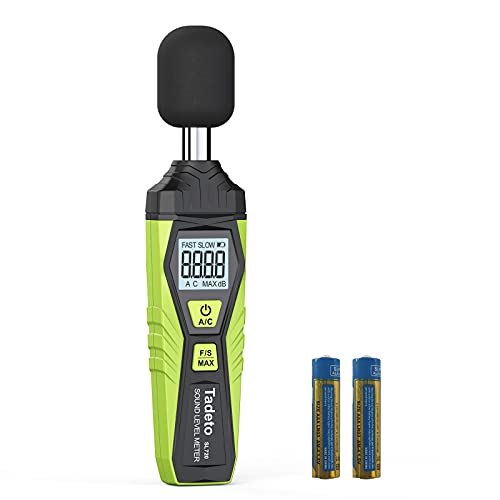
The listing is unusually educational, explaining that A weighting simulates the ear's response to lower intensity noise and suits ambient measurement, while C weighting suits higher intensity sound pressure. That is broadly the right distinction and it is more guidance than most manufacturers offer.
Having both time weightings as well as both frequency weightings is what makes this flexible in a workshop. Fast, at 0.125 seconds, follows the sharp transients of a chisel strike or a nail gun. Slow, at 1 second, averages a continuous source such as an extractor into a steady readable number. Trying to read a fast-weighted display on a continuous machine is an exercise in frustration, and trying to capture a transient on slow simply misses it. The stated accuracy of 2.0 dB is looser than the two above, which is honest to publish.
DANOPLUS Wall Mounted Sound Meter Best for Shared Spaces
A handheld meter measures when somebody picks it up, which in a shared workshop is almost never. A wall mounted display measures continuously and, more importantly, is visible to everyone in the room, which is how behaviour actually changes.
That makes this a different kind of product from the rest of the page. It does not give you a careful measurement of one machine; it gives everyone an ongoing awareness of the room. In a teaching workshop, a makerspace or a production shop where hearing protection compliance is patchy, a large visible number with an alarm indicator does more for hearing conservation than a precise handheld in a drawer. Adding temperature and humidity is sensible, since the same display then covers comfort and, in a woodshop, timber conditions.
Strengths
Continuous measurement visible to everyone
11 inch display readable across a workshop
Threshold alarm indicators
Temperature and humidity included
Limitations
No stated accuracy, range or weighting
Fixed position, so it cannot measure a specific machine
This is the only meter on the page that states a classification under the international standard for sound level meters, and that is the specification that decides whether a reading can be used formally. Class 2 is the general purpose grade accepted for most occupational and environmental measurement; Class 1 is the tighter laboratory grade.
Combined with a stated 1 dB accuracy, the tightest here, it is the choice for a production workshop where noise exposure might need to be documented rather than merely understood. It still ships without a calibrator, and for any formal assessment a calibrator check before and after the measurement is what makes the reading defensible. The trade against the cheaper meters is a higher starting point at 35 dB, which is irrelevant in a workshop.
Short answer: the TopTes TS-501B is the best general workshop meter because it publishes accuracy, frequency response and both weightings; the Extech SL510 is the one to buy if a reading might need to be defended, since it states Class 2 and 1 dB accuracy; and the DANOPLUS wall meter is the right answer for a shared space, where a visible number changes behaviour more than a precise one does.
Workshop noise is impulsive, and averages hide it
A workshop is quiet most of the time. Then a planer runs for four seconds, a mitre saw cuts for two, an impact driver rattles for one, and it goes quiet again. Averaged across an afternoon the figure can look unremarkable, and the moments that actually risk hearing damage vanish into it. This is why maximum capture is the most important function on a workshop meter: it records the peak while you concentrate on the cut, and the peak is what determines whether hearing protection was needed.
The gap between A and C tells you what kind of noise you have
A weighting deliberately discounts low frequencies because human hearing is less sensitive to them at moderate levels, and almost all noise regulation is written in A weighted decibels. C weighting is much flatter and includes the bass that A weighting throws away.
Measure the same machine with both and the difference is informative. A dust extractor, a compressor or a large planer typically reads substantially higher on C than on A, which tells you a lot of the energy is low frequency. That matters practically: low frequency noise travels through walls and floors rather than being absorbed, it is poorly attenuated by ordinary ear defenders, and it is the component most likely to annoy neighbours. A router or a bandsaw shows a much smaller gap, because its energy is higher up the spectrum.
Watch the upper frequency limit
Two meters here publish a frequency response and they differ in a way that matters for woodworking. One reaches 8000 Hz, the other stops at 4 kHz. Router bits, bandsaw blades and small high speed tools produce a great deal of their output above 4 kHz, and a meter whose response ends there will under-read them. If your shop is mostly compressors and extraction, the low end matters more; if it is mostly high speed cutting, the top end does.
Measure where your head is
The most common measurement error is taking the reading at the machine. Exposure is determined by the sound arriving at your ears, and sound falls off with distance, so a figure taken against the casing of a saw substantially overstates what the operator experiences. Stand where you actually stand while working, hold the meter at ear height and at arm’s length from your body, and take the reading there. Your own torso reflects sound, which is why arm’s length matters.
Formal measurement needs a calibrator
For understanding your own workshop, any meter on this page is adequate and the readings are comparable with each other. For anything documented, an occupational assessment, a complaint, a planning matter, the requirements are different: a meter of a stated class, checked with an acoustic calibrator immediately before and after the measurement, and frequently a dosimeter worn through a shift rather than spot readings. Only the Extech states a class rating and none includes a calibrator. Our comparison of the Extech SL510 and the 407732 kit covers what a calibrator adds, and the sound level meter roundup covers the wider category.
How We Research
Meters were compared on stated measurement range and accuracy, frequency response, available frequency and time weightings, maximum and minimum capture, class rating under the international standard, display size and whether continuous unattended monitoring is supported. We did not run laboratory tests and publish no measurements of our own.
A thermocouple is a temperature sensor made from two dissimilar metals that generates a small voltage proportional to the temperature difference between its measuring junction and a reference junction.
Thermocouples win on range, speed and ruggedness, and lose on absolute accuracy and cold-junction compensation; this explains the mechanism behind each.
A guide to reading a decibel meter's accuracy claims, choosing weighting and response settings, and knowing when a handheld meter is the wrong instrument.