Skip to content
AkerminMeasure. Monitor. Improve. Compare Products

Best Hygrometers for Instrument Cases: 7 Picks for Acoustic and Electric Storage

A soundboard cracks because the wood shrinks across the grain faster than the braces that hold it. The instrument does not need to be soaked; it needs to sit in air that stays between roughly 45 and 55 percent relative humidity. The meter you put in the case is how you know whether that is happening. This page separates instruments that measure from instruments that control, because they solve different halves of the problem.

  • Independent Research
  • Verified Specifications
  • Honest Recommendations

Measure It
Compare It
Buy Once

As an Amazon Associate, Akermin earns from qualifying purchases. Product links on this page are affiliate links.

Our Top Picks

This comparison covers hygrometers and humidity control systems intended for acoustic and electric instrument storage. Products were included only where the supplied listing describes use in or around an instrument case or soundhole.

Best overall
MusicNomad Hone Guitar Hygrometer

MusicNomad Hone Guitar Hygrometer

Clips to the strings and reads the air the guitar is actually sitting in.

  • Clips directly onto acoustic or electric guitar strings
  • Sensor samples every 20 seconds
  • LCD shows humidity and temperature
  • Stores maximum and minimum readings, resettable at any time
View on Amazon Read Full Review→
Best combined unit
MusicNomad Humitar ONE

MusicNomad Humitar ONE

Humidifier and hygrometer in one object, so you add water and read the result in the same place.

  • Combined acoustic guitar humidifier and built-in hygrometer
  • Reusable Humid-i-Bar sponge holds a large volume of water
  • Sensor monitors the environment every 20 seconds
  • LCD shows humidity and temperature
View on Amazon Read Full Review→
Best control system
D'Addario Humidipak Kit

D'Addario Humidipak Kit

Two-way packs that hold 45 to 50 percent without you adding water.

  • Two-way humidity control system for guitar cases
  • Maintains a constant 45 to 50 percent relative humidity
  • Maintenance-free; no water, no drips
  • Kit includes pouches and humidifier packs
View on Amazon Read Full Review→
Best refill pack
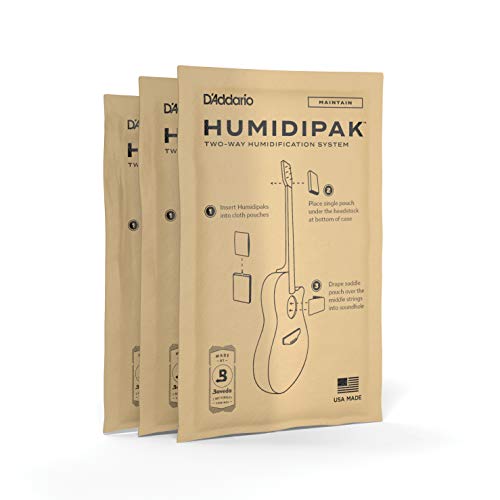
D'Addario Humidipak Maintain Packets

D'Addario Humidipak Maintain Packets

The same two-way system sold as replacement packets for people already running it.

  • Two-way humidification system for guitar cases
  • Automatically maintains 45 to 50 percent relative humidity
  • Packets stated to last 2 to 6 months depending on location and conditions
  • No water, no drips, no mess; sold as a 3-pack
View on Amazon Read Full Review→
Best for logging
Govee H5074 Bluetooth Hygrometer

Govee H5074 Bluetooth Hygrometer

Phone logging with a stated accuracy figure and a two year export.

  • Bluetooth app monitoring with a stated 262ft range, no obstacles
  • Stated accuracy of plus or minus 0.54 degrees F and plus or minus 3 percent RH
  • Reads every 2 seconds
  • 20 day on-board storage; export up to 2 years of data as CSV
View on Amazon Read Full Review→
Best analog soundhole unit
GUITTO GHD-01 Humidifier and Analog Hygrometer

GUITTO GHD-01 Humidifier and Analog Hygrometer

Clip-on soundhole humidifier with a no-battery mechanical gauge.

  • Combined refillable sponge humidifier and mechanical analog hygrometer
  • Clips to the soundhole edge with no string contact
  • Soft silicone pads at the contact points
  • Refillable via included dropper bottle through fill ports
View on Amazon Read Full Review→
Best budget analog
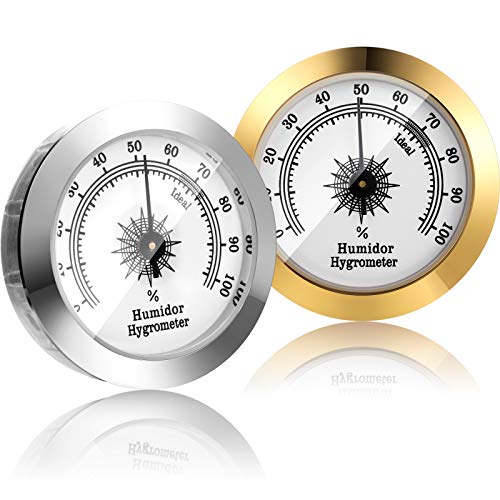
Frienda Analog Humidor Hygrometer

Frienda Analog Humidor Hygrometer

A cheap mechanical gauge with a stated plus or minus 5 percent error.

  • Sold as a 2 piece set, about 2 inches in diameter
  • Analog mechanical movement with a stable pointer
  • Stated humidity error of plus or minus 5 percent
  • Alloy body described as durable and anti-corrosion
View on Amazon Read Full Review→

Comparison Table

View Full Comparison→
PickTypeMeasuresControls humidityRefresh or responseStated accuracyPower
MusicNomad HoneDigital case meterHumidity and temperatureNoEvery 20 secondsNot statedNot statedView
MusicNomad Humitar ONEHumidifier with meterHumidity and temperatureYes, one-way spongeEvery 20 secondsNot statedNot statedView
D'Addario Humidipak KitTwo-way control systemNo displayYes, two-wayNot applicableNot statedNone requiredView
D'Addario Maintain PacketsTwo-way control refillNo displayYes, two-wayNot applicableNot statedNone requiredView
Govee H5074Bluetooth loggerHumidity and temperatureNoEvery 2 secondsPlus or minus 3 percent RH, plus or minus 0.54 degrees FNot statedView
GUITTO GHD-01Soundhole humidifier with analog gaugeHumidity only, per listingYes, one-way spongeNot statedNot statedNone requiredView
Frienda Humidor HygrometerAnalog gaugeHumidity onlyNoNot statedPlus or minus 5 percentNone requiredView

Cells marked Not stated are absent from the supplied listing text. Two-way control systems hold a band rather than reporting a reading, so accuracy and refresh columns do not apply to them.

How to choose a hygrometer for an instrument case

Work out which half of the problem you have first: measuring, or controlling. Most people need both, and they are usually two different products.

Decide measure or control

A meter tells you the number. A two-way pack system holds the number. If your case swings dry every winter, you need control; if you do not know whether it swings, you need a meter first.

Put the sensor in the case

A case is a small sealed volume. A meter on the wall reads different air. Clip a sensor to the strings, or place it in the accessory compartment, but not on the shelf beside the case.

Insist on max and min memory

The overnight low is what cracks a top, not the average. A meter without max and min memory can read 47 percent all day and hide the 30 percent night.

Check whether accuracy is published

Several listings give a refresh rate but no accuracy figure. Refresh rate is not accuracy. If the listing does not state an accuracy, treat the reading as a trend, not a measurement.

Know what a humidifier does not do

A one-way humidifier only adds moisture. In a damp climate it can push the case above the safe band. A two-way system corrects in both directions; a sponge does not.

Plan for the power source

Analog gauges need no battery, which suits an instrument stored for months. Digital meters need cells you will forget to change. A dead meter reads nothing and looks fine.

Frequently Asked Questions

View All FAQs→
What relative humidity should an acoustic guitar case be kept at?

The two-way control systems on this page are specified to hold 45 to 50 percent relative humidity, and that is the band most repair work assumes. Below roughly 40 percent, solid wood shrinks across the grain and the top can split along the centre seam or the braces can come loose. Above roughly 60 percent, the top swells, the action rises and glue joints suffer. The target is a band, not a single number.

Do I need a hygrometer if I already use Humidipak?

Yes, and this is the most common mistake. A two-way pack holds the band but does not display it, and it does not announce when it is spent. The listing for the replacement packets gives a two to six month lifespan depending on location and exposure. Without a separate meter you find out the pack has failed when the tuning drops and the fret ends feel sharp, which is already a sign the wood has moved.

Is a room hygrometer good enough for a guitar case?

No. A case is a small sealed volume with wood, lining and the instrument itself buffering the air inside it. A room meter on a shelf reads a much larger body of air that can differ by several percent, and in a heated room in winter the gap widens. Room meters like P2, P5, P11 and P12 are useful for knowing whether the room is dry enough to justify a case humidifier, but they are not case instruments.

Why does the listing give a refresh rate but no accuracy figure?

Because refresh rate is easy to specify and accuracy is not. A sensor that updates every 10 seconds can still be several percent out. Only P7 and P8 on this page publish an accuracy figure, at plus or minus 3 percent RH and plus or minus 5 percent respectively. Where no accuracy is stated, use the reading to detect direction and gross problems, not to make fine decisions.

Reviews

MusicNomad Hone Guitar Hygrometer

MusicNomad Hone Guitar Hygrometer Best overall

The reason a case meter beats a room meter is volume. A closed guitar case holds perhaps thirty to fifty litres of air, and the wood, the lining and the instrument itself all buffer that air. A meter on the wall across the room is measuring a different body of air that may be two or three percent different in relative humidity, and in winter with heating on it can be much further apart. The Hone solves the placement problem by hanging from the strings, so the sensor sits in the same pocket of air as the top and back.

The 20 second refresh matters less than the max and min memory. What cracks a soundboard is not the average; it is the excursion. A case that sits at 48 percent all week and drops to 28 percent on the night the heating comes on hard is the case that produces a split along the centre seam. The Hone records that low so you can see it the next morning even if the reading has already recovered. Reset it after each check and you have a rolling record of the worst the instrument has seen.

One caveat: it clips to the strings, so it is inside the instrument, not in the case cavity around it. For an acoustic in a closed case those two air masses equalise within minutes, so it makes almost no difference. For an electric in a hard case with a moulded interior, the strings sit in a tighter space and the reading is still representative, but you are measuring the neck pocket rather than the body cavity. Either way it is closer to the wood than a shelf meter.

Strengths

  • Mounts inside the instrument, so it reads the air the wood sees
  • Max and min memory captures the overnight low that matters
  • 20 second refresh is fast enough to catch a heating cycle
  • Works on electric guitars as well as acoustic

Limitations

  • Accuracy figure is not stated in the listing bullets
  • Must be removed before playing
  • No logging or app; you have to read it in person
  • Battery type and life are not stated in the listing bullets
View on Amazon
MusicNomad Humitar ONE

MusicNomad Humitar ONE Best combined unit

Most people who crack a guitar do it in the first winter they own a humidifier, because they fill it, put it in the case, and never check whether it is actually holding the target. The Humitar ONE closes that loop by putting the gauge on the device that is doing the humidifying. You fill the sponge, close the case, and the next morning you read the number on the same object. If it says 38 percent, you know the sponge is not keeping up and you need to refill more often or add a second source.

The Humid-i-Bar sponge is the mechanism worth understanding. Evaporation rate depends on surface area and on how dry the surrounding air is, so a large sponge releases more water per day than a small one and needs refilling less often. That is the whole argument for a bigger reservoir: fewer visits, and less chance the case drifts dry while you are away for a week. The listing does not publish a refill interval, and in practice it depends entirely on the case seal and the room.

The trade-off against P1 is placement. The Humitar ONE sits in the soundhole or in the case, depending on how you fit it, and it is a humidifier first. If you already run a two-way pack system like P3, you do not need this; you need a plain meter. If you are starting from nothing and want one purchase that both adds moisture and tells you the result, this is the sensible single item.

Strengths

  • Humidifies and measures in one unit
  • Large sponge reservoir means fewer refills than small humidifiers
  • 20 second sensor refresh matches the standalone Hone
  • No separate meter to lose or forget

Limitations

  • Requires refilling with water, unlike the two-way packs
  • Accuracy figure is not stated in the listing bullets
  • Refill interval is not stated and depends on case seal and climate
  • Bulkier in the case than a bare hygrometer
View on Amazon
D'Addario Humidipak Kit

D'Addario Humidipak Kit Best control system

A one-way humidifier only adds moisture. In a wet climate, or in a case that has been overfilled, that is the wrong direction and you can push the instrument above 60 percent, which swells the top and raises the action. A two-way pack contains a saturated salt solution that buffers toward a fixed equilibrium: below the target it releases water vapour, above it absorbs. The D'Addario system is specified to hold 45 to 50 percent, which is the band most repair shops consider safe for a solid wood acoustic.

This is the pick for the person who travels, or who leaves the instrument for weeks at a time, or who simply will not remember to top up a sponge. There is no water to spill into the instrument, which is the failure mode that ruins more guitars than dryness does. The listing states the system is maintenance-free and does not require adjustment for seasonal temperature changes or geography.

The limitation is that it controls, it does not report. You cannot read a number off a Humidipak. If you want to know what the case is actually doing, you still need a meter, and the honest answer is that the best setup is a pack system plus P1 or P7 to verify it. The listing does not publish an accuracy figure for the target band, and it does not state how long the included packs last; the replacement pack listing gives a range of two to six months depending on location and exposure.

Strengths

  • Two-way control, so it corrects both dry and damp conditions
  • No water to spill inside the case
  • Holds a stated 45 to 50 percent band
  • Nothing to adjust seasonally, per the listing

Limitations

  • Does not display a reading; it controls but does not report
  • Consumable packs need replacing
  • Accuracy of the held band is not stated in the listing bullets
  • Included pack lifespan is not stated in this listing
View on Amazon
D'Addario Humidipak Maintain Packets

D'Addario Humidipak Maintain Packets Best refill pack

This is functionally the same humidity control as P3, sold as consumable packets rather than as a kit with pouches. If you already own the pouch holder, this is the item you buy again; if you are starting fresh, P3 gives you the holder and the packs together. The listing is explicit that the packets last on average two to six months depending on geographic location and the conditions the instrument is exposed to, which is the most useful lifespan figure on this page.

That range is wide for a reason. A pack in a well-sealed hard case in a temperate room will sit near the top of it. A pack in a gig bag in a centrally heated flat in a cold climate will sit near the bottom, because the case is exchanging air with a very dry room and the pack is doing far more work. This is why a meter matters even with a control system: the pack does not tell you when it is spent, it simply stops holding the band, and the first sign is usually a tuning drop and a sharp fret end rather than a visible crack.

The listing states the system is maintenance-free and requires no adjustment for seasonal temperature changes. It does not publish an accuracy figure for the held humidity band. Treat the two to six month figure as the replacement schedule and check the case with a separate meter in between.

Strengths

  • Two-way control holds a stated 45 to 50 percent band
  • Lifespan guidance of 2 to 6 months is published
  • No water handling at all
  • 3-pack suits owners with more than one instrument

Limitations

  • Consumable; ongoing replacement is required
  • No display, so it cannot tell you the current reading
  • Accuracy of the held band is not stated in the listing bullets
  • Lifespan varies widely with case seal and climate
View on Amazon
Govee H5074 Bluetooth Hygrometer

Govee H5074 Bluetooth Hygrometer Best for logging

The reason to want logging rather than a display is that humidity problems are episodic. You check the case on Saturday morning and it reads 47 percent, so you conclude everything is fine. What you did not see was Thursday night at 31 percent when the heating cycled. A logger catches that, and the Govee is the only product on this page that publishes both a stated accuracy figure and an export path. The listing gives plus or minus 3 percent relative humidity and plus or minus 0.54 degrees F, which is a real specification rather than a resolution claim.

The 2 second refresh is faster than any case needs, but it is useful for a different job: finding the leak. If you suspect a case seal is failing, put the logger inside, close it, and watch how fast the reading tracks the room. A tight case will lag the room by a long way; a failed seal will follow it within minutes. The 20 day on-board buffer means you do not need the phone nearby every day, and the CSV export gives you a file you can show a repair shop.

Two things to be clear about. The listing states this is not a WiFi version, so remote access depends on Bluetooth range, stated at 262 feet with no obstacles; walls and a closed case will reduce that substantially. And the sensor is a general purpose indoor sensor, not a case specific one, so placement is on you. Put it in the case, not on the shelf next to it, or you are logging the room.

Strengths

  • Stated accuracy of plus or minus 3 percent RH and plus or minus 0.54 degrees F
  • 20 day on-board storage plus CSV export up to 2 years
  • 2 second refresh rate
  • Catches overnight excursions a display-only meter misses

Limitations

  • Not a WiFi version; range depends on Bluetooth and obstacles
  • Requires a phone and app to read anything
  • No mounting hardware for a case is described in the listing
  • Battery life is not stated in the listing bullets
View on Amazon
GUITTO GHD-01 Humidifier and Analog Hygrometer

GUITTO GHD-01 Humidifier and Analog Hygrometer Best analog soundhole unit

The GHD-01 is a humidifier with a gauge attached, not a precision instrument, and it should be judged that way. The mechanical movement needs no battery, which is genuinely useful for an instrument that sits in a case for months, because there is nothing to leak and nothing to go flat. The clip-on soundhole mount is the design point worth noting: it contacts the edge of the soundhole rather than hanging between the strings, so there is no string damping and no risk of the unit swinging into the top.

The listing is honest about the limitation, stating that in very dry climates below 40 percent RH the unit may need more frequent refilling. That is the physics of evaporation: the drier the air, the faster the sponge empties, and a soundhole humidifier has a limited reservoir. If your room drops into the twenties in winter, this alone will not hold the case, and you should be looking at a two-way pack system instead.

On the gauge itself, the listing does not publish an accuracy figure. Analog hygrometers of this type are typically quoted at plus or minus 5 percent or wider, and they are best used as a trend indicator, telling you whether humidity is rising or falling and roughly where it sits, rather than as a calibration reference. If you need a number you can trust, pair it with a digital meter. The listing also does not state the temperature range or whether temperature is displayed at all.

Strengths

  • No battery to leak or replace
  • Clips to the soundhole edge with no string contact
  • Refillable sponge with an included dropper bottle
  • Combines humidification and a visual humidity reference

Limitations

  • Analog gauge accuracy is not stated in the listing bullets
  • Struggles in very dry climates below 40 percent RH, per the listing
  • Humidity only; temperature display is not stated
  • Requires refilling with water
View on Amazon
Frienda Analog Humidor Hygrometer

Frienda Analog Humidor Hygrometer Best budget analog

This is a cigar humidor gauge, and the listing says so. It is included here because it is the cheapest way to get a mechanical humidity reference into a case, and because the stated plus or minus 5 percent error is at least published, which is more than several digital units on this page manage. A 2 inch dial fits in a case pocket or sits on the accessory shelf.

Be clear about what plus or minus 5 percent means in practice. If the gauge reads 45 percent, the true value could be anywhere from 40 to 50. That is a wide enough band that you cannot use it to decide whether you are at the bottom of the safe range or comfortably inside it. What it can do is tell you that the case is nowhere near 30 percent, which is the reading that should prompt action. Used as a coarse alarm rather than a measurement, it earns its place.

The mechanical movement is also slow to respond. A bimetal or hair-spring hygrometer takes minutes to settle after a change, so it will not show you the overnight low the way a digital max and min memory will. The listing does not state a temperature range, a response time, or whether temperature is measured at all. If you want a number rather than a needle position, this is not the instrument.

Strengths

  • Stated plus or minus 5 percent humidity error
  • No battery required
  • Two units in the pack, so one can go in each case
  • Compact 2 inch dial fits a case pocket

Limitations

  • Plus or minus 5 percent is too coarse for fine decisions
  • Slow mechanical response; no max and min memory
  • Designed for cigar humidors rather than instrument cases
  • Temperature measurement is not stated in the listing bullets
View on Amazon

Buying Guide

Short answer: For most acoustic owners the practical pairing is a meter that lives in the case and a control system that holds the target. P1 (MusicNomad Hone) is the overall pick because it clips to the strings inside the instrument, refreshes every 20 seconds and stores max and min, which is exactly what you need to see the overnight swing. P6 (MusicNomad Humitar ONE) is the smart pick if you want humidification and monitoring in one object. P3 (D’Addario Humidipak) is the value pick in the sense that it does the controlling job with no water and no refilling, and P10 is the same system sold as replacement packets. P7 (Govee H5074) is the one to choose if you want a phone log of the last three weeks rather than a number you have to walk over and read. P2, P5, P11 and P12 are room meters, not case meters; they are useful for the room the case sits in, but a case is a small sealed volume and a meter sitting on a shelf tells you very little about it. P8 is a cigar humidor gauge and P9 is a soundhole humidifier with an analog gauge, both of which belong to adjacent topics rather than this one.

What relative humidity actually does to instrument wood

Wood is hygroscopic. It takes on and releases moisture from the air around it until it reaches equilibrium, and as it does so it changes dimension. The change is not equal in all directions: along the grain a spruce top moves very little, across the grain it moves a great deal. A soundboard is braced across the grain, and the braces resist that movement. When the air dries and the top tries to shrink, the braces hold the outer edges in place and the stress concentrates along the centre seam and around the brace ends. That is where the crack appears.

The practical consequence is that the number that matters is not the average humidity but the low. A case that sits at 48 percent for six days and drops to 30 percent on the seventh has done real damage on the seventh. This is why max and min memory is the single most useful feature on a case hygrometer, and why a meter without it can look reassuring while the instrument is being harmed. If you want to understand how humidity measurement works more generally, the guide to digital hygrometers covers sensor types and calibration.

Why a case meter is not the same as a room meter

A closed guitar case holds a small volume of air, perhaps thirty to fifty litres, and that air is in contact with the instrument, the lining and the case shell. All of those buffer humidity changes, which is exactly what you want: the case slows the swing that the room experiences. But it also means the air inside the case can be several percent different from the air in the room, and the difference grows when the room is being heated or cooled aggressively.

A meter sitting on a shelf tells you about the shelf. To know what the instrument is experiencing you have to put the sensor in the case, and ideally inside the instrument. A clip-on meter like P1 does this by hanging from the strings. A logger like P7 can be dropped into the accessory compartment, though the listing does not describe any case mounting. Either way, the placement decision matters more than the specification sheet. If you are monitoring a room for other reasons, the material on air quality monitors covers the wider picture, but it is a different job.

One-way humidifiers, two-way systems, and the mistake people make

A sponge humidifier adds water vapour. That is all it does. If the case is at 35 percent it will push the reading up, and if the case is at 55 percent it will push it further up, because there is no mechanism to stop it. In a dry climate that is fine. In a damp one, or in a case with a good seal and a large sponge, it can take the instrument above the safe band, which swells the top and raises the action just as surely as dryness lowers it.

A two-way system contains a saturated salt solution that buffers toward a fixed equilibrium. Below the target it releases vapour; above it, it absorbs. The D’Addario system is specified to hold 45 to 50 percent, which is why it is the control pick here. The trade-off is that it is a consumable and it displays nothing. The best setup for most owners is a two-way system plus a meter to verify it, and the meter is what tells you when the packs have stopped working. For a wider look at how instruments and rooms interact over time, the page on humidity data loggers for museums explains the buffering principle in more depth.

Reading the specifications that listings actually publish

Look at what the listings on this page give you. P7 publishes an accuracy of plus or minus 3 percent RH and a 2 second refresh. P8 publishes plus or minus 5 percent. P1, P6 and P9 publish a refresh rate of 20 seconds or nothing at all, but no accuracy figure. P3 and P10 publish the band they hold, 45 to 50 percent, but no accuracy for that band. That pattern is normal in this category and it tells you something: refresh rate is cheap to specify and accuracy is not.

The practical rule is to treat a published accuracy as the basis for a decision and an unpublished one as a trend indicator. A meter that updates every 10 seconds but has no stated accuracy can still tell you that the case is heading toward 30 percent, which is the information you need to act. It cannot tell you whether you are at 44 or 49, and you should not make fine adjustments on the strength of it. Where a listing quotes an implausibly tight figure for a consumer sensor, that figure is usually display resolution rather than accuracy; none of the listings here do that, but it is worth knowing when you shop elsewhere.

Where a hygrometer stops being the right answer

A hygrometer is a measuring instrument, not a protective device. It will tell you the case is at 28 percent and it will do nothing about it. If your instrument is already showing a sunken top, sharp fret ends or a buzzing that appeared over one winter, the problem is not measurement, it is that the instrument needs to be seen by a repair shop and the storage conditions need to change.

There is also a point at which the case itself is the problem. A gig bag with a broken zip, or a hard case with a failed seal, will track the room no matter how much humidity you put into it. If a logger shows the case humidity following the room within minutes of closing, the fix is a new case, not a better meter. And if you are storing an instrument in a room you are also monitoring for other reasons, it is worth separating the two questions: the instrument needs a stable band in a small volume, and the room needs whatever the people in it need. The two are related but they are not the same measurement, and one meter cannot do both jobs well.

How We Research

This comparison covers hygrometers and humidity control systems intended for acoustic and electric instrument storage. Products were included only where the supplied listing describes use in or around an instrument case or soundhole. Room-only meters (P2, P5, P11, P12) were excluded from the picks because a case is a small sealed volume and a shelf meter does not describe it; they are named in the answer for readers who want to monitor the room. P8 is a cigar humidor gauge and is included only as a low-cost analog reference with a published error figure, with that limitation stated. P9 is a humidifier with an analog gauge rather than a precision meter, and is described as such. Every specification quoted comes from the supplied listing text. Where a listing does not publish a figure, the table and the review say so rather than estimating. No laboratory testing was performed and no measurements of our own are published.

Read our full review methodology→