Skip to content
AkerminMeasure. Monitor. Improve. Compare Products

Best Weather Stations for Small Farms: 5 Picks for Frost, Spray and ET

A farm weather station earns its keep on three jobs: warning you before a frost, telling you when wind and humidity make spraying safe, and logging the rainfall and temperature data you need to estimate evapotranspiration. A garden station that shows a nice indoor temperature will not do any of those reliably. The decision is mostly about siting, data access and whether the station can be read from the house or the tractor cab.

  • Independent Research
  • Verified Specifications
  • Honest Recommendations

Measure It
Compare It
Buy Once

As an Amazon Associate, Akermin earns from qualifying purchases. Product links on this page are affiliate links.

Our Top Picks

This comparison was built from the supplied manufacturer listing text for each product. Only stations that publish wind measurement, or that clearly serve a farm rainfall and conditions role, were included. P3, P4, P7, P8, P10 and P12 were excluded because their listings describe home or indoor comfort stations without the wind and solar radiation sensors a farm decision needs.

Best overall for farm decisions
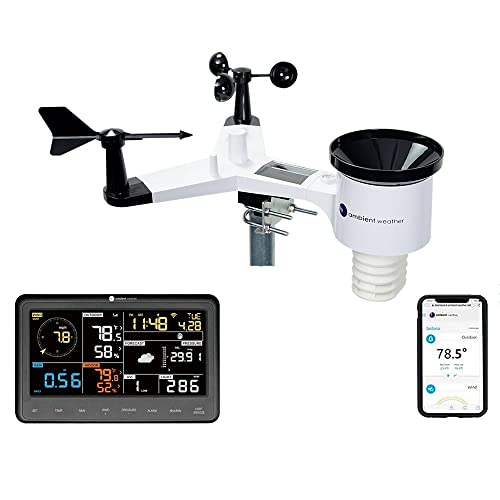
Ambient Weather WS-2902

Ambient Weather WS-2902

The sensor set a small farm actually needs, with alerts that reach a phone.

  • Osprey sensor array measures wind speed and direction, temperature, humidity, rainfall, UV intensity and solar radiation
  • Wi-Fi enabled with a colour LCD console
  • Alerts and remote data access via IFTTT, Google Home and Alexa
  • Rain cup and wind sensors are part of the all-in-one array
View on Amazon Read Full Review→
Best for calibration and mixed units
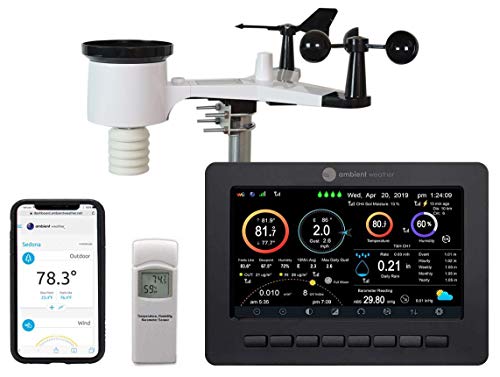
Ambient Weather WS-2000

Ambient Weather WS-2000

Same sensor set as the WS-2902 with a TFT display and calibration controls.

  • TFT colour display
  • All-in-one sensor array measures wind speed and direction, temperature, humidity, rainfall, UV and solar radiation
  • Supports imperial and metric units
  • Calibration is available
View on Amazon Read Full Review→
Best for simple installation
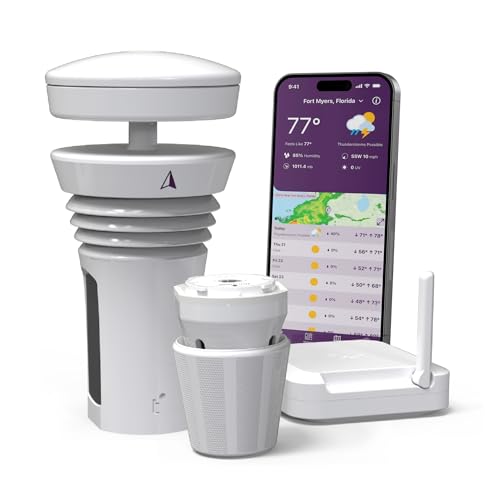
WeatherFlow Tempest

WeatherFlow Tempest

One solar-powered outdoor unit, app-based data, and lightning detection.

  • Single outdoor device monitors temperature, humidity, barometric pressure, wind speed and direction, dew point, solar radiation, UV index, lightning strikes and rainfall
  • Solar-powered outdoor sensor
  • Wireless transmission stated up to 1,000+ feet
  • Real-time updates stated every 3 seconds
View on Amazon Read Full Review→
Best budget rainfall logger
Sainlogic 12-in-1 (No WiFi)

Sainlogic 12-in-1 (No WiFi)

A no-WiFi station with a stated rainfall accuracy and a large display.

  • Rainfall tracked from 0 to 9999 mm with stated accuracy of plus or minus 7 percent
  • Hourly, daily, weekly, monthly and cumulative rainfall records
  • 6.5 inch HD colour display with three-level adjustable backlight
  • Stated temperature accuracy of plus or minus 0.2 degrees C and humidity accuracy of plus or minus 1.8 percent RH
View on Amazon Read Full Review→
Best for a simple rainfall record
Sainlogic 12-in-1 (6.5 inch, No WiFi)

Sainlogic 12-in-1 (6.5 inch, No WiFi)

A second no-WiFi Sainlogic with a stated rainfall accuracy and easy mounting.

  • 6.5 inch HD colour display with adjustable backlight and large fonts
  • Rain gauge stated at plus or minus 1 mm for rainfall below 15 mm and plus or minus 7 percent across 15 to 9999 mm
  • Hourly, daily, weekly, monthly and total rainfall records
  • Wireless sync with a mounting bracket for fences, roofs or pillars
View on Amazon Read Full Review→

Comparison Table

View Full Comparison→
PickWind speed and directionRainfallSolar radiation and UVRemote accessStated accuracy
Yes, statedYes, statedYes, statedWi-Fi, IFTTT, Google Home, AlexaNot statedView
Yes, statedYes, statedYes, statedNot stated in the listing bulletsNot statedView
Yes, statedYes, statedYes, statedApp, wireless to 1,000+ feetNot statedView
Not stated in the listing bulletsYes, statedNot stated in the listing bulletsNone, no Wi-FiRain plus or minus 7 percent; temp plus or minus 0.2 C; humidity plus or minus 1.8 percent RHView
Not stated in the listing bulletsYes, statedNot stated in the listing bulletsNone, no Wi-FiRain plus or minus 1 mm below 15 mm, plus or minus 7 percent to 9999 mmView

Cells are drawn only from the supplied listing text. Where a specification is not published, the cell says so rather than estimating. Only P1, P2 and P6 publish the full sensor set needed for spray windows and evapotranspiration estimates.

How to choose a farm weather station

The right station depends on which decision you are trying to make, not on how many features the box lists.

Decide the job first

If you need frost alerts and spray windows, you need wind, temperature, humidity and ideally solar radiation, plus a way to reach your phone. If you only want a rainfall record, a no-WiFi logger is enough.

Plan the siting before you buy

A farm is not a garden. Wind sensors need clear air, rain gauges need to be level and away from buildings, and the whole array needs to be within wireless range of wherever you will read it.

Check whether solar radiation is measured

Evapotranspiration is driven by the energy reaching the crop. A station that measures temperature and rain but not solar radiation cannot support a proper ET estimate, however good its display is.

Treat alerts as the safety feature

A frost warning only works if it reaches you. A station with no Wi-Fi and no phone alert is a read-on-the-wall instrument, not an alarm, and should not be relied on for a cold night.

Look for published accuracy

Some listings state rainfall and temperature accuracy; many do not. A stated figure you can compare is worth more than a long feature list with no numbers in it.

Check power and mounting

Solar-powered units need light, and battery units need changing. Confirm the mounting bracket suits a fence, post or roof before you commit to a position.

Frequently Asked Questions

View All FAQs→
Can a home weather station really warn me about frost?

Only if it can reach you. A station with Wi-Fi and app or smart home alerts, such as P1 or P2, can push a low-temperature warning to a phone. A no-WiFi station like P5 or P11 shows the temperature on a display, which is useful but not an alarm. Frost protection depends on the warning arriving in time to act.

What sensors do I need for spray decisions?

Wind speed and direction, temperature and humidity are the core set, because spray drift and evaporation depend on them. Solar radiation is a useful addition. P1, P2 and P6 all publish wind measurement in their listings; P5 and P11 do not state wind speed, so they cannot support a spray-window decision on their own.

Can these stations calculate evapotranspiration?

A station that measures solar radiation, temperature, humidity and wind has the inputs an ET calculation needs. P1, P2 and P6 publish solar radiation measurement. P5 and P11 do not state solar radiation, so an ET estimate from them would be incomplete. The listings do not state whether any of these stations calculates ET internally.

How accurate is the rainfall measurement?

It varies, and many listings do not say. P5 states plus or minus 7 percent across its range. P11 states plus or minus 1 mm below 15 mm and plus or minus 7 percent from 15 to 9999 mm. P1, P2 and P6 do not publish a rainfall accuracy figure in their listing bullets. For a farm rain record, a stated figure is worth having.

Reviews

Ambient Weather WS-2902

Ambient Weather WS-2902 Best overall for farm decisions

The reason P1 suits a farm rather than a garden is the sensor list. Wind speed and direction plus temperature, humidity, rainfall, UV and solar radiation is the minimum set for two farm jobs: deciding whether a spray window is open, and estimating evapotranspiration from solar radiation and temperature. A station that omits solar radiation cannot support a proper ET figure, because ET is driven by the energy reaching the crop, not just by air temperature. The listing states the array measures all of those quantities, so the data is there to work with.

The second useful part is the alerting. The listing states you can set up alerts and access data remotely through IFTTT, Google Home and Alexa. On a farm that matters more than on a patio: a frost alert that arrives on a phone at 4am is the difference between covering a crop and losing it. The colour console gives you a local readout in the farm office, and the Wi-Fi link means you are not walking to the shed to check conditions.

What the listing does not publish is the accuracy of any individual sensor, the transmission range, or the update interval. Those are the numbers you would normally weigh against a competitor, and here they are simply absent. Treat P1 as a well-specified all-in-one with good data access, and confirm the siting and range work for your holding before buying.

Strengths

  • Measures the full sensor set needed for spray windows and ET estimates
  • Alerts and remote access via IFTTT, Google Home and Alexa
  • Colour LCD console for local readout
  • All-in-one array simplifies installation

Limitations

  • Sensor accuracy figures are not stated in the listing bullets
  • Transmission range is not stated in the listing bullets
  • Update interval is not stated in the listing bullets
  • Requires Wi-Fi for the remote and alert features
View on Amazon
Ambient Weather WS-2000

Ambient Weather WS-2000 Best for calibration and mixed units

P6 is functionally very close to P1. Both use an all-in-one array measuring wind speed and direction, temperature, humidity, rainfall, UV and solar radiation, and both give you the sensor set a small farm needs for spray decisions and ET estimates. The differences the listing states are the display technology and the calibration option. A TFT display is brighter and easier to read at an angle than a standard LCD, which matters if the console sits on a farm office wall rather than a desk.

The calibration feature is the more substantive difference for farm use. Sensors drift, and a rain gauge that reads a few percent high or low will quietly bias every rainfall total you record. Being able to apply a correction factor against a known reference is how you keep a season of data comparable. The listing states calibration is available but does not publish the range or method, so treat it as a correction facility rather than a full calibration laboratory.

As with P1, the listing does not publish sensor accuracy, transmission range or update interval. If you are choosing between P1 and P6, the honest advice is that they are near-identical in capability; pick the one whose display and calibration arrangement suits your office, and do not expect a meaningful difference in the weather data itself.

Strengths

  • Full sensor set for spray windows and ET estimates
  • TFT colour display is easy to read at an angle
  • Calibration available to correct sensor drift
  • Supports both imperial and metric units

Limitations

  • Sensor accuracy figures are not stated in the listing bullets
  • Transmission range is not stated in the listing bullets
  • Update interval is not stated in the listing bullets
  • Functionally very similar to P1, so the choice is mostly about the display
View on Amazon
WeatherFlow Tempest

WeatherFlow Tempest Best for simple installation

P2 takes a different approach: everything is in one solar-powered outdoor unit, and the data goes to an app rather than a console. For a small farm that is a real advantage, because there is no separate rain gauge to level and no console to site indoors. The listing states the single device measures temperature, humidity, barometric pressure, wind speed and direction, dew point, solar radiation, UV index, lightning strikes and rainfall. That is the broadest sensor list in this comparison, and the inclusion of solar radiation again means ET estimates are possible.

The stated transmission range of up to 1,000+ feet and the stated 3-second update interval are the two figures that matter for farm siting. A holding is wider than a garden, so a sensor that reaches 1,000 feet can sit at the field edge while the phone stays in the house. A 3-second update is fast enough that a gust front or a sudden wind shift shows up while you are watching, which is useful before spraying. Lightning detection is a bonus for outdoor work planning.

The listing makes a claim that should be read carefully: it says the station is trusted by more than 90,000 users and was featured in several magazines. Those are popularity statements, not performance measurements, and they tell you nothing about accuracy on your land. The listing does not publish sensor accuracy figures. It also names a calendar year in its own marketing text, which is a publisher's claim rather than a specification. Judge P2 on its sensor list, range and update rate, which are genuinely strong.

Strengths

  • Broadest stated sensor list, including solar radiation and lightning
  • Single solar-powered outdoor unit is simple to install
  • Transmission range stated up to 1,000+ feet
  • Update interval stated at 3 seconds

Limitations

  • Sensor accuracy figures are not stated in the listing bullets
  • App-only access, with no dedicated console in the listing
  • Popularity claims in the listing are not performance data
  • Solar-powered unit depends on light for charging
View on Amazon
Sainlogic 12-in-1 (No WiFi)

Sainlogic 12-in-1 (No WiFi) Best budget rainfall logger

P5 is the value pick, and it is honest about what it measures. The listing states rainfall accuracy of plus or minus 7 percent across the full range, and gives temperature and humidity accuracies of plus or minus 0.2 degrees C and plus or minus 1.8 percent RH. Those are published figures, which is more than several of the pricier stations here offer. For a farm that mainly wants a rainfall record to compare seasons, a stated 7 percent rainfall accuracy is a workable basis.

The rainfall logging is the strongest feature for farm use. The listing states hourly, daily, weekly, monthly and cumulative records, which is exactly the structure you need to build a season picture and to sanity-check irrigation. The 6.5 inch display with a three-level backlight is readable in a farm office.

The limitation is in the name: no Wi-Fi. There is no remote access and no phone alert, so P5 cannot wake you for a frost. It is a station you walk to and read, not a monitoring system. The listing also does not state wind speed or solar radiation measurement, which means it cannot support a spray-window decision or an ET estimate on its own. Buy it as a rainfall and temperature logger, not as a farm decision tool.

Strengths

  • Stated rainfall accuracy of plus or minus 7 percent
  • Stated temperature and humidity accuracy figures
  • Hourly, daily, weekly, monthly and cumulative rainfall records
  • Large 6.5 inch display with adjustable backlight

Limitations

  • No Wi-Fi, so no remote access or phone alerts
  • Wind speed and solar radiation are not stated in the listing bullets
  • Cannot support a spray-window decision on its own
  • No frost alert to a phone
View on Amazon
Sainlogic 12-in-1 (6.5 inch, No WiFi)

Sainlogic 12-in-1 (6.5 inch, No WiFi) Best for a simple rainfall record

P11 is very close to P5 in concept and in the numbers it publishes. The rainfall specification is stated more precisely here: plus or minus 1 mm for rainfall below 15 mm, and plus or minus 7 percent across the 15 to 9999 mm range. That first figure is the one that matters for spray and irrigation decisions, because light rain events under 15 mm are exactly where a coarse gauge loses the plot. A stated 1 mm resolution at low rainfall is a useful claim for a farm rain record.

The listing states hourly, daily, weekly, monthly and total rainfall records, and describes mounting on fences, roofs or pillars with an included bracket. That is a straightforward install for a farm building. The 6.5 inch display with large fonts and an adjustable backlight is readable across a room.

Like P5, P11 has no Wi-Fi, so there is no remote access and no phone alert. The listing does not state wind speed or solar radiation measurement, so it cannot drive a spray decision or an ET estimate by itself. It is a rainfall and general conditions logger with a good stated rain accuracy, and it should be bought on that basis. If you need frost alerts, look at P1, P2 or P6 instead.

Strengths

  • Rain gauge stated at plus or minus 1 mm below 15 mm
  • Full range rainfall accuracy stated at plus or minus 7 percent
  • Hourly, daily, weekly, monthly and total rainfall records
  • Simple bracket mounting for fences, roofs or pillars

Limitations

  • No Wi-Fi, so no remote access or phone alerts
  • Wind speed and solar radiation are not stated in the listing bullets
  • Cannot support a spray-window decision on its own
  • No frost alert to a phone
View on Amazon

Buying Guide

Short answer: For most small farms the two strongest picks are P1 and P6, both Ambient Weather arrays that measure wind, rain, temperature, humidity, UV and solar radiation, which is the sensor set you need for spray decisions and for estimating evapotranspiration. P1 adds a colour console and smart home alerts; P6 adds a TFT display and calibration. If you want the simplest install with a single solar-powered outdoor unit and app-only access, P2 is the neatest option. P5 and P11 are budget no-WiFi stations that log rainfall well but will not push an alert to your phone, so they suit a farm office window rather than a frost alarm. P3, P4, P7, P8, P10 and P12 were excluded because they are home or indoor comfort stations without the wind and solar radiation sensors a farm decision needs.

What a farm weather station has to measure

The gap between a garden station and a farm station is the sensor list, not the display size. A garden station typically measures indoor and outdoor temperature and humidity, and maybe rainfall. A farm station needs wind speed and direction, temperature, humidity, rainfall, and ideally solar radiation and UV. Each of those maps to a decision you actually make.

Wind speed and direction tell you whether a spray window is open, because drift depends on both the strength and the direction of the air movement. Temperature and humidity tell you how quickly a spray droplet will evaporate before it reaches the leaf, and they drive disease risk models. Rainfall tells you what the soil has received. Solar radiation is the input that lets you estimate evapotranspiration, because ET is fundamentally about the energy arriving at the crop, not just the air temperature.

If you want to go deeper on the wind side, our guide to anemometers covers how wind sensors are built and what their accuracy figures mean. For the humidity and temperature side, the digital hygrometers page explains why cheap humidity sensors often quote display resolution rather than accuracy.

Frost warning: why the alert matters more than the sensor

A frost warning is only useful if it reaches you while you can still act. That is why the alerting path matters as much as the temperature sensor. A station with Wi-Fi and app or smart home alerts, such as P1 or P2, can push a low-temperature warning to a phone overnight. A no-WiFi station such as P5 or P11 will show the temperature on a display, but nobody is watching that display at 4am.

There is a second subtlety. Air temperature at the sensor is not the same as temperature at the crop. Cold air pools in low ground, so a sensor mounted at head height near a building can read several degrees warmer than the soil surface in a hollow at the bottom of a field. This is why siting across a holding matters: if you farm a valley, the frost pocket is where you need the reading, not the farmyard.

The listing for P2 states lightning detection, which is a useful extra for planning outdoor work, but no station here is a substitute for a dedicated frost alarm if a crop is genuinely at risk. Treat the weather station as a warning layer, not a guarantee.

Spray windows and evapotranspiration: reading the numbers

A spray window is a short period when wind, temperature and humidity are all within the label conditions for the product you are applying. Wind speed is the first filter: too much and the spray drifts off target, too little and temperature inversions can carry fine droplets long distances. Humidity and temperature together determine how much of the droplet evaporates before it lands. A station that logs all three lets you look back at the day and see whether the window you chose was actually open.

Evapotranspiration is a different calculation. It estimates how much water leaves the crop and soil, and it is driven by solar radiation, temperature, humidity and wind. A station that does not measure solar radiation cannot give you a complete ET input, which is why P1, P2 and P6 are the picks that publish solar radiation in their listings. P5 and P11 do not state solar radiation measurement, so they suit a rainfall record rather than an irrigation schedule.

If you are monitoring a greenhouse alongside field crops, the greenhouse CO2 monitors page covers the gas side of the same environment. For a broader view of what instruments fit together on a site, see environmental monitoring devices.

Siting across a holding, not a garden

The single most common mistake on a small farm is mounting the array where it is convenient rather than where it is representative. A wind sensor next to a barn reads turbulence, not wind. A rain gauge under a tree reads throughfall, not rainfall. A temperature sensor against a south-facing wall reads the wall, not the air. Any of those will give you a number, and the number will be wrong in a way that is hard to notice until a decision goes badly.

The practical rules are simple. Wind sensors want clear air, ideally at least ten times the height of the nearest obstruction away from it. Rain gauges want to be level and open to the sky. Temperature and humidity sensors want shade and airflow, which is why they usually sit inside a radiation shield on the array. If your holding has more than one distinct microclimate, a single station cannot represent all of it, and you should decide which field’s decision matters most and site there.

Wireless range is the constraint that usually forces a compromise. Only P2 states a range, at up to 1,000+ feet. The other listings do not publish one, so on a large holding you should test the link at the intended position before committing to a permanent mount.

Where a weather station stops being the right answer

A weather station is not an alarm, and it is not a control system. It will not open a valve, start a fan or switch on a heater by itself, and it will not satisfy any regulatory monitoring requirement that specifies a calibrated instrument. If you need a frost protection system that acts automatically, the station can inform it but cannot replace it.

It is also not a substitute for a soil moisture measurement. Rainfall and ET together estimate the water balance, but they do not tell you what is actually in the root zone. If irrigation scheduling is the goal, pair the station with a soil moisture probe and use the station data to interpret it. And if the decision is about air quality rather than weather, a weather station is the wrong instrument entirely; the air quality monitors page covers that category.

Finally, be honest about maintenance. Rain gauges clog with debris, radiation shields collect dust and spider webs, and wind bearings wear. A station that is not cleaned and checked will drift, and a drifted station is worse than no station because you will trust it. Budget a few minutes a month for inspection, and recalibrate or replace sensors when the readings stop matching a known reference.
How We Research

This comparison was built from the supplied manufacturer listing text for each product. Only stations that publish wind measurement, or that clearly serve a farm rainfall and conditions role, were included. P3, P4, P7, P8, P10 and P12 were excluded because their listings describe home or indoor comfort stations without the wind and solar radiation sensors a farm decision needs. Where a listing does not publish a figure, the entry says so rather than estimating. No laboratory testing was performed and no measurements of our own are published.

Read our full review methodology→