As an Amazon Associate, Akermin earns from qualifying purchases. Product links on this page are affiliate links.
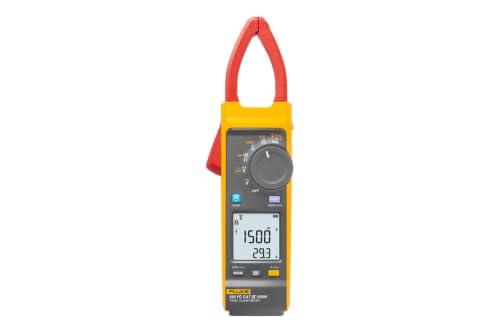
The pick for most readers working on PV strings and DC combiners is P1, the Fluke 393 FC, because it is the only product in this set whose listing states a CAT III 1500 V rating, a thin jaw for crowded combiner boxes, DC power measurement and an IP54 enclosure in the same instrument. If your work is three-phase power quality logging rather than handheld DC checks, P3 and P4 publish far more measurement channels and long-term recording, but neither is a handheld clamp meter you carry up a ladder. P2 is a 1000 A AC/DC TRMS clamp with wireless logging, and P5 is a single and three-phase AC power clamp kit whose listing does not publish a DC current or DC power function at all.
What DC power measurement actually adds to a clamp meter
A clamp meter measures current by sensing the magnetic field around a conductor. That works for AC because the field alternates and can be induced into a secondary coil, and it works for DC only if the jaw uses a Hall effect sensor or a flux gate, which is why DC-capable clamps cost more than AC-only ones. Current alone is not power. Power is volts times amps, and on a DC circuit the two are measured at the same instant at the same point.
An instrument with DC power measurement does that multiplication internally. You clamp the conductor, touch the test leads to the positive and negative terminals, and the display gives you watts directly. Without it you read amps on the clamp and volts on a separate meter, then multiply by hand, which is slower and introduces a timing error if the load is varying. On a solar string the voltage is roughly constant, so the multiplication is easy, but on a battery under charge or a motor under load the current moves and the two readings drift apart.
The listing for P1 states DC power measurement directly, alongside an audio polarity indicator and visual continuity. The audio polarity indicator matters on PV because a reversed string is a real fault and it is not always obvious from a voltage reading alone. P2 publishes a 1000 A AC/DC TRMS range and wireless logging but its bullets do not state a DC power display, so treat it as a DC current clamp with logging rather than a power meter. P5 publishes single and three-phase AC power functions; its bullets do not publish a DC current or DC power range.
Jaw access, safety category and the combiner box problem
On a rooftop array the hard part is often not the measurement but reaching the conductor. Combiner boxes are crowded, and a thick jaw will not close around a cable that is already surrounded by others. P1’s listing states a thin jaw specifically for access to cables in crowded combiner boxes, and an IP54 rating for outdoor use. Both of those are practical rather than electrical specifications, and both matter more than they sound. An IP54 enclosure means dust ingress is limited and water spray from any direction will not cause harm, which is the difference between a meter that survives a rooftop and one that does not.
The safety category is the other half. CAT III 1500 V, as published for P1, describes the transient withstand the instrument is designed for when connected on a distribution circuit, and 1500 V is the level that matters on a modern string. If you are working on the DC side of a PV system, the category and voltage rating on the meter should meet or exceed the system voltage. A meter rated CAT III 1000 V is not the right instrument for a 1500 V string, regardless of what its current range says.
P4 publishes IEC 61010 CAT IV 600 V and CAT III 1000 V with plus or minus 1 percent voltage and current accuracy, double insulation and ground fault protection. CAT IV is the higher category for the origin of the installation, but 600 V at CAT IV is a lower voltage rating than 1500 V at CAT III. The two are not interchangeable, and the correct one depends on where in the system you are working. For more on matching a meter to a PV system, see 1500 V DC multimeters for solar PV.
Handheld clamp or benchtop analyzer: the logging depth question
P3 and P4 are power quality analyzers, not handheld clamp meters in the usual sense. They use separate current clamps on leads rather than a fixed jaw, and they are designed to be left connected for long periods. P3 publishes four current channels and four voltage channels, a DSP plus ARM architecture, 60 stored screenshots, 150 captured transient waveforms, 12,800 alarm records and a built-in 2G memory card that can record 20 parameters at one sample every five seconds for 300 days. P4 publishes four voltage and four current channels, harmonics to the 50th order, peak factors, short-term flicker, 150 stored waveforms, 12,800 alarm logs and 300 days of trend recording at one-minute intervals, with four 68 mm clamps rated 1.0 A to 1000 A.
Those two listings are close enough in capability that the honest answer is that they are functionally similar instruments. They differ in the clamp aperture, the sample interval published for trend recording, and the accuracy statement, which P4 publishes at plus or minus 1 percent and P3 does not publish at all. If you need a three-phase power quality logger, choose between them on availability and on whether the published accuracy and clamp size suit your conductors, not on an invented feature difference.
The trap is buying an analyzer when you wanted a clamp meter. An analyzer with four clamps on leads is awkward to hold one-handed at the top of a ladder. A handheld clamp with a fixed jaw is awkward to leave recording for a week. Both are legitimate; they answer different questions.
Four instruments that publish DC power, and what each one is for
Fluke 393 FC Solar Clamp Meter
CAT III 1500 V, thin jaw, IP54 and DC power measurement in one handheld.
Fluke 376 FC 1000 A AC/DC TRMS Clamp
A 1000 A AC/DC TRMS clamp with Bluetooth logging and an iFlex probe.
HFBTE Three Phase Power Quality Analyzer
Four current and four voltage channels with deep harmonic and transient logging.
EITAI5000-068B Three Phase Power Quality Analyzer
CAT IV 600 V analyzer with four 68 mm clamps and 300-day trend recording.
What the listings publish, side by side
| Instrument | DC power stated | Safety category | Current range stated | Logging stated | Jaw or clamp |
|---|---|---|---|---|---|
| P1 Fluke 393 FC | Yes, DC power measurement | CAT III 1500 V | Not stated in the listing bullets | Fluke Connect software enabled | Thin jaw, iFlex included |
| P2 Fluke 376 FC | Not stated in the listing bullets | Not stated in the listing bullets | 1000 A AC/DC TRMS | Bluetooth to Apple or Android, Fluke Connect app | Jaw with iFlex |
| P3 HFBTE analyzer | Active, reactive and apparent power stated | Not stated in the listing bullets | 0.10 A to 100 A per clamp | 300 days, 20 parameters, one sample every 5 s | Four 20 mm x 20 mm clamps |
| P4 EITAI analyzer | Power quality parameters stated | CAT IV 600 V, CAT III 1000 V | 1.0 A to 1000 A per clamp | 300 days, 20 parameters, 1-minute intervals | Four 68 mm clamps |
| P5 Extech 380976-K | Not stated in the listing bullets | Not stated in the listing bullets | 1000 A AC | Analog output to a recorder | Clamp, single and three phase AC |
Two things stand out. First, only P1 explicitly publishes DC power measurement in its bullets, which is why it leads this page. Second, P3 and P4 publish power parameters in the context of three-phase AC analysis; their listings do not describe a handheld DC power function. Read the table as what the listings say, not as what the instruments might do.
The maintenance and setup nobody mentions
Hall effect clamps drift with temperature and with residual magnetism in the jaw. After a heavy fault current the jaw can hold a small remanent field, and the next DC reading will be offset. The usual fix is to open and close the jaw a few times, or to degauss the instrument if the manufacturer provides that function, before taking a low-current DC reading. None of these listings publish a degauss function or a temperature coefficient, so that is a question to put to the supplier rather than assume.
Battery state matters more on a DC clamp than on an AC one. The Hall sensor needs a stable supply, and a meter running on a low battery can read low on DC while reading correctly on AC. On P1 the IP54 rating protects the enclosure but not the battery compartment if you leave it open. On P3 and P4 the long recording runs depend on the internal memory and on a power supply that lasts the recording period; P3 publishes a built-in 2G memory card and P4 publishes 300 days of trend recording, but neither listing publishes battery life, so plan for external power if you intend to leave one connected.
For the handheld side, the clamp jaw needs to be clean. A film of dirt or a nick in the mating faces changes the magnetic circuit and shifts the reading, particularly at low DC currents. Wipe the jaw faces before a commissioning measurement. For background on the measurement itself, see how to measure current with a clamp meter.
Where a DC power clamp stops being the right instrument
A clamp meter reads current in a conductor you can separate and enclose in the jaw. If the conductors are bundled, if the cable is too large for the jaw, or if you need to measure a current that flows in a PCB trace, a clamp is the wrong tool. If you need to know whether a circuit is live before touching it, a clamp meter is not a voltage detector, and a non-contact tester is a different instrument. If you need an alarm rather than a reading, a meter will not wake you at three in the morning; a fixed monitor or a data logger with alarm outputs will.
On PV specifically, a clamp meter tells you the current in a string and, with DC power measurement, the power that string is producing at that moment. It does not tell you the irradiance, so it cannot tell you whether that power is low because the string is faulty or because the sun went behind a cloud. That is a separate measurement, and the page on solar irradiance meters with temperature probes covers the instruments that do it. Pairing the two is how you turn a current reading into a performance judgement.
Finally, a clamp meter is a snapshot instrument. If the fault is intermittent, a clamp with logging, such as the Bluetooth logging published for P2, or a full analyzer such as P3 or P4, is the only way to catch it. Buying a handheld clamp for an intermittent fault is the most common mismatch in this category.
Recommended Tools


EITAI5000-068B 3-Phase Power Quality Analyzer, Manufacturer Direct Sales, Multi-Functional Power
View on AmazonProducts shown because their documented specifications fit this guide. Price and availability are on Amazon and can change.
Frequently Asked Questions
Can a clamp meter measure DC power directly?
Only if the listing states a DC power function. A DC current range is not the same thing; it means the jaw can sense direct current, not that the instrument multiplies volts by amps for you. Of the products here, P1 publishes DC power measurement explicitly. P2 publishes a 1000 A AC/DC TRMS current range but its bullets do not state a DC power display. P3 and P4 publish power parameters as part of three-phase power quality analysis.
Is CAT III 1500 V better than CAT IV 600 V?
They are different ratings, not a ranking. CAT III 1500 V, published for P1, is a higher voltage withstand on a distribution circuit. CAT IV 600 V, published for P4, is a higher category for the origin of the installation but at a lower voltage. For a 1500 V PV string you need a meter whose voltage rating meets the string voltage, so CAT III 1500 V is the relevant one. For work at the service entrance, CAT IV is the relevant one.
Do I need a power quality analyzer or just a clamp meter?
If you are taking a reading at one moment, a handheld clamp is faster and easier to hold. If you are chasing an intermittent fault, a harmonic problem or a three-phase imbalance, you need recording, and that is what P3 and P4 publish: multiple channels, trend recording over 300 days and alarm logs. A handheld clamp with Bluetooth logging, such as P2, sits in between.
What current range do the analyzers cover?
P3 publishes 0.10 A to 100 A per clamp with a 20 mm by 20 mm aperture. P4 publishes 1.0 A to 1000 A per clamp with a 68 mm aperture. The larger aperture on P4 will fit bigger conductors, but its stated lower limit is higher, so it will not resolve the small currents that P3 can. Match the clamp to the conductor size and the current you expect.
Are P3 and P4 the same instrument?
Their published capabilities are very close: four voltage and four current channels, harmonics, transients, alarm logs and 300 days of trend recording. The differences the listings publish are the clamp aperture, the trend sample interval and the accuracy, which P4 states at plus or minus 1 percent and P3 does not state. Choose between them on the clamp size and the published accuracy you need, not on a feature difference that is not there.
Does the listing for P5 include DC power?
No. The listing describes a single and three-phase 1000 A AC power clamp meter kit with analog output and fast or slow response. It does not publish a DC current range or a DC power function. It is included here because it is a power clamp meter, but it is not a DC power instrument on the published information.
Affiliate disclosure: Akermin earns a commission from qualifying Amazon purchases made through links on this page. Our editorial picks are based on documented specifications and owner feedback, not commissions.