As an Amazon Associate, Akermin earns from qualifying purchases. Product links on this page are affiliate links.
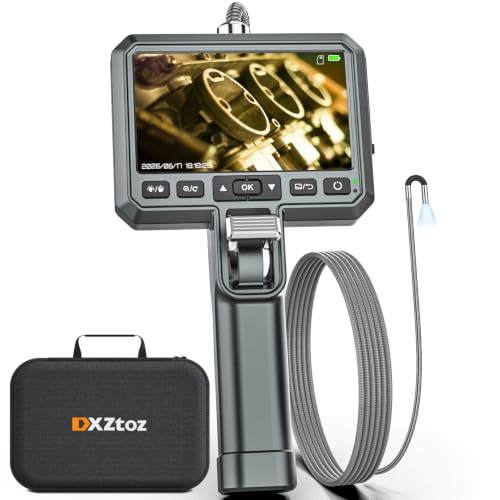
DXZtoz · DXZtoz 3.9mm Ultra-Slim Articulating Borescope, Stainless Steel Probe | Professional Industrial Endoscope with Light for Aircraft Automotive Mechanic Inspection, 2-Way 220°, 5'' HD Screen - 5FT
View on AmazonPrice and availability are shown on Amazon and can change at any time.
An articulating borescope built around a 3.9 mm probe, which is genuinely slim for a steerable tip, on a 5 ft stainless steel cable with a 5 inch IPS screen, six adjustable LEDs, a stated close focus of 1 cm, 10X digital zoom and a 32 GB card for photos and video with sound. The slim steerable tip is the reason to buy it. Two of the figures that would tell you where it can be used arrive without their units, and one of those is the heat limit, which on a tool the listing aims at engine internals is the figure you most need.
A listing that keeps dropping its units
Read the bullets closely and the same error appears twice.
The first bullet describes 220 two way rotation. Two way rotation is a steering description and 220 is a quantity, but no unit follows it. Degrees is the only reading that makes sense, and a 220 degree two way bend is a credible and good figure for an articulating tip, so the intent is clear enough. It remains an inference rather than a published specification.
The fourth bullet describes the probe as heat resistant up to 60. Again no unit, and here the inference is far less comfortable, because the two candidate units are a long way apart and the answer changes what the tool can be used on.
A specification that loses its units is not usually hiding anything. It is usually a translation or a formatting loss. But a buyer cannot verify a number with no unit attached, and on a borescope these two particular numbers decide whether the tip will turn the corner you need and whether it survives the place you put it.
Sixty of what, on a tool sold for engines
Take the heat figure seriously, because the first bullet places this tool inside aircraft and automotive engines.
If 60 means degrees Celsius, the figure is reasonable for a stainless clad flexible probe with a camera and LEDs at the end, and it carries a plain working rule: inspect a cold engine. A cylinder head that has been running sits well above 60 C for a long time after shutdown, and an exhaust component stays hot longer still. Waiting is not an inconvenience, it is the operating condition.
If 60 means degrees Fahrenheit, which is below room temperature in a warm workshop, it cannot be functioning as a limit at all and the number must be describing something else entirely.
The distance between those readings is the problem. A thermal limit is a damage limit, and damage to a borescope happens at the tip, where the sensor and the LED package live, and where you cannot watch it happen. Compare how the other steerable tool in this group handles the same risk: that one publishes a high temperature warning triggering at 90 C or above, which is not a material rating but is at least a figure the instrument acts on. Here you get a number with nothing attached.
Until the unit is confirmed, use the conservative reading and let anything you intend to inspect cool to the point where you would be comfortable putting a hand near it.
Three percentages that are not measurements
Three of the five bullets carry a percentage, and not one of the three measures anything.
- The 3.9 mm version handles 30 percent more tiny inspection applications than larger diameter versions. Applications are not a countable quantity, so the percentage has no denominator. A thinner probe does fit more places, which is true and obvious, and that is the whole of what the claim establishes.
- The 5 inch screen delivers 30 percent clearer details than 4.3 or 4.5 inch screens. Clarity is not a function of diagonal. A larger panel at the same pixel count makes everything bigger, softness included; what you actually gain is comfort and the ability to notice something from arm length. The screen pixel count is not published, so there is no way to work out whether detail improves or merely enlarges.
- The stainless steel probe is 60 percent more wear resistant than standard gooseneck cable. Wear resistance has no single unit, and the reference cable is not named, so the comparison cannot be checked. Stainless braid over a flexible core is a genuinely durable construction and the plain claim would have carried more weight without the number.
Percentages written this way are a style rather than a specification, and the test for any of them is the same: ask what was measured, in what unit, against what. If there is no answer, delete the figure and judge the sentence that remains.
Only the near end of the focal range is published
The second bullet states an optimised focal range with close up to 1 cm, which is useful and specific. A lens that holds focus a centimetre from the subject is what lets you read a crack, a thread, a casting flaw or a valve seat, and the bullet names exactly those applications.
What is missing is the far end. A focal range has two limits, and depth of field on a fixed focus borescope lens is narrow by design, so a lens optimised for 1 cm will go soft at a distance. That is not a defect, it is the trade you make for close detail, but it decides the work. Pointing a close focus probe along a duct or across a wall cavity returns a bright blur.
The 10X zoom does not repair it. Zoom here is digital: it crops the sensor output and scales it up, enlarging the pixels already captured without adding detail, and nothing in software can change what the lens has in focus. It makes a small feature easier to see on screen, which is worth having, and it does not extend reach.
Six LEDs with adjustable brightness is the right complement to a close focus lens. At a centimetre, a fixed bright light washes a pale surface out completely, so brightness control is the difference between a readable image and a white patch. For other probes in this size class see borescopes with tiny probe cameras.
The figures that are complete, and the ones that are not
| Specification | Published in the listing |
|---|---|
| Probe diameter | 3.9 mm |
| Probe length | 5 ft |
| Probe construction | Stainless steel, flexible |
| Articulation | Two way, stated as 220 with no unit given |
| Close focus | 1 cm |
| Zoom | 10X, digital |
| Lighting | Six LEDs, adjustable |
| Screen | 5 inch IPS, true colour, described as reducing reflection |
| Recording | Photos and video with sound |
| Storage | 32 GB card pre installed, files downloadable to a computer |
| Heat resistance | Stated as up to 60, with no unit given |
| Camera resolution in pixels | Not stated in the listing bullets |
| Screen resolution | Not stated in the listing bullets |
| Field of view | Not stated in the listing bullets |
| Far limit of the focal range | Not stated in the listing bullets |
| Bending section length | Not stated in the listing bullets |
| Immersion or ingress rating | Not stated in the listing bullets |
| Battery capacity and runtime | Not stated in the listing bullets |
The absent immersion rating is worth reading next to the stainless steel probe, because a wear resistant cable and a sealed one are different properties and the bullets only claim the first. The absent battery figures matter on a standalone unit with its own screen, since nothing says how long a session can run before it has to find a socket. And the bending section length, the distance from the tip over which the probe actually curves, is what decides whether a 220 bend can be used inside a confined cavity or only where there is room to describe the arc.
Who gets the benefit of 3.9 mm
Probe diameter is the only specification that opens or closes a job outright, and 3.9 mm with a steerable tip is a hard thing to build. Steering needs control wires, anchor points and a jointed section inside the same tube as the camera, the lens and the lighting, and every millimetre removed from the outside takes room away from all of them. A 3.9 mm articulating probe is a real piece of engineering, and the uses the first bullet names, precision instruments, robotics, 3D printers and engine internals, are the right ones. See slim probe borescopes for the rest of this size class.
Buy it if access is the problem: fastener holes, injector ports, gearboxes, small castings, the inside of a machine you cannot take apart. A slim tip reaches places a thicker one cannot, and once inside, the steering is what turns a glimpse into a look. Articulating borescopes for engine inspections covers the alternatives at larger diameters.
Skip it if your openings are generous. A thinner probe is a compromise everywhere else, with less room for the lens, less room for light and less stiffness to resist being pushed, so a larger probe through a larger hole will give a better image. And either way, settle the heat limit and its unit before putting the tip anywhere that has recently been running.
Recommended Tools


Products shown because their documented specifications fit this guide. Price and availability are on Amazon and can change.
Frequently Asked Questions
What does heat resistant up to 60 mean without a unit?
It has to be read as degrees Celsius, because 60 F is below room temperature in a warm workshop and could not function as a limit. On that reading the figure is sensible for a stainless clad flexible probe carrying a camera and LEDs at the tip, and it carries a clear working rule: inspect a cold engine. A cylinder head that has been running stays above 60 C for a long time after shutdown, and exhaust components stay hot longer still. Until the unit is confirmed, use the conservative reading.
Is 220 the articulation angle?
Almost certainly, since degrees is the only unit that makes sense of a two way rotation figure, and a 220 degree two way bend is a credible and good number for a steerable tip. It is still an inference rather than a published specification, and it is the second figure in the same listing to appear without its unit. What is definitely not published is the length of the bending section, which is the distance over which the probe curves and therefore the space the bend needs in order to be used.
Are the percentage claims in the bullets meaningful?
No. Thirty percent more tiny inspection applications has no denominator, because applications are not a countable quantity. Thirty percent clearer details than a 4.3 or 4.5 inch screen confuses size with resolution, since a larger panel at the same pixel count enlarges the softness along with everything else, and the pixel count is not published. Sixty percent more wear resistant has no unit and no named reference cable. Read each sentence with the number deleted and judge what is left.
What does a 1 cm close focus get you, and what does it cost?
It gets you detail. A lens holding focus a centimetre from the subject is what lets you read a crack, a thread, a casting flaw or a valve seat, and the bullet names exactly those uses. The cost is the far end of the range, which is not published. Depth of field on a fixed focus borescope lens is narrow by design, so a lens optimised for close work goes soft at a distance, and pointing it down a duct or across a cavity returns a bright blur.
Does the 10X zoom help?
Not with resolution. Zoom on an instrument like this is digital: it crops the sensor output and scales it up, which enlarges the pixels already captured without adding detail, and it cannot change what the lens has in focus. It is genuinely useful for making a small feature easier to see on screen at arm length, and it is not a substitute for getting the tip closer.
Why is 3.9 mm with articulation a hard combination to build?
Because steering needs control wires, anchor points and a jointed section inside the same tube that already carries the camera, the lens and the lighting. Every millimetre taken off the outside diameter takes room away from all of them, which is why slim probes are usually fixed and steerable probes are usually thicker. A 3.9 mm articulating probe is therefore a genuine piece of engineering, and the trade is that the lens, the sensor and the LEDs all have less room than they would on a larger probe.
Affiliate disclosure: Akermin earns a commission from qualifying Amazon purchases made through links on this page. Our editorial picks are based on documented specifications and owner feedback, not commissions.