As an Amazon Associate, Akermin earns from qualifying purchases. Product links on this page are affiliate links.
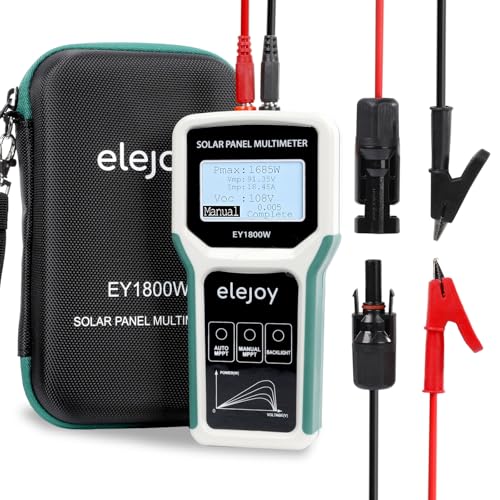
elejoy · ELEJOY 1800W Solar Panel Tester MPPT Photovoltaic Multimeter Watt | Meter Smart Portable Tool for Solar PV Panel Data Troubleshoot Measures Power Output Performance and Open Circuit Voltage
View on AmazonPrice and availability are shown on Amazon and can change at any time.
A pocket photovoltaic tester that reads output power at the maximum power point, open circuit voltage and short circuit current, draws its own supply from the panel under test, shows the results on an LCD and arrives with MC4 connectors, alligator clips and an EVA case. The bullets state a 60 A maximum current and a 120 V rated voltage. The product name states 1800 W. Those three numbers do not multiply together, and since the voltage figure is a safety limit on a source that cannot be switched off, the discrepancy has to be resolved before this goes near an array.
1800 watts in the name against 60 amps at 120 volts
Take the two figures in the fourth bullet at face value. A maximum current rating of 60 A and a rated voltage of 120 V implies a power handling of 7200 W. The name of the product says 1800 W.
Work the other direction and it gets worse rather than better. If 1800 W is the genuine ceiling, then at the full rated 120 V the current is limited to 15 A, and at the full rated 60 A the voltage is limited to 30 V. So the page describes three mutually exclusive instruments and labels all of them as this one.
There is a benign explanation available. Testers of this type often carry a terminal rating, which is what the connectors and the shunt survive, and a separate measurement ceiling, which is the largest panel the sweep can handle. If that is the case here, then 60 A and 120 V are the terminal ratings and 1800 W is the working envelope, and the three figures describe a coherent product badly.
But a buyer cannot assume that, and this is not a specification where you guess. The useful instruction is narrow: do not exceed any of the three published numbers, and get the maximum system voltage confirmed in writing before connecting anything in series.
Calling it an MPPT controller is simply wrong
The fifth bullet opens with the words The MPPT Solar Controller and then talks about MC4 connectors. The product is not a controller.
The distinction is not pedantry. A maximum power point tracking charge controller is a permanently installed power conversion device. It sits between an array and a battery, continuously hunts for the operating point that extracts the most power, and does that for years. People buy them to run a system.
What this instrument does is sweep a load across the panel once, find where the product of current and voltage peaks, and display that point along with the open circuit voltage and short circuit current. It is a measurement of where the maximum power point is, not a device that holds the panel at it. Connect it and nothing is charged, nothing is regulated and nothing is stored.
Somebody buying a charge controller from that sentence would be badly misled, which is why it belongs near the top of a review rather than in a footnote. The rest of the listing describes a tester correctly, and the title words Photovoltaic Multimeter are closer to the truth. It is the one bullet that reads as pasted from another product.
Needing no battery has two consequences, one of them awkward
The second bullet makes a genuine virtue of the power supply: no batteries are required, simply connect to your solar panel to start testing immediately. For field work that is worth having, because a flat cell at the top of a ladder ends the afternoon.
The first consequence is logical rather than electrical. If the instrument lives on the output of the panel it is examining, a panel producing nothing leaves you with a blank screen. That is the single most ambiguous result available: it could be a dead module, a disconnected lead, deep shade, or the tester itself having failed. A self powered instrument cannot distinguish between no signal and no instrument. The habit that fixes it is to confirm the tester wakes up on a panel you know is working before trusting a blank reading on one you suspect.
The second is about what the reading represents. To locate a maximum power point you have to vary the load, which means the panel is being driven from near open circuit towards short circuit during the test. The figure you are shown is therefore the panel delivering into a sweep, which is the correct way to measure it and also a reminder that the instrument is doing something to the array rather than watching it. Our walkthrough of measuring solar panel output covers how much a result moves with conditions.
A pmax reading with nothing to correct it against
The measurement set is the right one for the job: output power at the maximum power point, performance, open circuit voltage and short circuit current. Those four between them separate most module faults. A low open circuit voltage points at a cell group or a bypass diode. A low short circuit current with a healthy voltage points at soiling, shading or glass. A sound pair of end points with a disappointing power figure points at series resistance somewhere in the string of cells.
What the listing never provides is a way to judge a single panel against its own datasheet. Nameplate figures are quoted at standard test conditions, a defined irradiance with a defined cell temperature and spectrum, and nothing on a roof is ever there. Without an irradiance figure and a cell temperature at the instant of the test, a reading below nameplate is uninterpretable: the module may be degraded, or it may be a hazy afternoon, or the cells may simply be hot.
This instrument takes neither input. That is not a flaw at its level, it is what separates a field check from a commissioning record. The practical method is comparison rather than certification. Walk a row measuring every module within a few minutes under the same sky and the odd one out is the one to investigate, because the conditions were common to all of them. Our note on irradiance against panel output explains why the relationship is nearly linear and why that makes same session comparison trustworthy.
Five bullets, one safety figure, no tolerance
| Published figure | Value given in the bullets or name |
|---|---|
| Measurements | Output power at Pmax, performance, Voc, Isc |
| Maximum current | 60 A |
| Rated voltage | 120 V |
| Power figure in the product name | 1800 W |
| Power supply | None required, taken from the panel under test |
| Display | LCD, no size given |
| Connections | MC4 connectors and alligator clips |
| Carrying case | EVA tool kit |
| Accuracy on any reading | Not stated in the listing bullets |
| Resolution on any reading | Not stated in the listing bullets |
| Irradiance or cell temperature input | Not stated in the listing bullets |
| Data hold or stored readings | Not stated in the listing bullets |
| Duration or behaviour of the sweep | Not stated in the listing bullets |
| Operating temperature range | Not stated in the listing bullets |
The missing accuracy figure is the one that undermines the word accurately in the first bullet. An instrument with no stated tolerance can tell you that one panel differs from its neighbours, which is useful, and cannot tell you by how much with any authority.
The MC4 connectors deserve a specific mention on the other side of the ledger. MC4 is the standard photovoltaic connector, so a tester that arrives able to join a string without an adapter is a tester you can use the day it turns up, and the alligator clips cover junction box and bench work. That is a sensible pair to include.
For scale on the voltage question, another instrument in this set, a clamp meter aimed at solar work, publishes a 1500 V DC capability. That is the order of ceiling a string level photovoltaic instrument carries, and it puts 120 V in context: this is a module and small series pair tester, not a string tester. Our guide to open circuit against operating voltage shows why the cold weather figure is the one that has to fit.
Where this tester belongs, and the ceiling to confirm first
This suits an owner or a general electrician checking individual panels: confirming a module makes roughly what its neighbours make, catching a dead or shaded unit, verifying a replacement before it goes on the roof. Self powered, pocket sized, MC4 ready, reading the four quantities that matter, and quick enough that a whole row can be done under one sky. For that work it is well matched.
It is the wrong instrument for a string of any length, because 120 V is reached quickly in series and because open circuit voltage climbs as the cells get cold. It is the wrong instrument for commissioning paperwork, because it publishes no accuracy and accepts no irradiance or temperature input, so its readings cannot be corrected to standard conditions. And anybody expecting a charge controller from the fifth bullet is buying the wrong category of product entirely.
Before it touches an array, resolve the three limits. Ask which of 1800 W, 60 A and 120 V binds, and get the answer in writing. A power ceiling that turns out to be lower than you assumed costs you a tester. A voltage ceiling that turns out to be lower than you assumed costs you more than that.
Recommended Tools


Products shown because their documented specifications fit this guide. Price and availability are on Amazon and can change.
Frequently Asked Questions
Is the real limit 1800 W, or 60 A at 120 V?
The listing does not say, and the three figures do not fit together. Sixty amps at 120 V is 7200 W, four times the number in the product name. If 1800 W is the binding ceiling then at the full 120 V you could only draw 15 A, and at the full 60 A you could only present 30 V. Those are three different instruments. Get the maximum voltage and the maximum power confirmed in writing before you connect this to anything, and until then treat the lowest figure in each dimension as the limit.
Why does the voltage rating matter more than the power rating?
Because exceeding it is a safety event rather than a measurement error. A photovoltaic array cannot be switched off while there is light on it, so an instrument connected to a string is connected to a live source whatever you do at the panel. Open circuit voltage also rises as cell temperature falls, so the worst case is a bright cold morning, which is exactly when people go out to commission a system. A power limit is usually about heat inside the instrument. A voltage limit is about insulation and arcing.
How many panels can 120 V cover?
That depends entirely on the modules, and the arithmetic is simple: open circuit voltages add in series. A single module well under 60 V open circuit leaves headroom at 120 V. Two in series is plausible for many common modules but needs checking against the datasheet with the cold temperature coefficient applied, not the nameplate figure. A longer string is out. In practice this is a module level and small string level tester rather than a string tester.
What does needing no batteries actually mean?
That the instrument powers itself from the panel it is measuring. The convenience is real, since there is nothing to go flat on a roof. The consequences are two. A panel producing nothing gives you a blank display, which is ambiguous between a dead module, no light and a faulty tester, so a dark screen is not a diagnosis. And the instrument has to load the panel to find the maximum power point, so what it reports is the panel working into a sweep rather than a static reading.
Is this an MPPT charge controller?
No, although the fifth bullet calls it one. A charge controller sits permanently between an array and a battery and continuously adjusts the operating point to extract the available power. This is a test instrument that sweeps the load once to find where maximum power occurs and then displays the figure. Buying it expecting a controller would be a serious mistake, and the bullet that says MPPT Solar Controller is simply wrong.
Can I compare the Pmax reading with the panel datasheet?
Not directly, and nothing in this listing helps you do so. Datasheet figures are quoted at standard test conditions, which specify an irradiance, a cell temperature and a spectrum, and no roof is ever at those conditions. To make a field reading comparable you need the irradiance and the cell temperature at the moment of the test, and this instrument accepts neither. So the readings are good for comparing panels with each other under the same sky, and not for judging a single panel against its nameplate.
Affiliate disclosure: Akermin earns a commission from qualifying Amazon purchases made through links on this page. Our editorial picks are based on documented specifications and owner feedback, not commissions.