As an Amazon Associate, Akermin earns from qualifying purchases. Product links on this page are affiliate links.

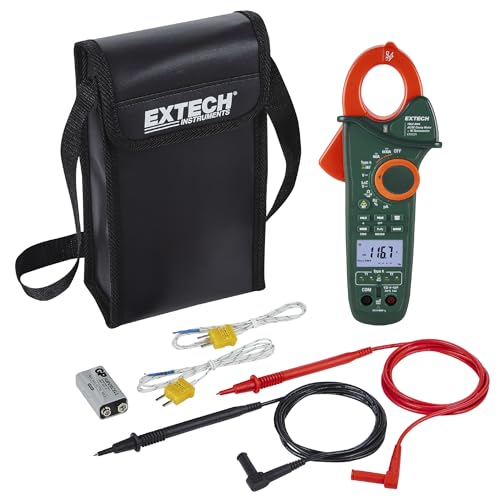
Extech · Extech EX655 600A True RMS AC/DC Clamp Meter with NCV | AC/DC to 600A (3 ranges), voltage to 1000V, resistance, capacitance, frequency, temp, NCV, 6000-count
View on AmazonPrice and availability are shown on Amazon and can change at any time.
Verdict
The Extech EX655 is a general-purpose clamp meter with an unusually useful current range structure. Most 600 A clamps have one or two ranges; the EX655 has 600 mA, 6 A and 600 A, which means it can resolve a control circuit drawing a few hundred milliamps and a compressor drawing hundreds of amps with the same jaw. Add AC and DC current, True RMS, voltage to 1000 V, resistance, capacitance, frequency, temperature, diode test and continuity, plus a non-contact voltage detector, and it covers the day-to-day work of an HVAC or facilities technician. It is not a power-quality instrument and it has no wireless logging. Within its class, the documentation supports it as a well-rounded choice.
Who It Is For
- HVAC technicians who need DC current for control boards and AC current for compressors and fans.
- Maintenance electricians who want one meter for panels, motors and low-current instrumentation.
- Solar and battery installers who need DC current measurement without breaking the circuit.
Our guide to choosing a clamp meter explains which of these functions matter for different trades.
Documented Specifications
| Item | Documentation |
|---|---|
| Current | AC and DC to 600 A, True RMS, three ranges: 600 mA, 6 A, 600 A |
| Voltage | AC and DC to 1000 V |
| Other functions | Resistance, capacitance, frequency, temperature, diode test, continuity |
| Non-contact voltage | Built-in NCV detector |
| Display | 6000-count backlit LCD |
The manufacturer’s datasheet lists the accuracy for each function and the safety category rating. We have not reproduced those figures here; check the datasheet for the current revision before relying on a specific tolerance.
Why Three Current Ranges Matter
A clamp meter with a single 600 A range and a 6000-count display resolves 0.1 A at best. That is fine for a motor and useless for a 24 V control circuit drawing 300 mA, where the reading would flicker between 0.2 and 0.4. The EX655’s 600 mA range resolves that same current to 0.1 mA, and the 6 A range covers pumps, lighting circuits and small appliances with 1 mA resolution. In practice this is what lets one meter replace both a clamp and a series-connected multimeter for many jobs. DC current through the jaw relies on a Hall-effect sensor, which drifts with temperature and residual magnetism; the meter has a zero function and you should use it before each DC reading. The technique is covered in how to measure current with a clamp meter.
Voltage, Temperature and NCV
Voltage to 1000 V AC and DC is enough for commercial three-phase and for residential solar strings within that limit. The non-contact voltage detector is a convenience for checking whether a cable is live before clamping; it is not a substitute for a proper test with leads. Temperature via thermocouple lets an HVAC technician record supply and return air or a compressor discharge line with the same tool used for amperage. Capacitance covers motor run and start capacitors, one of the most common HVAC diagnostics. See choosing a clamp meter for HVAC.
Practical Notes
Owners report that the selector and function button layout is easy to learn and that the backlight is bright enough for a dim mechanical room. Two habits make the meter more useful. Zero the DC current range before each reading, because the Hall-effect sensor drifts with temperature. And centre the conductor in the jaw; a conductor pressed against one side reads slightly differently from one in the middle, and on the 600 mA range that difference is visible. A thermocouple for the temperature function is a separate accessory to budget for if one is not included with the unit you buy.
Strengths
- Three current ranges give useful resolution from milliamps to hundreds of amps.
- AC and DC current with True RMS.
- Broad function set including temperature and capacitance.
- Backlit display and NCV detector.
Limitations
- No inrush capture or low-pass filter, both of which the EX840A adds.
- No wireless connection or data logging.
- DC current readings need regular zeroing, as with any Hall-effect clamp.
How It Compares
The Extech EX840A raises the current limit to 1000 A and adds LoZ, a low-pass filter, inrush capture and an infrared thermometer. The EX623A keeps 600 A and adds dual type K inputs and an infrared thermometer for HVAC work. The MA445 is a smaller 400 A AC/DC clamp with a 40000-count display. The EX655 is the balanced middle option when milliamp resolution matters more than inrush or temperature extras.
How We Research
This review is based on the manufacturer’s published specifications, the Amazon product listing and owner reports. We did not run laboratory tests.
Recommended Tools


Products shown because their documented specifications fit this guide. Price and availability are on Amazon and can change.
Frequently Asked Questions
Does the EX655 measure DC current?
Yes. It measures both AC and DC current through the jaw, which is what separates it from AC-only clamp meters and makes it useful for automotive, solar and battery circuits.
What are the three current ranges for?
The 600 mA and 6 A ranges give useful resolution on small loads such as control circuits and electronics; the 600 A range covers motors and feeders. A single-range meter would show small currents with too few digits.
Does it have a temperature input?
Yes. The listing includes temperature among its functions, which is typically measured with a type K thermocouple plugged into the meter.
Is True RMS important on a clamp meter?
It is when loads are non-sinusoidal, which includes anything on a variable frequency drive, LED lighting and switch-mode power supplies. An average-responding meter reads low on those waveforms.
Affiliate disclosure: Akermin earns a commission from qualifying Amazon purchases made through links on this page. Our editorial picks are based on documented specifications and owner feedback, not commissions.