As an Amazon Associate, Akermin earns from qualifying purchases. Product links on this page are affiliate links.

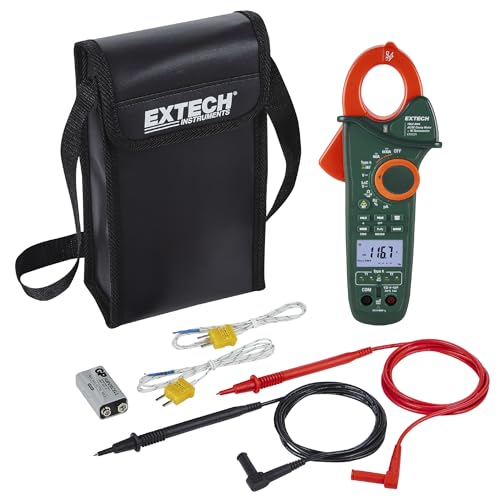
Extech · Extech EX840A 1000A True RMS AC/DC Clamp Meter with IR Thermometer | AC/DC to 1000A, IR thermometer with laser, LoZ, low pass filter, inrush, CAT IV 600V, 8-piece leads
View on AmazonPrice and availability are shown on Amazon and can change at any time.
Verdict
The Extech EX840A is aimed at the electrician or industrial technician who works on drives, motors and service equipment and wants one clamp that copes with all three. The headline is 1000 A AC and DC True RMS, but the features that matter are the LoZ mode for ghost voltages, the low-pass filter for drive outputs, inrush capture for motor starts and a CAT IV 600 V safety rating. A built-in infrared thermometer adds a quick surface temperature check, and the meter ships with an eight-piece industrial lead kit. If you rarely see a drive and never open a service panel, the EX655 gives you most of the measurement capability for less. If you do, the EX840A’s extras are the ones you would otherwise buy a second meter to get.
Who It Is For
- Industrial electricians working on motor control centres and variable frequency drives.
- Service electricians who need a CAT IV rated meter at the service entrance.
- HVAC and refrigeration technicians who diagnose compressors and want inrush and temperature in one tool.
Documented Specifications
| Item | Documentation |
|---|---|
| Current | AC and DC to 1000 A, True RMS |
| Ghost voltage rejection | LoZ low-impedance mode |
| Noise filtering | Low-pass filter for electrically noisy equipment |
| Inrush | Inrush current capture for start-up current |
| Temperature | Built-in infrared thermometer for non-contact readings |
| Display | 6000-count backlit LCD |
| Safety rating | CAT IV 600 V |
| Included | 8-piece industrial test lead kit |
Measuring Around Drives
The output of a variable frequency drive is not a sine wave. It is a train of high-frequency pulses whose average shape approximates one. A True RMS meter without a filter includes the pulse energy in its reading and shows a voltage or current higher than the motor effectively receives, and the reading can jump around. The low-pass filter cuts the switching frequency so the meter settles on the fundamental. That is the number you compare with the motor nameplate. The same filter helps on lighting circuits with electronic ballasts and on any equipment with a switch-mode supply. Our article on measuring AC voltage covers the general principle.
LoZ and Inrush in Practice
Ghost voltage is the reading you get on a de-energised conductor that runs alongside live ones; capacitive coupling induces tens of volts that disappear the moment any load is connected. A high-impedance meter shows it as if it were real, which wastes time and can cause a conductor to be treated as live when it is not, or the reverse. LoZ mode presents a low impedance so the phantom voltage collapses while a real supply holds its value. Inrush capture addresses a different problem: a motor that trips its breaker on start. The meter records the surge during the first part of the start so you can compare it with the breaker’s trip curve and the motor’s locked-rotor rating. Both features are standard on higher-end clamps and their presence on the EX840A is the main argument for choosing it over the EX655.
Infrared Thermometer
The built-in infrared thermometer reads surface temperature of a breaker face, a motor housing or a connection without contact. It is a screening tool: a breaker running hotter than its neighbours or a terminal warmer than the rest of the bus warrants a closer look. It does not replace a thermal camera for scanning a whole panel, and infrared readings on shiny metal are low because of emissivity. See choosing a thermal camera for electrical work for when a camera is the better tool.
Strengths
- 1000 A AC and DC with True RMS.
- LoZ, low-pass filter and inrush cover the common industrial problems.
- CAT IV 600 V rating for service-entrance work.
- Infrared thermometer and a full lead kit in the box.
Limitations
- Larger and heavier than a 400 A clamp for everyday panel work.
- No wireless logging or app.
- Infrared thermometer is a single-spot reading with no emissivity adjustment noted in the listing.
How It Compares
The Extech EX655 gives 600 A with milliamp ranges and most of the same functions but without LoZ, filter, inrush or the infrared thermometer. The EX623A is the HVAC-flavoured sibling with dual type K inputs. The MA1500 reaches 1500 A in a compact body with a low-pass filter but fewer extras. Among Fluke equivalents, the Fluke 381 covers 1000 A with a detachable display and iFlex.
How We Research
This review is based on the manufacturer’s published specifications, the Amazon product listing and owner reports. We did not run laboratory tests.
Recommended Tools


Products shown because their documented specifications fit this guide. Price and availability are on Amazon and can change.
Frequently Asked Questions
What does LoZ do?
LoZ is a low-impedance voltage mode. It loads the circuit slightly so that capacitively coupled ghost voltages on unconnected conductors collapse to near zero, while a genuinely energised conductor still reads its true voltage.
When should I use the low-pass filter?
On the output side of variable frequency drives and on other electrically noisy equipment. The filter removes high-frequency switching content so the meter reads the fundamental voltage or current the motor actually sees.
What is the inrush function?
It captures the surge current in the first fraction of a second when a motor or transformer starts. Comparing inrush with the nameplate helps diagnose hard-starting motors and nuisance breaker trips.
What is the CAT IV 600 V rating for?
CAT IV covers the origin of the installation: service entrance, meter base and utility connections. It is the highest transient category and means the meter is rated for the most severe environments up to 600 V.
Affiliate disclosure: Akermin earns a commission from qualifying Amazon purchases made through links on this page. Our editorial picks are based on documented specifications and owner feedback, not commissions.