As an Amazon Associate, Akermin earns from qualifying purchases. Product links on this page are affiliate links.

Extech · Extech MO57A Pinless Moisture Meter, Spherical Sensor, 4 in Depth | Non-destructive spherical sensor, moisture in wood/drywall, depth to 4in, audible/visual alerts, portable
View on AmazonPrice and availability are shown on Amazon and can change at any time.
Verdict
The MO57, sold now as the MO57A, is a leak finder. Its spherical sensor rolls over tile, stone, plaster and wood without marking them, and it senses moisture to 4 in (100 mm) below the surface, far deeper than the 0.75 in of a typical pinless meter. It reports with low, medium and high droplet icons and an audible alarm that beeps faster as moisture rises, so it can be used while looking at the wall rather than the screen. It weighs 5.5 oz and measures 8.3 by 2.8 by 1.3 in. What it does not do is give a calibrated percentage; it tells you where the water is, not how much. For locating a leak behind a shower wall, under a floor or above a ceiling, it is the right tool. For drying targets and wood percentages, pair it with a measuring meter such as the MO265.
Who It Is For
- Plumbers and restoration technicians locating the source and extent of a leak.
- Home inspectors checking behind tiled showers and under bathroom floors.
- Homeowners tracing a stain to its origin before opening a wall.
Documented Specifications
| Item | Documentation |
|---|---|
| Listed model | MO57A (current version of the MO57) |
| Sensor | Non-marking spherical (ball) sensor |
| Depth | Up to 4 in (100 mm) |
| Alerts | Audible alarm that speeds up with moisture; low, medium, high droplet icons |
| Materials | Wood, sheetrock, tile, concrete, mortar |
| Size and weight | 8.3 × 2.8 × 1.3 in, 5.5 oz |
Why 4 Inches Changes the Job
A standard pinless meter reads about three-quarters of an inch, which covers drywall and the surface of a stud but not the cavity behind it. A leak from a shower valve or a pipe joint sits inside the wall, wetting the back of the board and the framing before the front shows anything. The MO57A’s sensing depth reaches into that space, so it can follow the wet area across a tiled wall to the point of origin without removing tiles. The same applies to a floor: moisture under a tile bed or in a subfloor is within reach. Deep sensing has a cost: the reading is an average over a larger volume, so it is less able to say whether the moisture is at the surface or deep, and metal within the field, such as pipes, produces high readings. Our guide to choosing a moisture meter explains how to weigh depth against precision.
The Spherical Sensor and the Alerts
The ball sensor is the practical difference from a flat-pad meter. It keeps contact on textured plaster and grouted tile, rolls over corners and does not scratch polished stone or painted surfaces. The alarm system is designed for scanning: the beep rate rises as moisture rises, and the droplet icons give a three-level summary. Owners describe sweeping a whole bathroom wall in a minute, listening for the change, then marking the boundary. Once the wet area is mapped, a pin meter at the edge and centre gives the numbers for a drying log. See using a moisture meter on drywall for the follow-up technique.
Materials and False Readings
The listing names wood, sheetrock, tile, concrete and mortar. Dense materials and metal within four inches of the sensor, including pipes, conduit, metal lath and foil-backed insulation, will read high. The reliable method is comparison: scan a known dry area of the same construction first, then the suspect area, and treat only the difference as moisture. A tiled shower wall is the classic case: scan the wall opposite the shower head first for a dry baseline, then the wall behind the valve and the floor at the threshold, and expect a pipe run to produce a narrow line of high readings that does not spread, while a leak produces a patch that widens toward the source.
Strengths
- Four-inch sensing depth reaches inside walls and under floors.
- Non-marking ball sensor for tile, stone and finished surfaces.
- Audible and visual alerts suited to fast scanning.
Limitations
- Detector, not a measuring meter; no percentage.
- Metal within the sensing depth causes false highs.
- Larger than pocket meters.
How It Compares
The Extech MO257 is a shallower pinless meter with a relative mode. The Extech MO280 gives species-corrected wood percentages. The Extech MO50 is the pocket pin meter for confirming what the MO57A finds. Most professionals carry the MO57A alongside one of them rather than instead of it.
How We Research
This review is based on Extech’s published specifications, the Amazon listing for the MO57A and owner reports. We did not run laboratory tests.
Recommended Tools


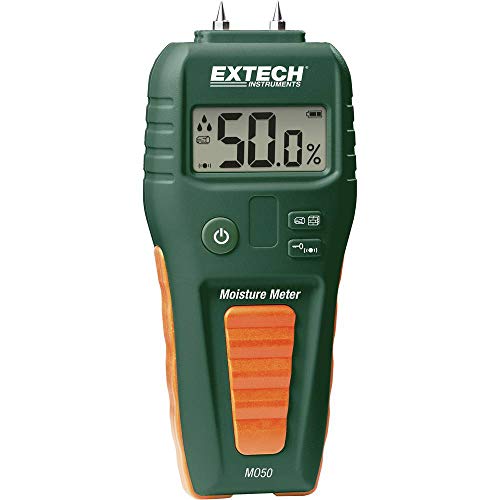
Products shown because their documented specifications fit this guide. Price and availability are on Amazon and can change.
Frequently Asked Questions
Is the listing the MO57 or the MO57A?
The current Amazon listing is the MO57A, which Extech positions as the current version of the MO57. This review is based on that listing.
Does it show a moisture percentage?
It is a detector rather than a measuring meter. The listing describes low, medium and high droplet icons and an audible alarm that speeds up with moisture, not a calibrated percentage.
How deep does it read?
The listing states up to 4 in (100 mm), which is several times deeper than a typical pinless meter.
Why a spherical sensor?
A ball sensor glides over tile, stone and textured surfaces without scratching and keeps consistent contact on uneven materials.
Affiliate disclosure: Akermin earns a commission from qualifying Amazon purchases made through links on this page. Our editorial picks are based on documented specifications and owner feedback, not commissions.