As an Amazon Associate, Akermin earns from qualifying purchases. Product links on this page are affiliate links.

Extech · Extech MO265 Combination Pin and Pinless Moisture Meter with RJ45
View on AmazonPrice and availability are shown on Amazon and can change at any time.
Verdict
The MO265 is the moisture meter to buy if you only buy one. Its pinless sensor scans wood and building materials to 0.75 in (22 mm) without leaving marks, and its remote pin probe, plugged in through an RJ45 connector, confirms a reading at a point with replaceable pins. The backlit LCD reads in a crawl space and the tri-colour LED bargraph gives a fast visual indication while scanning. This scan-then-confirm pairing is how professional moisture surveys are done, and having both in one body avoids carrying two meters. It lacks the humidity and infrared functions of the MO290, and the pinless sensor is not as deep-reading as the MO57A, but for general inspection work it is the balanced choice.
Who It Is For
- Home inspectors who need to find and confirm moisture in one visit.
- Restoration and drying contractors tracking a wet area as it dries.
- Serious homeowners dealing with a leak, a damp basement or a flooring project.
Documented Specifications
| Item | Documentation |
|---|---|
| Pinless | Non-invasive sensor, depth to 0.75 in (22 mm) |
| Pin | Remote pin probe on RJ45 connector, replaceable pins |
| Materials | Wood and other building materials |
| Display | Backlit digital LCD |
| Indicator | Tri-colour LED bargraph |
Scan, Then Confirm
A pinless sensor averages moisture over a volume below the pad, which makes it fast at finding a wet area but unable to say whether the moisture is at the surface or deeper, and prone to false highs over metal or wiring. A pin probe measures resistance between two points at pin depth and gives a reading that can be compared with drying targets, but it only tells you about that spot. The MO265 is built for the sequence most inspectors follow: scan the wall or floor with the pinless pad and the bargraph, mark where the reading rises, then push the pin probe into the marked area to confirm and quantify. Our guide to choosing a moisture meter explains why this pairing matters more than any single specification.
The Remote Pin Probe
Putting the pins on a lead rather than on the meter body changes what can be reached. The probe can be pushed into a joist from below while the meter is read at arm’s length, into insulation behind a removed skirting, or into a subfloor through a small hole. The RJ45 connector is a standard, robust plug. Replaceable pins matter because pins bend and corrode; a meter with fixed pins becomes unreliable after a year of use. See using a moisture meter on wood for pin depth and species considerations.
Display and Bargraph
The backlight is a practical necessity in the places moisture meters go: under sinks, in basements and roof spaces. The tri-colour LED bargraph shows green, amber and red as the reading rises, which lets the operator watch the wall rather than the screen while scanning. The numeric display is read once the bargraph has found the area of interest. Owners consistently mention the bargraph as the feature that makes scanning fast.
Using It for a Drying Log
Restoration work depends on a record that shows moisture falling to a target over days. The MO265 supports that well: the pinless pad maps the boundary of the wet area on the first visit, and the pin probe takes readings at marked points that are repeated on each visit. Because the pin reading is at the same depth and the same spot each time, the trend is meaningful, and the pinless scan confirms the boundary is shrinking. A dry reference reading on the same material, taken at every visit, anchors the log. Our article on using a moisture meter on drywall gives the reference and target levels commonly used.
Strengths
- Both measurement types in one meter.
- Remote probe reaches places a body-mounted pin cannot.
- Backlit display and bargraph for fast scanning in dark spaces.
- Replaceable pins.
Limitations
- No humidity, temperature or infrared function.
- Pinless depth of 0.75 in; deeper leaks need the MO57A.
- Larger than a pocket pin meter.
How It Compares
The Extech MO257 is pinless only, smaller and simpler. The Extech MO290 adds a psychrometer and infrared thermometer for drying contractors who track dew point. The Extech MO50 is the pocket pin meter for spot checks. The MO55A is Extech’s compact pin and pinless alternative. The MO265 is the general-purpose professional choice among them.
How We Research
This review is based on Extech’s published specifications, the Amazon listing and owner reports. We did not run laboratory tests.
Recommended Tools

Products shown because their documented specifications fit this guide. Price and availability are on Amazon and can change.
Frequently Asked Questions
What is the RJ45 connector for?
The remote pin probe plugs into an RJ45 socket on the meter. The probe on a lead can be pushed into a joist or behind a skirting while the meter is read in the hand.
How deep does the pinless sensor read?
The listing states up to 0.75 in (22 mm) below the surface.
Why have both pin and pinless?
Pinless finds where moisture is without damage; pins confirm how much at a point and cut through false readings from metal or air gaps. Most inspectors use both on every job.
Are the pins replaceable?
Yes. The listing states replaceable measurement electrode pins.
Affiliate disclosure: Akermin earns a commission from qualifying Amazon purchases made through links on this page. Our editorial picks are based on documented specifications and owner feedback, not commissions.
Related Guides
Extech MO55A Review: Pin and Pinless Moisture Meter Compared
A compact combination meter with a pinless sensor for scanning and fold-out pins for confirmation, aimed at inspectors who need both in one pocket.
Read More→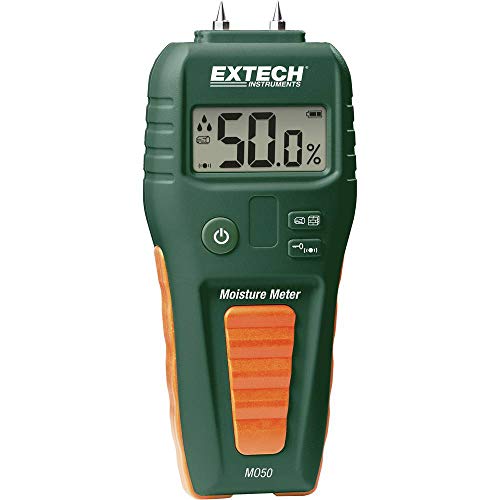
Extech MO50A Review: Compact Pin Moisture Meter
A pocket-sized pin moisture meter for wood and building materials with droplet icons, an audible alert and a self-test cap.
Read More→
Extech MO290 Review: Moisture Psychrometer With Infrared Measurement
A pinless moisture meter with humidity, air temperature and infrared surface readings that calculates dew point and condensation risk on the spot.
Read More→