As an Amazon Associate, Akermin earns from qualifying purchases. Product links on this page are affiliate links.
Verdict
The Extech MO55A is the compact answer to a question every inspector faces: carry a pinless meter, a pin meter, or both. It combines a pinless sensor in the back of the case with pins on the top, so one instrument scans a wall and then confirms a reading at a point. The manufacturer’s documentation describes droplet icons and an audible alert in the same style as the MO50A and MO57A. It is not currently listed on Amazon US, which matters if you want to buy it with the usual returns cover; the listed alternatives are the MO265, which does the same combination with a remote probe, and the MO50, which is pin only. If the MO55A is available to you through another retailer, it is a sensible everyday meter. If not, the MO265 covers the same ground with more features.
Pin Versus Pinless: What Each Mode Does
| Aspect | Pinless mode | Pin mode |
|---|---|---|
| Contact with surface | Sensor pad rests on surface, no damage | Pins pushed into material, leaves small holes |
| What it measures | Electrical property of a volume below the surface | Resistance between the pin tips |
| Best use | Scanning to find the extent of a wet area | Confirming moisture at a point, checking lumber |
| Affected by | Density, metal, wet material behind the surface | Surface moisture, salts, pin contact quality |
| Speed | Fast sweep | One point at a time |
Because the two modes fail in different ways, agreement between them is strong evidence. A high pinless reading that the pins do not confirm often points to a pipe, a metal corner bead or foil-backed insulation rather than water. The article on choosing between pin and pinless meters goes through those cases.
Documented Specifications
| Item | Documentation |
|---|---|
| Measurement types | Pinless sensor plus pin electrodes in one body |
| Materials | Wood and common building materials (manufacturer) |
| Indicators | Digital readout with moisture icons and audible alert (manufacturer) |
| Form | Compact handheld with protective cap |
| Amazon US availability | Not listed at the time of writing |
The manufacturer publishes the numeric ranges and depth on the datasheet. We have not reproduced figures here that we could not confirm from a current document.
In Use
A typical damp inspection with a combination meter goes in two passes. First, with the cap on the pins, the back of the meter is swept over the wall in a grid, watching the icons and listening to the alert to map the wet area. Second, the cap comes off and the pins are pressed into the wall at the wettest point and at a dry reference point, giving two numbers to compare. On wood the order reverses: the pins give the moisture content that matters for construction or woodworking, and the pinless sensor is used to check that the board is uniform. The compact body of the MO55A suits this two-pass routine better than carrying two instruments, which is its main argument.
Where a Compact Combination Meter Fits
For a home inspector the practical question is how many meters to carry up a ladder. A combination meter answers it with one, and the MO55A’s compact body makes it the meter most likely to be in the pocket when a stain is spotted. The compromise is that a fixed pin spacing and an integrated pinless pad are both smaller than on dedicated instruments, so the pinless reading covers a smaller area per pass and the pins reach less deep into thick timber. For lumber grading or a large drying job, a dedicated pin meter with a hammer probe remains the right tool. The MO55A is for finding and confirming problems, not for production measurement.
Strengths
- Scanning and confirmation in one pocket-sized meter.
- Same icon and alert approach as the rest of the Extech compact range.
- Cheaper and simpler than carrying two dedicated meters.
Limitations
- Not currently listed on Amazon US.
- Integrated pins cannot reach into cavities the way the MO265 remote probe can.
- Shallow pinless depth compared with deep-scanning meters such as the MO57A.
How It Compares
The Extech MO265 is the listed combination meter and adds a remote pin probe, a backlit display and a tri-colour bargraph. The MO50A is the pin-only sibling with the same compact form. The MO290 is the top of this family, adding humidity, air temperature and an infrared thermometer for condensation diagnosis.
How We Research
This review is based on the manufacturer’s published documentation for the MO55A and the related MO50 and MO265 listings on Amazon US. We did not run laboratory tests. Our moisture meter guide covers the category.
Recommended Tools

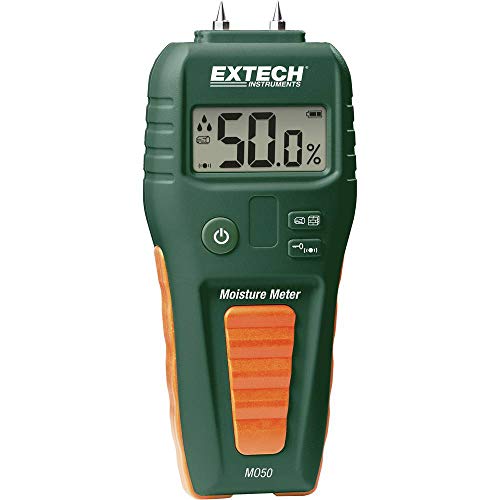
Products shown because their documented specifications fit this guide. Price and availability are on Amazon and can change.
Frequently Asked Questions
Is the Extech MO55A available on Amazon US?
At the time of writing it is not listed on Amazon US. The closest listed Extech models are the MO265 combination meter and the MO50 pin meter, both linked from this page.
Why have both pin and pinless in one meter?
Pinless scanning finds wet areas quickly without marking the surface; pins confirm the reading at a specific point and are less affected by what lies behind the surface. Having both means you can scan and confirm without carrying two meters.
Which mode should I use on drywall?
Scan with the pinless sensor first to find the extent of the damp area, then use the pins in an inconspicuous spot to confirm. On finished drywall many inspectors stay pinless unless the reading needs confirming.
Does it replace the MO265?
Not entirely. The MO265 has a remote pin probe on a cable and a bargraph display, which are useful in cavities and for trend checks. The MO55A is smaller and simpler.
Affiliate disclosure: Akermin earns a commission from qualifying Amazon purchases made through links on this page. Our editorial picks are based on documented specifications and owner feedback, not commissions.