As an Amazon Associate, Akermin earns from qualifying purchases. Product links on this page are affiliate links.
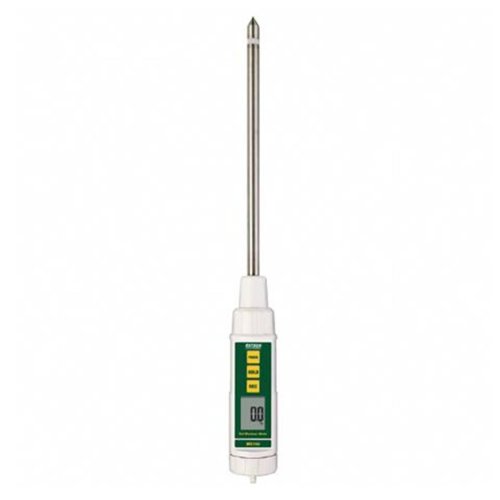
Extech · Extech MO750 Soil Moisture Meter
View on AmazonPrice and availability are shown on Amazon and can change at any time.
Verdict
The MO750 is a digital soil moisture meter with an 8 in stainless steel probe and a large LCD, running on AAA batteries. It is aimed at gardeners, landscapers, greenhouse managers and field researchers who want a repeatable number instead of a wobbling analogue needle. Push the probe into the bed, read the display, move on. The reading is relative to soil type and salinity rather than an absolute water content, which is true of every consumer soil probe, so its value is in comparison: this bed against that bed, the surface against root depth, today against last week. For those jobs it is well made and simple. For irrigation scheduling on a farm scale or for research that needs volumetric water content, a calibrated capacitance or TDR sensor is the appropriate instrument.
Who It Is For
- Home gardeners and allotment holders deciding when to water.
- Landscapers and grounds staff checking beds, lawns and newly planted trees.
- Greenhouse and nursery managers comparing containers.
- Students and field researchers who need a quick relative soil reading.
Documented Specifications
| Item | Documentation |
|---|---|
| Measurement | Soil moisture |
| Probe | 8 in stainless steel |
| Display | Large digital LCD |
| Power | AAA batteries |
| Build | Lightweight handheld body, rugged probe |
| Applications | Gardening, landscaping, agriculture, forestry, environmental studies |
What a Soil Moisture Reading Means
Probe-type soil meters sense the electrical behaviour of the soil around the probe, which changes with water content but also with soil texture, compaction, temperature and dissolved salts. A sandy soil and a clay soil at the same water content will not read the same, and a bed that has just been fertilised will read wetter than it is. That is why the MO750, like every meter in its class, is most useful as a comparative tool. Establish what the reading is in a bed that is clearly too dry and one that has just been watered, and the numbers in between become meaningful for that soil. The principle is the same as using a hygrometer for relative comparisons indoors, covered in measuring relative humidity correctly.
Probe Depth and Technique
The 8 in probe reaches root depth for most vegetables, perennials and container plants. Surface soil dries first, so a reading at 2 in tells you about seedlings and a reading at 8 in tells you about established roots. Insert the probe slowly to avoid bending it on stones, wait a few seconds for the reading to settle, and take two or three readings around a plant rather than one. Wipe the probe after use; soil left on it corrodes the contacts and shifts future readings. Owners moving from analogue dial probes describe the digital display as the main improvement, because a number can be written down and compared, and a large LCD can be read in sunlight.
Beyond the Garden
The listing names agriculture, forestry and environmental studies. For a smallholding or a tree nursery, a digital probe is a sensible step up from guessing. For field research, the MO750 gives a relative index that can be logged by hand alongside a site and date; where a study needs volumetric water content or continuous logging, dedicated soil sensors with published calibration curves are the tools, and the MO750 is the quick check between them. For newly planted trees and shrubs, where the failure mode is usually a dry root ball inside wet surrounding soil, the long probe is particularly useful: a reading at the edge of the planting hole and one in the root ball itself often differ, and that difference is the watering instruction.
Strengths
- Long stainless probe reaches root depth.
- Digital display that can be read in daylight and recorded.
- Standard AAA batteries and a rugged build.
Limitations
- Relative reading; affected by soil type and salts.
- No logging or connectivity.
- Not a substitute for calibrated research soil sensors.
How It Compares
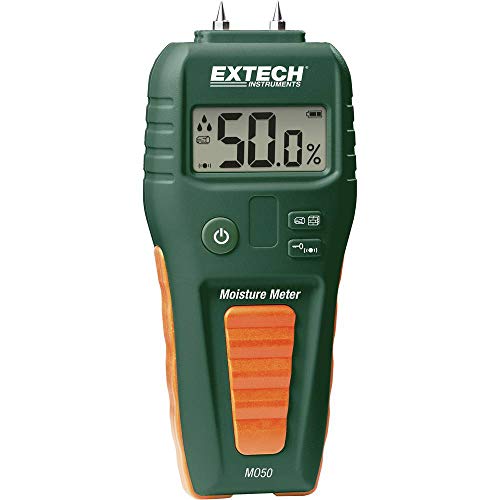
Within Extech’s moisture range the MO750 is the only soil probe; the others measure building materials. The Extech MO50 pin meter is sometimes pressed into service on timber posts and raised-bed lumber, and the MO265 covers structures. For the soil itself, the MO750 is the Extech option, and the alternatives are analogue dial probes at the low end and research-grade capacitance sensors at the high end.
How We Research
This review is based on Extech’s published specifications, the Amazon listing and owner reports. We did not run laboratory or field tests.
Recommended Tools

Products shown because their documented specifications fit this guide. Price and availability are on Amazon and can change.
Frequently Asked Questions
What does the MO750 measure?
Soil moisture along an 8 in stainless steel probe, shown on a digital LCD, according to the listing. The reading reflects the moisture of the soil in contact with the probe.
Is the reading a percentage of water?
Soil probes of this type give a relative moisture reading that depends on soil texture and salinity. It is best used to compare beds, pots or depths and to track drying over time.
How deep does it read?
The probe is 8 in long, so it can read at root depth for most beds and containers. Insert it fully for a deep reading or partially for a shallow one.
What batteries does it use?
Standard AAA batteries, per the listing.
Affiliate disclosure: Akermin earns a commission from qualifying Amazon purchases made through links on this page. Our editorial picks are based on documented specifications and owner feedback, not commissions.