As an Amazon Associate, Akermin earns from qualifying purchases. Product links on this page are affiliate links.

Fluke · Fluke 1AC II VoltAlert Non-Contact Voltage Tester, Pocket-Sized, 90-1000V AC, Audible Beeper, CAT IV Rating
View on AmazonPrice and availability are shown on Amazon and can change at any time.
A pocket non contact voltage tester that glows red at the tip and sounds a beeper when voltage is detected, runs a continuous self test so a dead unit announces itself, and can be set to audible or silent. One line has to be settled before buying: the detection range bullet gives 90 V to 1000 V AC or 200 V to 1000 V AC, and on this kind of instrument the lower threshold is the whole specification rather than a variant.
The word or in the detection range bullet
Bullet three reads: voltage detection range for wide application use, 90 V to 1000 V AC or 200 V to 1000 V AC.
The phrase wide application use frames that as breadth. It is not breadth, it is ambiguity. Two different lower thresholds have been placed in one sentence joined by or, and nothing on the page says which one a given unit carries. The product name, meanwhile, states 90 to 1000 V AC without the alternative, so the listing contradicts itself across its own fields.
On most instruments an unspecified variant would be an irritation. Here it is the specification. A non contact voltage tester has essentially one number, the concentration of the field at which it begins to respond, and every other feature exists to communicate that one binary result.
Until the page resolves it, the unit that arrives may or may not respond to the circuits you work on most. That has to be confirmed in writing before ordering, in the same way a voltage ceiling on a solar tester has to be confirmed before it goes near an array.
A 200 volt threshold is a different tool
Consider what each version can do on a nominal 120 V supply.
The 90 V version responds. The circuit voltage sits comfortably above the threshold, and the tip glows.
The 200 V version does not respond, because the circuit voltage is below the point at which it is designed to indicate. And the output of a non responding tester is visually and audibly identical to the output of a tester reporting a dead conductor. Nothing glows. Nothing beeps. The user draws the obvious conclusion.
That is the worst possible failure for an instrument of this type. A tester that will not turn on at all is safe, because its uselessness is obvious. A tester that silently cannot see the voltage class you work on supplies a confident false negative, and it does so repeatedly and consistently.
On 230 V single phase both versions respond, which is why the ambiguity is more dangerous in some markets than others. If your work includes any nominal 120 V circuits, the threshold is not negotiable. Our page on how non contact voltage detection works covers what the threshold really describes.
Continuous self test is aimed at the failure that hurts
The second bullet is the best thing on the page: continuous self test so you always know it is working.
Understand what that is for. The characteristic way a non contact tester kills someone is not by giving a wrong reading. It is by giving no reading, because the battery died in a toolbox three weeks ago or the sensing circuit failed quietly. The instrument then reports absence of voltage on every conductor it meets, which is exactly what a user hopes to see, and it does it convincingly.
A tester that continuously demonstrates its own liveness converts that silent failure into a visible one. It is a small feature with a large effect on the only outcome that matters, and it is the reason the habit of proving a tester on a known live source exists in the first place.
It is worth being precise about what is still not covered. Self test confirms the instrument is alive. It cannot confirm the field reached the sensor, and there are plenty of reasons it might not: screened cable, steel conduit, armour, a conductor deep inside an enclosure, thick insulation, or a user wearing gloves and standing on an insulating mat so the capacitive path to earth is poor.
CAT IV in the name with no voltage attached
The product name carries a CAT IV rating. The bullets do not mention measurement category at all, and no voltage is attached to it anywhere.
A measurement category is not a quality grade. It describes where in an installation an instrument may be connected, graded by how much energy is available to turn a fault into an arc. CAT II is appliance and socket level. CAT III is fixed distribution, panels and hard wired equipment. CAT IV is the origin of the installation, the service entrance and the supply side of the main disconnect, where fault energy is highest and transients are least attenuated.
The rating only means something as a pair. CAT IV 600 V and CAT IV 1000 V describe different withstand requirements, and an instrument qualified for one is not qualified for the other. Publishing the category without the voltage leaves the claim incomplete on exactly the work where it matters most. Our page on CAT ratings sets out the categories properly.
Audible or silent, and why the choice is not trivial
| Specification | Published in the listing |
|---|---|
| Indication | Tip glows red, audible beeper |
| Self test | Continuous |
| Detection range, as published | 90 V to 1000 V AC or 200 V to 1000 V AC |
| Detection range, product name | 90 to 1000 V AC |
| Which threshold ships | Not stated in the listing bullets |
| Modes | Audible or silent |
| Measurement category | CAT IV in the product name, with no voltage stated |
| Form factor | Pocket sized |
| Frequency range | Not stated in the listing bullets |
| DC detection | Not stated in the listing bullets |
| Battery type and life | Not stated in the listing bullets |
| Ingress protection rating | Not stated in the listing bullets |
| Drop rating | Not stated in the listing bullets |
| Operating temperature range | Not stated in the listing bullets |
The listing files the audible and silent modes under added convenience, which undersells one of them and oversells the other. In a plant room with a running fan the beeper is inaudible and the glow is the indication. In an occupied house at night, or in a hospital, the beeper is the thing you switch off and the glow is again the indication. So one mode is not a preference, it is what makes the tool usable in a given environment.
The consequence is worth stating plainly. In silent mode the only indication is visual, which means the tip has to be in your line of sight at the moment of contact. That is a different working posture from listening for a tone while looking into a crowded enclosure, and it is the kind of thing that decides whether a result is noticed.
The missing frequency range is the most interesting blank row. Detection depends on the field alternating, and the rate at which it alternates affects coupling, which is why a specified frequency band is normal on this class of instrument.
Presence is what it proves, and absence is what it cannot
As a presence detector this is a sound design. Two indication channels, a continuous self test aimed at the one failure mode that injures people, a pocket form factor so it is actually carried, and a stated category rating even if the voltage is missing. For checking whether a circuit you are about to disturb is live, it does the job and announces its own health while doing it. Our non contact voltage tester comparison shows how the category differs.
It is not a proving instrument and should never be used as one. Establishing that a conductor is dead before working on it is a two pole test against a known reference, with the tester proved before and after, because a single pole detector can be defeated by screening, by poor earth coupling and by induced voltage on a nearby dead conductor that makes it indicate when nothing is connected.
So the buying advice is narrow. Confirm the detection threshold in writing, confirm the CAT IV voltage, and then treat it as what it is: a fast, self checking way to know that something is live, and never as evidence that something is not.
Recommended Tools


Products shown because their documented specifications fit this guide. Price and availability are on Amazon and can change.
Frequently Asked Questions
Which detection range will actually arrive?
The listing does not say, and that is the problem. Bullet three gives 90 V to 1000 V AC or 200 V to 1000 V AC as if the two were interchangeable. They describe different instruments for different supply systems. A buyer on a nominal 120 V supply needs the lower threshold and a buyer working only on three phase distribution may be content with the higher one. Until the page distinguishes them, the threshold has to be confirmed before ordering.
Why would a 200 V tester not see a 120 V circuit?
Because the number is a detection threshold rather than a maximum. Below it the instrument is not designed to respond, so a live 120 V conductor produces no glow and no beep. The dangerous part is what that looks like to the user, which is identical to a dead conductor. An instrument that cannot see the voltage on your most common circuit is worse than no instrument, because it supplies a reassuring negative.
Does the continuous self test mean a no voltage indication can be trusted?
It removes one failure mode, not the category of them. Continuous self test addresses the silent death of a tester, where a flat battery or a failed sensor produces a permanent and convincing no voltage result. That is a genuine improvement. It does not address shielded cable, armoured or conduit runs, deeply buried conductors, a hand not providing a path to earth, or a threshold above the circuit voltage. A single pole tester indicates presence of voltage and never proves absence of it.
What does CAT IV mean with no voltage beside it?
Not very much. A measurement category describes where in an installation an instrument may safely be connected, with CAT II at appliance and socket level, CAT III at fixed distribution and CAT IV at the origin of the installation where the available fault energy is greatest. The rating is only complete with a voltage attached, because CAT IV 600 V and CAT IV 1000 V are different instruments. The product name gives the category and omits the voltage.
Will it detect direct current?
Nothing in the bullets suggests so, and the physics is against it. A capacitive non contact tester works by sensing the alternating electric field around a live conductor, which requires the field to be changing. A steady DC conductor presents no changing field to couple into, so the detector has nothing to respond to. Every voltage figure on this page is specified as AC, and that is consistent.
Affiliate disclosure: Akermin earns a commission from qualifying Amazon purchases made through links on this page. Our editorial picks are based on documented specifications and owner feedback, not commissions.
Related Guides
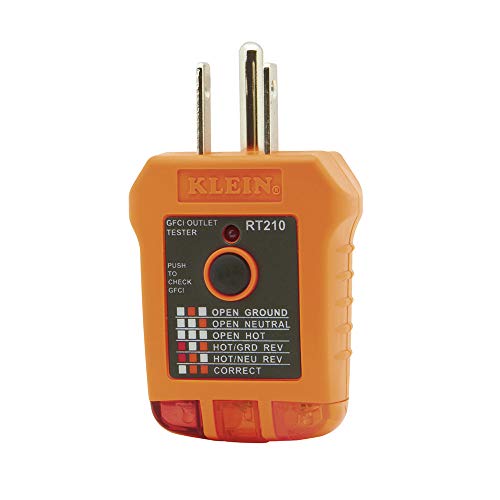
Klein Tools RT210 Review: A Fault Finder That Does Not List Its Faults
A three wire receptacle tester for standard and GFCI North American outlets, specified for 110 to 125 volts AC at 50 or 60 Hz, a 6.6 foot drop and an operating range of 32 to 140 degrees Fahrenheit.
Read More→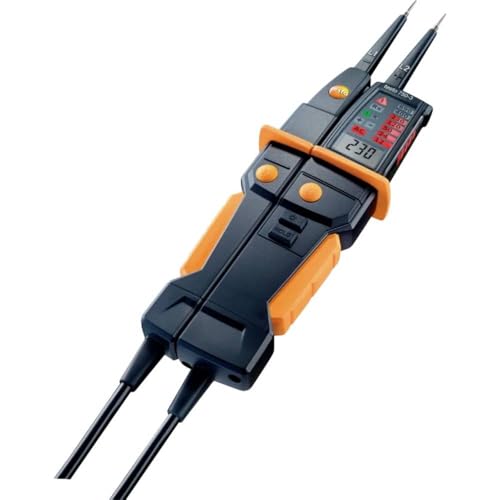
Testo 750-3 Review: Four Bullets, and No Published Category Rating
A two pole voltage tester with a three digit LCD showing measured voltage, a patented LED voltage bar viewable from any angle, polarity detection on DC and a GFCI test function for AC outlets.
Read More→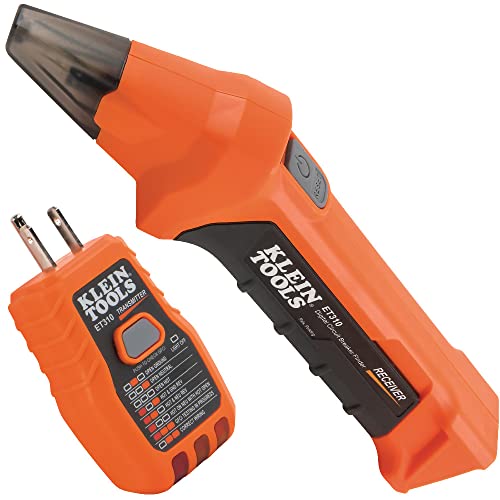
Klein Tools ET310 Review: Wide Compatibility Means 90 to 120 Volts
A two part circuit breaker finder with a transmitter that connects at the outlet or fixture and a receiver that scans the panel, stated to work on 90 to 120 V AC circuits and carrying a built in GFCI test function.
Read More→