As an Amazon Associate, Akermin earns from qualifying purchases. Product links on this page are affiliate links.
Short answer: take the MMD4E for timber, framing, subfloor and anywhere holes do not matter, and for readings you may need to defend. Take the ET140 for finished surfaces and for sweeping large areas quickly to find where the wet region actually is.
What Each Listing States
| Item | General MMD4E | Klein ET140 |
|---|---|---|
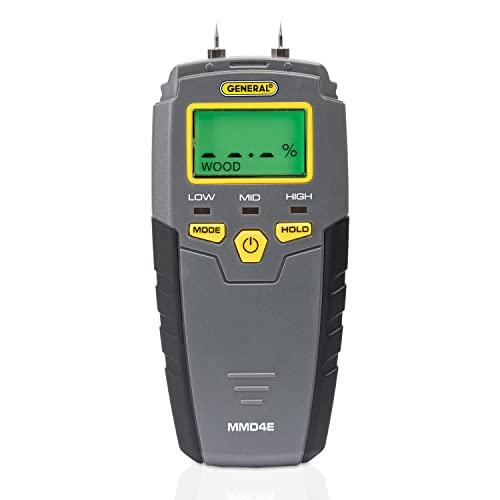
| Method | Pin, 8 mm stainless steel pins | Pinless, electromagnetic field |
| Depth | Determined by pin length | Up to three quarters of an inch |
| Display | 0.3 inch digits, backlit LCD, hold button | Not detailed in the bullets |
| Alerts | Low, medium and high tones plus on-screen icons | Not stated in the bullets |
| Calibration check | Built into the protective cap | Not stated in the bullets |
| Spares and power | Extra pins supplied, 9 V battery | Not stated in the bullets |
| Surface marking | Leaves two small holes | None |
One Question Decides It
Are you allowed to make holes in what you are testing? That single question resolves nine out of ten purchases. Framing, studs, joists, subfloor, firewood and rough timber: pins are fine and give you the better measurement. Finished floors, decorated walls, ceilings, cabinetry and anything a customer will see: pins are out, and the choice is pinless or nothing.
The secondary question is whether you are searching or confirming. Pins are hopeless at searching because each reading is a separate operation, whereas a pinless meter is swept like a torch. If your usual job starts with “water is coming in somewhere”, the pinless meter finds the somewhere faster.
What the MMD4E Does Better
Three things stand out in its listing. The audible tones mean you can probe along a joist without watching the screen. The 0.3 inch backlit digits are readable in a dim crawlspace, which is exactly where moisture work happens. And the calibration check in the cap is the feature most meters at this level omit: press the pins to the contact, confirm the meter reads what it should, and you know the battery and the electronics are working before you trust a number. Spare pins are supplied, which matters because pins bend in hard material.
What the ET140 Does Better
Speed and access. You can check a whole wall in the time it takes to make ten pin readings, and you can check surfaces that pins must never touch. It also works on masonry, where driving pins is impractical. The compromise, stated plainly in the Klein listing itself, is that the reading is relative moisture content rather than an absolute percentage, so it is best used by comparison against a known-dry area of the same material.
Many People End Up With Both
These two meters are cheap enough, and different enough, that professionals in damp and restoration work commonly carry one of each: pinless to map, pins to measure and record. If you are buying your first and expect to buy a second, buy the pinless meter first, because finding the problem is the harder half of the job.
Who Buys Which
- Carpenter, builder, firewood, flooring subfloor checks: MMD4E.
- Anyone working on finished surfaces: ET140.
- Leak hunting across a large area: ET140.
- Documented drying records: MMD4E, or a combination meter such as the Extech MO265.
How We Research
All specifications are from the manufacturer listings. We did not run laboratory tests and publish no measurements of our own. See also pin versus pinless moisture meters and the how to choose a moisture meter.
Recommended Tools


Products shown because their documented specifications fit this guide. Price and availability are on Amazon and can change.
Frequently Asked Questions
Does the MMD4E leave holes?
Yes. It uses 8 mm stainless steel pins pushed into the material, which leave two small holes. On framing, subfloor and unfinished timber that is harmless. On a finished surface it is not acceptable.
Can the MMD4E check its own calibration?
The listing states the protective cap doubles as a calibration checker. That gives you a quick confidence check before a reading, which very few meters at this level offer.
Which is faster to scan a wall?
The ET140, by a wide margin. A pinless sensor is swept across a surface continuously, while pins have to be pushed in and pulled out for every single reading.
Which gives a more trustworthy number?
Pins give a more specific measurement between two known points, which is easier to defend and repeat. A pinless reading covers an area and can be influenced by anything within the sensing field.
Affiliate disclosure: Akermin earns a commission from qualifying Amazon purchases made through links on this page. Our editorial picks are based on documented specifications and owner feedback, not commissions.