As an Amazon Associate, Akermin earns from qualifying purchases. Product links on this page are affiliate links.
A hygrometer is a measuring instrument: it reports relative humidity, and sometimes temperature, as a number you read. A humidistat is a control device: it contains a humidity sensor and a switch, and it turns a humidifier, dehumidifier or fan on and off to hold a setpoint. If you want to know what the air is doing, you need a hygrometer. If you want a machine to hold a humidity level automatically, you need a humidistat, or a controller that accepts a hygrometer’s output. The products this site covers, such as the Govee WiFi Thermometer Hygrometer H5179 and the Temtop S1+, are hygrometers with app alerts. They measure and notify; they do not switch mains equipment. A true humidistat, by contrast, is usually a wall-mounted or duct-mounted control with a setpoint dial and relay contacts.
The one-letter difference that changes the device
The words look almost identical: hygrometer, humidistat. The suffix is the whole story. -meter comes from the Greek for measure; a hygrometer measures humidity. -stat comes from the Greek for standing or holding; a humidistat holds humidity at a setpoint by switching equipment.
A hygrometer is a read-only instrument. It gives you a number, either on a display or in an app. A humidistat is a closed-loop controller. It contains a humidity sensor, a comparator and a relay or triac output. You set a target, say 50 percent relative humidity. When the sensor reads below that, the humidistat closes a contact to run a humidifier. When the reading rises above the target, it opens the contact. The sensor inside a humidistat may be the same type as the sensor inside a hygrometer, but the device as a whole does something different with the signal.
This matters because the two devices are sold in overlapping packaging. Many inexpensive products described as humidistats are simply hygrometers with a low-power relay that can switch a small load. They cannot safely switch a mains-powered dehumidifier. Conversely, a good hygrometer with a logging output can be part of a control system, but only if something else does the switching. The instrument and the controller are separate functions, and the buyer needs to know which one the task requires.
What a hygrometer actually reports, and why relative humidity is a ratio
Almost every consumer and trade hygrometer reports relative humidity, abbreviated RH. Relative humidity is not a quantity of water in the air. It is a ratio: the amount of water vapour present divided by the maximum amount the air could hold at that temperature, expressed as a percentage. Because the denominator depends on temperature, a sealed room can gain or lose relative humidity without any water entering or leaving. Warm the air and RH falls; cool it and RH rises. This is why a hygrometer that reports only RH can mislead you about moisture problems. A cold corner of a basement can show 80 percent RH while the centre of the room shows 55 percent, because the corner is colder, not wetter.
Better hygrometers also report temperature, and some report dew point or absolute humidity. Dew point is the temperature to which the air must be cooled for condensation to begin. It is an absolute measure of water vapour content and does not change with room temperature. For diagnosing damp, dew point is often more useful than RH. The Govee WiFi Thermometer Hygrometer H5179 reports temperature and humidity and refreshes every two seconds, with stated accuracy of plus or minus 0.54 degrees Fahrenheit and plus or minus 3 percent RH. That is a typical specification for a consumer sensor. The listing does not publish dew point or absolute humidity, so those values are not available from that device.
Accuracy figures deserve scrutiny. A claimed plus or minus 3 percent RH is plausible for a Swiss-made capacitive sensor in a consumer device, but it is a statement about the sensor element, not about the whole instrument in its enclosure. Placement, airflow and self-heating can add error. A hygrometer hung against a wall in still air will read the microclimate of that wall, not the room. The accuracy of a hygrometer is therefore a system property, not just a sensor datasheet number.
What a humidistat controls, and what it does not measure
A humidistat is defined by its output, not its display. The simplest whole-house humidistats are mechanical: a nylon or hair element expands and contracts with humidity and operates a switch. Electronic humidistats use a capacitive or resistive sensor and a comparator. In either case, the device is installed in the duct or on a wall and wired to the equipment it controls. The setpoint is the humidity level you want the equipment to maintain, not necessarily the humidity you want to read. A humidistat may have no numerical display at all, only a dial marked with relative humidity percentages.
Because a humidistat is a controller, its accuracy specification is often looser than a hygrometer’s. A control that switches a humidifier at 35 percent plus or minus 5 percent is adequate for comfort, because the equipment has its own hysteresis and the occupant does not notice a few percent. A hygrometer used for building diagnostics needs tighter accuracy and better resolution. The two devices are optimised for different jobs.
Some products blur the line. A plug-in controller with a humidity sensor and a switched outlet is a humidistat in function, even if the listing calls it a hygrometer controller. A data logger with an alarm relay is a hygrometer with a control output. The question to ask is not what the product is called but what it does with the measurement: does it simply report, or does it change the state of another device?
Where the market confuses the two, and how to read a listing
Search for a humidistat and you will find many devices that are really hygrometers. The confusion is commercial: humidity is a feature people want to monitor, and control is a feature people want to automate, so listings mix the words. A product that sends an alert to your phone when humidity crosses a threshold is a monitoring hygrometer with an alarm, not a humidistat. The GoveeLife 2.0 WiFi Hygrometer Thermometer with Gateway is an example: it pairs up to ten sensors to a gateway and sends app and email notifications when preset temperature or humidity values are crossed. That is an alerting function. It does not switch a dehumidifier. The listing states that the alarm is a notification, not a relay output.
Similarly, the Govee Smart Bluetooth Thermometer Hygrometer H5074 stores twenty days of data on board and exports up to two years of records as CSV. That is a diagnostic tool. It helps you understand a moisture pattern over time, which is exactly what you need before deciding whether to buy a control device. The value of a hygrometer is highest when you are trying to find out what is happening; the value of a humidistat is highest once you know what you want to hold constant.
To read a listing correctly, look for three things: a setpoint, a switched output and a load rating. If the listing gives a humidity threshold for an app notification but no relay contact rating, it is a hygrometer. If it gives a terminal for a humidifier and a maximum switching current, it is a humidistat or a controller. If it gives neither, it is probably a display-only instrument.
The maintenance nobody mentions: drift, calibration and sensor poisoning
Both hygrometers and humidistats depend on a humidity sensor, and all humidity sensors drift. Capacitive polymer sensors, the most common type in consumer and HVAC devices, absorb water into a polymer layer and change capacitance. Over time the polymer can become contaminated by dust, cooking oils, cleaning solvents or high concentrations of volatile organic compounds. The result is a slow bias, often reading high in dry conditions and low in humid conditions. A hygrometer that was accurate when new may be several percent off after a couple of years in a kitchen or workshop.
Humidistats suffer the same drift, but the consequence is different. A drifted hygrometer gives you a wrong number; a drifted humidistat gives you a wrong setpoint, so the equipment runs too long or too little. In a heated home, a humidistat that reads low will over-humidify, risking condensation on cold surfaces. In a basement, a humidistat that reads high will under-run a dehumidifier, leaving the space damp. The control device should be checked against a known reference periodically, and the reference should be a hygrometer that is itself checked. The difference between a hygrometer and a hydrometer is worth remembering here: a hydrometer measures liquid density, not air humidity, and cannot be used as a reference for either device.
Calibration is not usually a user-serviceable function on consumer devices. The listing for the Govee H5179, the GoveeLife 3-Pack, the Temtop S1 and the Govee H5074 does not publish a calibration procedure or a recalibration interval. Not stated in the listing bullets. For trade users, the practical approach is to compare the device against a calibrated reference hygrometer at the start of each season and replace it when the bias exceeds the accuracy you need.
When neither instrument is the right answer
There are tasks where a hygrometer and a humidistat both fail to answer the question. If you are looking for the source of a leak or the extent of damp in a wall, you need a moisture meter that measures the moisture content of building materials, not the humidity of the air. A hygrometer tells you the air is humid; it does not tell you which wall is wet. The difference between a moisture meter and a hygrometer is the difference between a material measurement and an air measurement. A humidistat is even less useful here, because it controls equipment rather than locating a problem.
If you are assessing air quality rather than humidity, you need a particle counter or a total volatile organic compound sensor. The Temtop S1+ combines temperature and humidity with PM2.5 and an air quality index, and the listing states a battery life of up to sixty days. That is a multi-parameter monitor, not a humidistat, and not a substitute for a moisture meter. It is useful when the question is whether the air in a room is healthy to breathe, not whether a wall is wet.
Finally, if you need to control humidity in a space that is not served by fixed equipment, a humidistat alone will not help. You need a humidistat plus a humidifier or dehumidifier, correctly sized. The control device is the switch, not the machine. The meaning of hygrometer is often stretched in marketing to cover anything that reports humidity, but the functional distinction remains: measurement, control, or both.
Choose the function, then the device
A hygrometer answers the question what is the humidity. A humidistat answers the question how do I hold the humidity at a chosen level. If you are diagnosing, logging or alerting, buy a hygrometer with the accuracy and logging you need. If you are automating a humidifier or dehumidifier, buy a humidistat or a controller with a rated switched output. If you are finding a leak, buy a moisture meter. The terminology on the box is less reliable than the presence of a setpoint and a relay.
Frequently Asked Questions
Can a hygrometer control a dehumidifier?
Not directly. A hygrometer measures and may send an alert, but it does not have a switched output rated for mains equipment. Some controllers combine a humidity sensor with a relay and are sold as humidistats. The Govee and Temtop products referenced here are monitoring devices; their listings do not publish relay contacts or load ratings.
Is a humidistat just a hygrometer with a display?
No. A humidistat contains a sensor and a switch, and its purpose is to hold a setpoint by turning equipment on and off. A hygrometer reports a reading. A humidistat may have no display at all, and a hygrometer usually has no switched output. The two functions can be combined in one enclosure, but the listing should state the output rating if it does.
Which is more accurate, a hygrometer or a humidistat?
Accuracy depends on the sensor and the design, not the category. Consumer hygrometers often state plus or minus 3 percent RH, as the Govee listings do. Humidistats for HVAC control may have wider tolerance because comfort control does not require high accuracy. For diagnostic work, choose a hygrometer with a published accuracy figure and check it against a reference.
Do I need a hygrometer if I already have a humidistat?
It helps. A humidistat tells you what the control system thinks the humidity is, but it does not give you an independent reading. A separate hygrometer lets you verify that the humidistat is holding the level you intended and that the sensor has not drifted. The two devices serve different purposes and are complementary.
Can I use a hygrometer to find a leak?
No. A hygrometer measures the humidity of the air, not the moisture content of building materials. A wall can be wet while the room air is dry, and a humid room does not tell you which surface is wet. Use a moisture meter for materials and a hygrometer for air conditions.
What does 'Not stated in the listing bullets' mean in this article?
It means the product listing supplied to us does not publish that figure. We do not estimate or infer missing specifications. If a listing does not state a calibration interval, a relay rating or a dew point range, we say so rather than inventing a number.
Related Guides
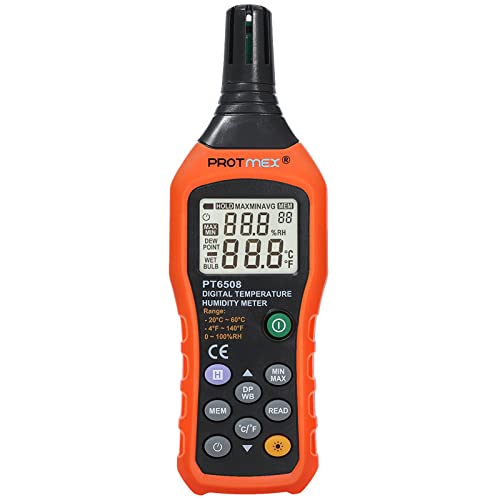
Protmex PT6508 Temperature Humidity Meter Review: One Instrument, Four Numbers
A single-product review of the Protmex PT6508, explaining what its four measurements mean in practice, where the design forces a compromise, and who should buy a different kind of instrument.
Read More→Bluetooth Logger or WiFi Logger for a Cellar: Which One Actually Works
This article explains how Bluetooth and WiFi data loggers differ in a cellar, what each can and cannot do, and how to pick the one that matches your building and your alarm requirements.
Read More→
Testo 510i Differential Pressure Manometer: A Single Product Review
A mechanism-first review of the Testo 510i differential pressure manometer, based only on the manufacturer listing.
Read More→