As an Amazon Associate, Akermin earns from qualifying purchases. Product links on this page are affiliate links.
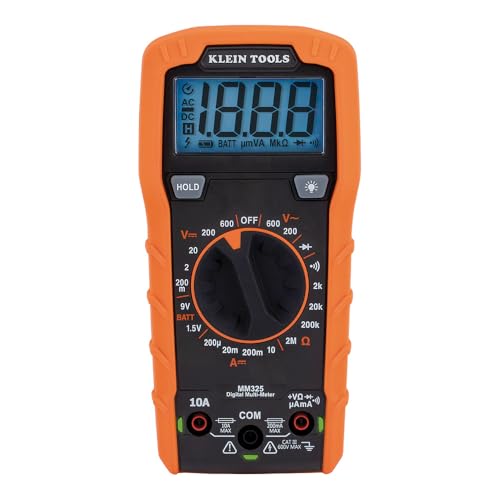
KLEIN TOOLS · Klein Tools MM325 Digital Manual-Ranging Multimeter | 600V AC/DC Voltage Tester, Tests Batteries, Current, Resistance, Diodes, and Continuity
View on AmazonPrice and availability are shown on Amazon and can change at any time.
A manual ranging digital multimeter measuring AC and DC voltage up to 600 V, 10 A of direct current and resistance up to 2 megohms, with continuity, diode and battery test modes, a backlit screen, lead holders on the back, a kickstand and an optional magnetic hanger. The headline feature is not any of those. It is a set of LEDs that illuminate to confirm the test leads are in the correct sockets, which is aimed at the one error that both destroys multimeters and hurts the people holding them. Two published figures then define the scope: resistance stops at 2 megohms, and the current function is direct only.
Lead Alert is aimed at one specific accident
Here is the accident. You measured current, so the red lead went into the 10 A socket. Then you decided to check a voltage, and you forgot to move it.
Understanding why that is so bad requires knowing what a current input is. To measure current the meter has to be inserted into the circuit and carry it, and to avoid changing the thing it is measuring, that path has to present almost no resistance. Inside, the current input is a shunt of a tiny fraction of an ohm. Electrically it is a piece of wire.
Now put the probes across a live supply with the lead still in that socket. You have connected a piece of wire across a source. The circuit delivers whatever it can into a short, through your instrument, in your hand. A fuse is fitted to end this, and in a properly designed meter it does, but the event is not gentle and the meter is usually finished.
Lead-Alert does not protect against the fault. It prevents the setup. LEDs on the face light to indicate correct lead placement, so the information arrives while you are still looking at the meter rather than after the probe has landed. It is a design feature aimed at how people actually make mistakes, which is by carrying over a configuration from the previous measurement, and it is worth more on a first meter than any additional function would be.
Our guide on choosing a multimeter for home electrical work rates lead placement feedback highly for exactly this reason.
Manual ranging, printed in the product name
The product title says manual ranging. That is unusual, because manual ranging is generally treated as the thing you do not mention.
The difference is simple. On an automatic meter you choose a function and the instrument finds the range. On a manual meter you choose both, and if you choose too low a range the display tells you it cannot represent the value.
Automatic is faster and better for someone moving between a 3 V battery and a 230 V circuit all morning. Manual has three real advantages that are easy to overlook. The resolution does not change while you are watching an unsteady reading, so a drifting value is not also hopping between scales. An over range indication is a definite statement that your expectation was wrong, which is diagnostic information. And selecting a range means forming an estimate first, which is the habit that separates someone measuring from someone pointing probes.
Printing it in the name rather than burying it is to the listing credit. A buyer who wants automatic ranging knows from the title not to buy this, which is better than discovering it on the first job.
Two megohms is a low ceiling, and it rules things out
The resistance range is published as 2 megohms, and that number deserves a moment because it is both adequate and limiting depending on the work.
What it covers comfortably is nearly everything in general electrical work. Motor and transformer windings sit in the ohms to hundreds of ohms. Heating elements are tens of ohms. Switch and relay contacts should be a fraction of an ohm. Thermistors and temperature sensors run from hundreds of ohms to tens of kilohms. Conductor continuity is near zero. All of that is inside the range with room to spare.
What it cannot reach is anything above 2 megohms, and that includes several things people reach for a meter to check. Insulation between a winding and a frame is supposed to be far higher than this ceiling, so a healthy machine reads over range and tells you nothing, while a failing one may still be above 2 megohms and also read over range. Leakage across a damp or contaminated surface sits in the same territory. High value resistors in electronics are frequently beyond it.
The honest framing is that insulation condition is not a job for a general purpose multimeter at any resistance ceiling, because it needs a high test voltage to be meaningful at all. The point is simply to know that over range on this meter is not the same as good. Our note on measuring resistance safely covers the practical side, starting with the fact that the circuit must be dead and discharged.
Ten amps of direct current, and nothing alternating
The current specification reads 10 A DC. No alternating current function appears anywhere in the bullets.
For the audience this meter is built for, that is a reasonable design rather than a gap, and the reason is the measurement itself. Reading current with a multimeter means putting the instrument in series with the load, which means opening the circuit, connecting the meter into the break, and energising it with your instrument carrying everything the load draws. On a mains branch circuit that is an unattractive procedure, and the sensible alternative is a clamp that reads the magnetic field around an intact conductor without disturbing anything.
Where 10 A of direct current is genuinely useful is the territory the battery test mode also points at: vehicle and equipment circuits, low voltage lighting, chargers, solar and battery wiring, bench supplies. On those the circuit is small, often already accessible, and direct current is what is flowing.
So read the pairing as a statement of intent. This is a voltage, resistance and continuity meter with a useful direct current range and a battery check, for work on circuits you can safely interrupt. If AC current is a regular part of your week, the companion tool is a clamp meter rather than a different multimeter.
Six hundred volts with no category attached
| Specification | Published in the listing |
|---|---|
| Voltage, AC and DC | Up to 600 V |
| Current | 10 A, direct current |
| Resistance | Up to 2 megohms |
| Other functions | Continuity, diode test, battery test |
| Ranging | Manual |
| Lead placement warning | LEDs indicate correct test lead placement |
| Display | LCD with backlight |
| Handling | Lead holders on the back, kickstand, optional magnetic hanger as catalogue number 69445 or 69417 |
| Measurement category rating | Not stated in the listing bullets |
| Accuracy, any function | Not stated in the listing bullets |
| Display count or digits | Not stated in the listing bullets |
| True RMS or averaging | Not stated in the listing bullets |
| Input fuse rating | Not stated in the listing bullets |
| Battery type and life | Not stated in the listing bullets |
| Capacitance, frequency, temperature | Not offered, no bullet claims them |
The 600 V figure is a measuring range. It tells you how much voltage the meter will display. It does not tell you where in an installation the instrument is built to withstand the voltage spikes that travel through wiring, and those are separate specifications that are quoted together as a category and a voltage. The display count is absent for the same reason, and that is the figure deciding how finely 600 V can be shown.
The missing True RMS statement is worth a sentence. On distorted waveforms an averaging meter reads low, and nothing in these bullets claims the instrument is anything other than averaging. For clean mains voltage that is immaterial. On the output of electronic equipment it is not, and the silence should be read as the cheaper option until the datasheet says otherwise.
The handling details earn their place without overpromising. Lead holders on the back keep the probes with the meter instead of in a pocket. A kickstand means you can read it while both hands are busy. And the magnetic hanger is named by catalogue number as an optional extra, which is a specific statement rather than an implied inclusion.
A good first meter and a poor only meter
As a first multimeter this is well judged. The function set is the one a beginner needs and no more, the manual ranging builds the habit of estimating before measuring, the lead placement LEDs guard the mistake beginners actually make, and the voltage range covers domestic and light commercial circuits. Our roundup of multimeters for home and DIY work places meters of this shape above feature loaded alternatives for exactly that reason.
As the only meter in a working kit it will run out of road. No AC current means a clamp meter is coming eventually. No capacitance means motor capacitors are somebody else diagnosis. No frequency or duty cycle means control signals are out of reach. No temperature means a separate probe. And no published accuracy, count or category rating means anything you want to record rather than simply decide needs a meter that publishes its numbers.
Buy it as a sound, safety conscious basic instrument from a brand that printed the limitation in the name. Just do not expect it to be the last one you own.
Recommended Tools


Products shown because their documented specifications fit this guide. Price and availability are on Amazon and can change.
Frequently Asked Questions
What exactly does Lead-Alert protect against?
Leaving a test lead in the current socket and then probing a voltage source. A current input is deliberately built as a very low resistance shunt, because it has to carry the circuit current without disturbing it. Put that near zero ohm path across a live supply and you have created a short circuit through the instrument. The fuse is there to end it, but the event can be violent, and it is the commonest way meters die. LEDs that light to confirm correct lead placement interrupt that sequence before the probe touches anything.
Is manual ranging a disadvantage?
It is slower and it demands you think, which cuts both ways. You select the range, so an over range condition is a signal to change your assumption rather than something handled silently. The resolution stays fixed instead of hunting while you are trying to read a drifting value, and a reading is never ambiguous about its scale. Automatic ranging is more convenient for mixed work. Manual ranging teaches, and Klein has put the words manual ranging in the product name rather than leaving buyers to find out.
What does a 2 megohm resistance ceiling rule out?
Anything that lives above it. Insulation paths, leakage across a damp surface, high value resistors in electronics and some sensor circuits all sit in the megohm to gigohm region, and this meter simply reports over range for those. What it covers well is the range most electrical work actually involves: windings, heating elements, switch contacts, thermistors, low value resistors and continuity of conductors. Insulation testing is a separate instrument with a high test voltage, not a job a general purpose meter does.
Can it measure AC current?
The bullets list 10 A DC current and no alternating current function at all. For a meter aimed at home and general electrical work that is a coherent choice rather than an oversight, because measuring AC amps in series means breaking into a live circuit and routing it through the instrument, which is the least attractive measurement in the trade. A clamp meter reads AC current around the outside of a conductor without opening anything, which is why the two tools are usually owned together.
What is the battery test mode for?
It applies a small load while measuring, which is the difference that matters. An unloaded voltage reading from a tired cell can look almost perfect, because there is nothing drawing current to expose the internal resistance that has built up inside it. Put even a modest load on the same cell and the voltage sags. A battery test mode is doing that for you, which is why it gives a verdict a plain voltage reading does not.
Does the listing state a measurement category rating?
Not stated in the listing bullets. The 600 V figure describes how much voltage the meter is built to measure, which is a different statement from how much transient energy the instrument is designed to survive at a given point in an installation. Those two are set out separately, and a category rating with its own voltage is the one that answers where you may safely use it. Check the datasheet for the figure before working anywhere beyond a socket outlet.
Affiliate disclosure: Akermin earns a commission from qualifying Amazon purchases made through links on this page. Our editorial picks are based on documented specifications and owner feedback, not commissions.