As an Amazon Associate, Akermin earns from qualifying purchases. Product links on this page are affiliate links.

OWON · OWON HDS242 oscilloscope 2 in 1 40MHz Professional Handheld PC oscilloscope, 20000 Counts Digital multimeter 3.5 inch LCD Display Universal Test Instrument (oscilloscope+multimeter)
View on AmazonPrice and availability are shown on Amazon and can change at any time.
Verdict
The OWON HDS242 is a portable oscilloscope that also happens to be a good multimeter. The listing states 40 MHz bandwidth, a 20,000 count multimeter covering AC and DC voltage and current, resistance, diode, capacitance and continuity, a 3.5 inch high contrast colour LCD described as suitable for outdoor use, consumption under 5 W and roughly six hours from two 18650 cells. For field service, automotive electronics, control systems and anyone who needs to see a waveform somewhere a bench scope cannot go, it is a genuinely useful instrument.
Documented Specifications
| Item | Manufacturer listing |
|---|---|
| Oscilloscope bandwidth | 40 MHz, stated in the product name |
| Multimeter resolution | 20,000 counts |
| Multimeter functions | AC and DC voltage and current, resistance, diode, capacitance, continuity |
| Display | 3.5 inch high resolution, high contrast colour LCD |
| Power consumption | Under 5 W |
| Battery | Two 3.7 V 18650 cells at 2200 mAh, about six hours of use |
| Charging | Up to 4.5 hours when switched off |
The listing does not state sample rate, memory depth, channel count details, input protection or a safety category rating. Check the datasheet for those before using it on anything above low voltage.
What a Waveform Tells You That a Number Cannot
A multimeter reduces a signal to one number. That is fine for a supply rail and useless for anything that changes. A sensor output with a glitch in it, a PWM control signal with the wrong duty cycle, a communication bus with poor edges, a switching supply with ripple, an ignition pattern: all of these look normal on a meter and obvious on a scope.
The reason this matters in a handheld is that the faults live in the equipment, not on a bench. Taking the equipment to the scope is often impossible, so the scope has to travel. That is the entire argument for this class of instrument, and it is why the battery and the readable outdoor screen appear in the specification list alongside the bandwidth.
Reading the 40 MHz Figure Sensibly
Bandwidth is the frequency at which the scope’s response has fallen noticeably, so a signal at the bandwidth limit is already being misrepresented. The conventional guidance is to choose bandwidth several times higher than the highest frequency you care about, and to remember that a square wave contains harmonics far above its fundamental. A 1 MHz square wave with meaningful edges needs far more than 1 MHz of bandwidth to look like a square wave.
For automotive sensors, control signals, motor drive outputs, power supply ripple and general industrial electronics, 40 MHz is comfortable. For radio frequency work or fast digital buses it is not, and that is a different class of instrument.
The Meter Is Not an Afterthought
Twenty thousand counts is higher resolution than the 6,000 count meters most technicians carry, which means small changes in a reading are visible rather than hidden in the last digit. Combined with the scope, it means one instrument can take the static measurement and then look at the dynamic behaviour without swapping tools, which is exactly how most diagnostics actually proceed: measure, be surprised, look closer.
Power Consumption Is a Real Design Choice
Under 5 W and about six hours of use is the difference between an instrument you can rely on for a working day and one that dies mid-job. Two removable 18650 cells also mean a spare pair can be carried, which a sealed internal battery does not allow. The listing’s note about lithium cells not being shipped with the product is worth reading before you buy, because a scope with no cells on arrival is a scope you cannot use that day.
The Missing Safety Rating
Oscilloscope inputs are usually referenced to earth and are far less tolerant of mains-level transients than a multimeter input. The listing states no safety category rating, and this instrument should not be connected across mains circuits without understanding the probe, the grounding arrangement and the rating. Handheld scopes with isolated inputs exist precisely because this is a real hazard. Use it for low voltage electronics, sensor signals and control circuits, and use a properly rated meter for the mains side.
Strengths
- A usable scope in a hand-portable body with a readable outdoor screen.
- 20,000 count multimeter rather than a token one.
- Low consumption with removable, replaceable cells.
- One tool covers both the static and the dynamic measurement.
Limitations
- No sample rate, memory depth or input protection stated in the bullets.
- No safety category rating published.
- Cells may not ship with the product.
- Small screen compared with a bench scope, which matters when comparing two traces.
How It Compares
The ZOTEK 702S is the cheaper automotive-focused alternative at 10 MHz with a 9999 count meter and a published input limit. For bench work where portability is irrelevant, a bench multimeter and a mains-powered scope give more capability for the money. Our ranking is in the multimeter roundup.
How We Research
All figures come from the manufacturer listing. We did not run laboratory tests and publish no measurements of our own.
Recommended Tools

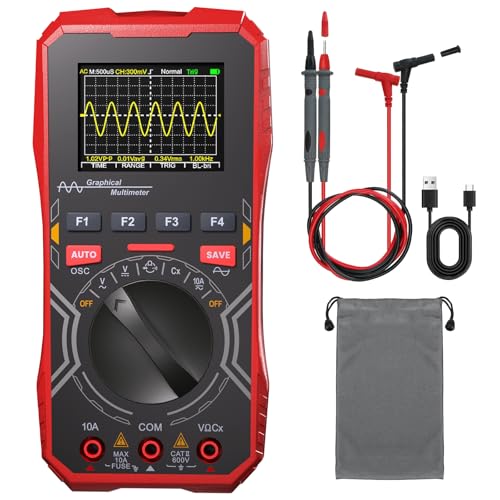
Products shown because their documented specifications fit this guide. Price and availability are on Amazon and can change.
Frequently Asked Questions
What bandwidth does it state?
The product name states 40 MHz. Bandwidth determines the fastest signal the scope can represent accurately, and a common rule of thumb is that you want several times the frequency of the signal you are looking at.
How good is the multimeter side?
The listing states a 20,000 count digital multimeter measuring AC and DC voltage and current, resistance, diode, capacitance and continuity. Twenty thousand counts is higher resolution than most handheld meters, which usually offer 6,000.
How long does the battery last?
The listing states ultra low consumption under 5 W and two 3.7 V 18650 cells of 2200 mAh each, giving about six hours of use, with up to 4.5 hours to charge when switched off.
Are the batteries included?
The listing carries a note that no standalone lithium batteries are sold with the product, which is a shipping restriction. Check what arrives in the box before planning to use it on the day it lands.
Affiliate disclosure: Akermin earns a commission from qualifying Amazon purchases made through links on this page. Our editorial picks are based on documented specifications and owner feedback, not commissions.