As an Amazon Associate, Akermin earns from qualifying purchases. Product links on this page are affiliate links.

ZOTEK · ZOTEK 702S 2 in 1 Handheld Automotive Oscilloscope Multimeter - 10MHz Bandwidth 48MS/s Sampling Rate,Auto-Ranging 9999 Counts T-RMS Multimeter with Temperature Tester for Electronics Repair Test
View on AmazonPrice and availability are shown on Amazon and can change at any time.
Verdict
The ZOTEK 702S is aimed at automotive and general electronics diagnosis, and its listing does something unusual: it publishes almost everything. Bandwidth of 10 MHz, sampling at 48 MS per second, plus or minus 400 V input, vertical sensitivity from 200 mV to 10 V per division, horizontal range from 8 and 50 ns per division out to 20 s per division, 20 ppm time base accuracy, and a full set of multimeter ranges at 9999 counts with True RMS. For a sensor waveform, an injector pattern, a control signal or a ripple check, that is a well specified tool.
Documented Specifications
| Item | Manufacturer listing |
|---|---|
| Bandwidth | 10 MHz |
| Sampling rate | 48 MS per second |
| Input limit | Plus or minus 400 V |
| Vertical sensitivity | 200 mV to 10 V per division |
| Horizontal range | 8 and 50 ns per division to 20 s per division |
| Time base accuracy | 20 ppm |
| Trigger | Auto, normal, single |
| Display | 2.8 inch IPS full view colour |
| Multimeter | 9999 counts, True RMS |
| Meter ranges | AC 0 to 750 V, DC 0 to 999.9 V, current 0 to 9.999 A, resistance to 99.99 megohms, capacitance to 9.999 mF, frequency to 99.99 kHz, temperature -20 to 1000 C |
| Test output | 3 V 1 kHz square wave |
The 400 Volt Input Is the Number to Respect
Every oscilloscope has an input limit, and exceeding it is how scopes die. Publishing it plainly, as this listing does, is genuinely helpful. It also tells you where the instrument belongs: comfortably inside automotive systems, low voltage control circuits, sensor outputs and electronics, and not across a mains supply where transients routinely exceed nominal voltage by a wide margin.
Remember that the limit applies to the peak of whatever you connect, including spikes you did not expect. Inductive kickback from a relay coil or an injector can far exceed the supply voltage, which is exactly the kind of signal an automotive technician wants to look at. Use an appropriately rated attenuating probe when the signal may approach the limit.
Single Trigger Is the Feature Automotive Work Needs
The listing states auto, normal and single triggering. Single is the one that solves real problems: it arms the scope, waits for the event, captures it once and stops. Cranking a starter, activating a solenoid once, catching a fault that happens on a specific action, all of these are single events, and auto triggering will happily overwrite them before you can look.
Combined with a horizontal range that reaches 20 seconds per division, slow mechanical and thermal events can be captured too, which is a wider span than many small scopes offer.
A Genuinely Complete Meter
The multimeter side publishes every range, which makes it easy to check against your work before buying. True RMS at 9999 counts covers general electrical measurement, the resistance range to 99.99 megohms is high enough to see leakage paths, and a temperature range to 1000 C with a thermocouple covers exhaust and component temperatures. Data storage and export are stated too, so a reading or waveform can leave the instrument.
Compensate the Probe First
The 3 V 1 kHz square wave output exists for a reason and is routinely ignored. An uncompensated probe distorts edges, making a clean square wave look rounded or overshooting, and you then spend an hour diagnosing a fault in the probe. Connect to the test output, adjust the probe trimmer until the square wave has flat tops and sharp corners, and only then go and measure something.
Strengths
- Unusually complete published specification, including the input limit.
- Single shot triggering for one-off events.
- Full True RMS multimeter with published ranges.
- Data storage, export and a built-in probe compensation output.
Limitations
- 10 MHz is enough for automotive and control work, not for fast digital or radio frequency.
- 2.8 inch screen is small for comparing detail.
- No safety category rating stated; not for mains measurement.
- No memory depth published, which limits judging long captures.
How It Compares
The OWON HDS242 offers 40 MHz and a 20,000 count meter on a larger screen, for more money. For static measurement only, a good handheld meter such as the Klein MM420 costs far less. Our ranking is in the multimeter roundup.
How We Research
All figures come from the manufacturer listing. We did not run laboratory tests and publish no measurements of our own.
Recommended Tools

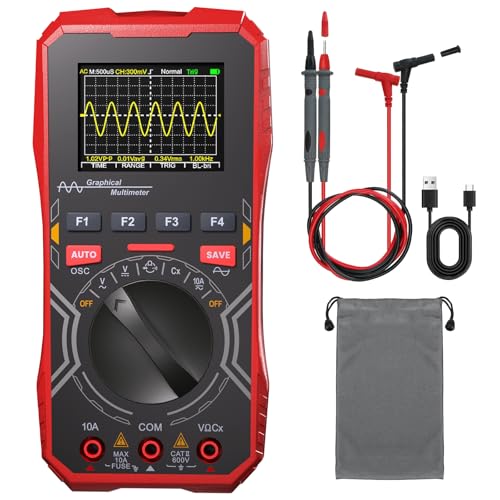
Products shown because their documented specifications fit this guide. Price and availability are on Amazon and can change.
Frequently Asked Questions
What is the sampling rate?
The listing states 48 MS per second with 10 MHz bandwidth. Sampling rate and bandwidth work together: enough samples per cycle are needed to reconstruct the waveform rather than alias it into something misleading.
What is the input voltage limit?
The listing states plus or minus 400 V input on the oscilloscope side. That is a hard limit and the most important number on the page, because exceeding it destroys the input.
What ranges does the multimeter cover?
The listing publishes them: AC voltage 0 to 750 V, DC voltage 0 to 999.9 V, AC and DC current 0 to 9.999 A, resistance to 99.99 megohms, capacitance to 9.999 millifarads, frequency to 99.99 kHz and temperature from -20 to 1000 C, with 9999 counts and True RMS.
Does it output a test signal?
Yes. The listing states a 3 V 1 kHz square wave output, which is what you use to compensate a probe before taking measurements.
Affiliate disclosure: Akermin earns a commission from qualifying Amazon purchases made through links on this page. Our editorial picks are based on documented specifications and owner feedback, not commissions.