As an Amazon Associate, Akermin earns from qualifying purchases. Product links on this page are affiliate links.

KLEIN TOOLS · Klein Tools MM420 Auto-Ranging TRMS Digital Multimeter | 600V AC/DC Voltage, 10A AC/DC Current, 50 MOhms Resistance
View on AmazonPrice and availability are shown on Amazon and can change at any time.
Verdict
The Klein MM420 is a mid-range auto-ranging True RMS multimeter with a sensible function list and one feature worth singling out: LEDs that indicate correct test lead placement. The listing states 600 V AC and DC, 10 A AC and DC current, 50 megohm resistance, plus continuity, temperature, capacitance, frequency and duty cycle and diode test, with a backlit display. It is a good general electrician’s meter and an unusually good first serious meter, because the lead alert addresses the mistake that beginners actually make.
Documented Specifications
| Item | Manufacturer listing |
|---|---|
| Voltage | AC and DC to 600 V |
| Current | 10 A AC and DC via test leads |
| Resistance | To 50 megohms |
| Measurement | Auto-ranging True RMS |
| Other functions | Continuity, temperature, capacitance, frequency and duty cycle, diode test |
| Safety feature | Lead-alert LEDs confirming socket placement |
| Display | Backlit LCD |
The listing does not state a safety category rating, accuracy figures or a count resolution. Confirm the category rating on the datasheet before using the meter on service equipment.
The Feature That Deserves the Attention
The single most dangerous multimeter mistake is measuring voltage with the leads still in the current sockets. In that configuration the meter presents a near short circuit across the supply. On a stiff source the result is an explosion of energy, a destroyed meter and, frequently, an injury. Every experienced user has done it or watched it happen.
The MM420 lights an LED to show which sockets the leads should be in for the selected function. It does not physically prevent the error, and no meter at this level does, but it converts an invisible mistake into a visible one at the moment it matters. For anyone training apprentices, or for a meter shared across a crew, that is worth a great deal more than an extra digit of resolution.
True RMS Is Not Optional Any More
An average-responding meter assumes a sine wave and scales accordingly. Modern loads do not oblige: LED drivers, computer power supplies, variable speed drives and electronic ballasts all draw current in narrow peaks. On those, an average-responding meter reads low, sometimes by a wide margin, and the error is invisible because the display looks perfectly normal. True RMS computes the heating value of the waveform whatever its shape, which is why it has moved from premium feature to baseline expectation.
A 50 Megohm Range Is Genuinely Useful
Most general purpose meters stop at a few megohms. Fifty megohms lets you see leakage paths that a lower range simply reads as open circuit: a damp junction box, a chafed cable, a contaminated terminal block. It is not an insulation resistance test, because that applies 500 V or 1000 V and this meter does not, but it does mean the meter can tell the difference between genuinely open and slightly conductive, which is where intermittent faults live.
Ten Amps Through the Leads Has Limits
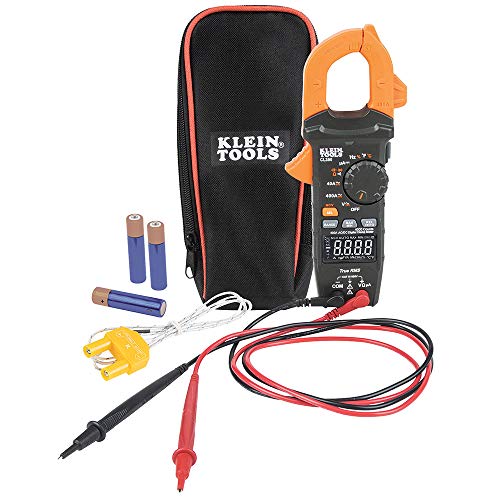
Lead-based current measurement requires breaking the circuit and putting the meter in series. That is fine on a bench, awkward in a panel and impossible on a fixed installation without disconnecting something. A clamp meter measures current without any of that, which is why most electricians carry both. If current is a routine measurement for you, the Klein CL390 is the companion tool.
Strengths
- Lead-alert LEDs addressing the most serious common user error.
- Auto-ranging True RMS as standard.
- 50 megohm resistance range, higher than most meters at this level.
- Broad function list including temperature and capacitance.
Limitations
- No safety category rating stated in the listing bullets.
- No accuracy or count resolution published.
- Current measurement requires breaking the circuit.
- No low pass filter stated for drive output measurement.
How It Compares
The AstroAI 6000 count meter covers a similar function list for less, without the lead alert. The Fluke 87V is the industrial step up, with a published category rating, a low pass filter and 20,000 count resolution. For current without breaking circuits, pair this with a clamp. Our ranking is in the multimeter roundup.
How We Research
All figures come from the manufacturer listing and Klein’s published documentation. We did not run laboratory tests and publish no measurements of our own.
Recommended Tools

Products shown because their documented specifications fit this guide. Price and availability are on Amazon and can change.
Frequently Asked Questions
What is lead-alert protection?
The listing states LEDs on the meter illuminate to indicate proper test lead placement. Putting leads in the current sockets and then touching a live circuit in voltage mode is how meters and people get hurt, so a visual confirmation of socket choice is a genuine safety feature.
What is the current range?
The listing states 10 A AC and DC through the test leads. That is a lead-based measurement, so the circuit has to be broken to insert the meter, unlike a clamp meter.
How high does the resistance range go?
The listing states 50 megohms, which is high for a general purpose meter and useful for checking insulation-adjacent faults, although it is not a substitute for a dedicated insulation resistance tester at 500 V or 1000 V.
Is it True RMS?
Yes. The listing states auto-ranging True RMS, which gives correct readings on the non-sinusoidal currents drawn by LED drivers, switch mode supplies and drive-fed motors.
Affiliate disclosure: Akermin earns a commission from qualifying Amazon purchases made through links on this page. Our editorial picks are based on documented specifications and owner feedback, not commissions.
Related Guides
Ideal Industries 3-Pole Ground Resistance Tester: One Trade-Off Decides the Owner
A mechanism-first review of the Ideal Industries 3-pole ground resistance tester, covering the Fall of Potential trade-off, the unpublished specifications, and where the instrument stops being useful.
Read More→
Fluke 177 True-RMS Digital Multimeter: How It Measures, and What the Listing Leaves Out
A plain explanation of how the Fluke 177 turns a test signal into a reading, what its display and memory features are for, and which specifications buyers must confirm elsewhere.
Read More→
Hioki PD3129 Review: A Non-Contact Phase Rotation Meter and Its Ownership Costs
A single-product review of the Hioki PD3129, focused on its non-contact measurement method, published CAT III 600V rating, and the consumable and maintenance questions the listing does not answer.
Read More→