As an Amazon Associate, Akermin earns from qualifying purchases. Product links on this page are affiliate links.

AstroAI · AstroAI Digital Multimeter, True RMS 6000 Counts Auto-Ranging Volt Meter for Automotive & Home Electrical Troubleshooting, AC/DC Voltage Current Resistance Continuity Capacitance Temperature Tester
View on AmazonPrice and availability are shown on Amazon and can change at any time.
Verdict
The AstroAI True RMS meter is a capable general purpose instrument for automotive and household electrical work, and the listing’s function list is genuinely complete: AC and DC voltage and current, capacitance, frequency, duty cycle, resistance, diode, continuity and temperature, with auto-ranging, True RMS, data hold, a backlit display, auto shut-off and a kickstand. What it does not publish is a safety category rating, and that is the specification that should decide where you use it. As a meter for a car, a bench, an appliance and a household circuit, it does everything most people need. For service equipment and three phase distribution, buy something with a published and certified category rating.
Documented Specifications
| Item | Manufacturer listing |
|---|---|
| Measurement | True RMS for AC current and AC voltage |
| Ranging | Auto-ranging |
| Display | 6000 counts, large backlit LCD |
| Functions | AC and DC current and voltage, capacitance, frequency, duty cycle, resistance, diode, continuity, temperature |
| Convenience | Data hold, auto shut-off, kickstand |
| Safety category | Not stated in the listing bullets |
Why True RMS at This Level Matters
For years the practical difference between a cheap meter and a professional one was that the cheap one lied about AC current on anything other than a heater. Average-responding meters assume a sine wave, and modern loads do not produce one, so a meter without True RMS reads low on LED lighting, computer supplies and drive-fed motors. The error is silent.
A meter at this price stating True RMS on both AC current and AC voltage is therefore doing the important thing correctly. It does not make it a professional instrument, but it does mean the readings it gives you on modern loads are the right kind of number.
The Category Rating Question, Answered Honestly
Safety category ratings describe how much transient energy a meter is designed to survive at a given point in an installation. CAT II is appliance and outlet level, CAT III is distribution, CAT IV is the origin of supply. The ratings exist because a voltage spike on a stiff supply can turn a meter into an arc source, and the measurement that kills is rarely the one you expected.
This listing does not state a category rating. That is not proof the meter is unsafe, but it does mean you have no published basis for using it on a panel or a service, and there is no independent certification quoted. The sensible position is to treat it as a bench, automotive and appliance meter, which is exactly the role the listing itself describes, and to spend the extra on a rated meter for anything upstream of a socket.
The Small Features That Get Used
A kickstand sounds trivial until you are working alone and need the meter to stand up facing you while both hands hold probes. Data hold captures a reading taken in a position where you cannot see the screen. Auto shut-off is the reason the battery is alive next month. A backlit display is the difference between using the meter under a dashboard and giving up. None of these appear in specification comparisons and all of them decide whether a tool is pleasant to own.
Automotive Is Where It Fits Best
Car electrical work is mostly low voltage DC, resistance, continuity and the occasional duty cycle or frequency measurement on a sensor. All of that is inside this meter’s comfort zone, none of it involves the transient energy that category ratings protect against, and the temperature function covers a quick check on a component. For a home mechanic this is a well matched tool.
Strengths
- True RMS on AC current and voltage at an entry level price.
- Complete function list including capacitance, frequency and temperature.
- Auto-ranging with data hold, backlight, auto shut-off and kickstand.
- Well matched to automotive and household troubleshooting.
Limitations
- No safety category rating stated, so not a panel or service meter.
- No published accuracy figures.
- 6000 counts is adequate rather than high resolution.
- No low pass filter for drive output measurement.
How It Compares
The Klein MM420 adds lead-alert LEDs and a 50 megohm range. The Fluke 87V publishes a CAT III 1000 V and CAT IV 600 V rating along with a low pass filter and 20,000 count resolution, and is the right answer for professional distribution work. Our ranking is in the multimeter roundup.
How We Research
All figures come from the manufacturer listing. We did not run laboratory tests and publish no measurements of our own. Where the listing states no safety rating, this review says so rather than assuming one.
Recommended Tools

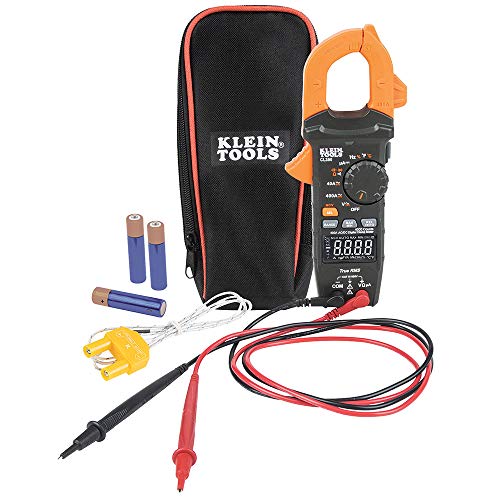
Products shown because their documented specifications fit this guide. Price and availability are on Amazon and can change.
Frequently Asked Questions
Is this meter really True RMS?
The listing states True RMS for both AC current and AC voltage, along with auto-ranging. That is the specification that matters most on modern non-linear loads, and it is unusual to find it at this level.
What does 6000 counts mean?
The display can show up to 6000 increments, so a 600 V range resolves to 0.1 V. Higher count meters resolve smaller changes; 6000 counts is standard for general purpose work.
Is it safe for panel work?
The listing does not state a safety category rating. Without a published CAT rating and independent certification, treat it as a bench and appliance meter rather than one for service equipment or three phase distribution.
Does it measure temperature?
Yes, the listing includes temperature among its functions, along with capacitance, frequency, duty cycle, diode and continuity.
Affiliate disclosure: Akermin earns a commission from qualifying Amazon purchases made through links on this page. Our editorial picks are based on documented specifications and owner feedback, not commissions.
Related Guides

Fluke 116 HVAC Multimeter Review: What the Listing Leaves Out
A review of the Fluke 116 HVAC multimeter that focuses on the specifications the manufacturer listing does not publish and what that silence means for a buyer.
Read More→
Ideal Industries 3-Phase Motor Rotation Tester: One Specification Decides If It Fits
A close read of the Ideal Industries 3-phase rotation tester, built around the one published specification that decides whether it belongs in your kit.
Read More→Meter With Data Logging vs One Without: Which Do You Actually Need?
A guide to what data logging adds to an electrical meter, what it does not, and when the plain meter is the smarter purchase.
Read More→