As an Amazon Associate, Akermin earns from qualifying purchases. Product links on this page are affiliate links.

Fluke · Fluke 87V Industrial Digital Multimeter, for Advanced Troubleshooting, Measures 1000 V AC/DC, Peak Min/Max, Low Pass Filter, Includes TL75 Test Leads, AC175 Alligator Clips, 80BK Temp Probe
View on AmazonPrice and availability are shown on Amazon and can change at any time.
Verdict
The Fluke 87V has been the default industrial multimeter for a long time, and the listing explains why in three bullets: a Fluke-designed low pass filter for accurate frequency measurement on adjustable speed drives, peak capture as fast as 250 microseconds, and switchable display resolution from 6,000 to 20,000 counts, all within a CAT III 1000 V and CAT IV 600 V safety rating. It ships with TL75 leads, AC175 alligator clips and an 80BK temperature probe. Nothing here is flashy; everything here is the thing you need at the moment you need it.
Documented Specifications
| Item | Manufacturer listing |
|---|---|
| Voltage | 1000 V AC and DC |
| Filtering | Fluke-designed low pass filter for adjustable speed drives |
| Transient capture | Peak capture as fast as 250 microseconds |
| Resolution | Switchable 6,000 to 20,000 counts |
| Safety rating | CAT III 1000 V, CAT IV 600 V |
| Supplied | TL75 test leads, AC175 alligator clips, 80BK temperature probe |
| Other | Peak min and max capture |
The Drive Filter Solves a Real and Common Error
A variable speed drive does not output a sine wave. It outputs a rapidly switched voltage whose average, over a cycle, approximates one. Point an ordinary meter at that and it reports a number influenced by the switching frequency rather than the motor frequency, and the value is wrong in a way that looks plausible. Technicians have replaced perfectly good drives on the strength of such readings.
A low pass filter removes the high frequency switching content and leaves the fundamental, which is the quantity that actually matters to the motor. Given how many motors now run on drives, this is not a niche feature; it is the difference between a meter that works on modern equipment and one that does not.
Catching What You Cannot See
A display updates a few times a second. An inrush current, a switching transient or a momentary sag lasts a fraction of a millisecond. Those events cause real faults, and they are invisible to an ordinary meter because they are gone before anything can be shown. A 250 microsecond peak capture records the extreme value even though nobody was watching, which turns “the breaker trips sometimes” into a number.
It pairs naturally with min and max capture over a longer window. Peak finds the spike, min and max find the envelope, and between them a fault that only occurs occasionally becomes describable.
Switchable Resolution Is More Useful Than It Sounds
High resolution is not always better. Twenty thousand counts shows every flicker of a noisy circuit, which makes a reading hard to take. Six thousand counts gives a steadier display for a quick check. Being able to choose means the meter suits both the moment you want a fast answer and the moment you are watching a slow drift. Very few meters offer the choice.
The Rating Is the Reason It Is Allowed on Site
CAT III 1000 V and CAT IV 600 V describe the transient energy the meter is built to survive at defined points in an installation. This is not a marketing number, it is what makes a meter acceptable for distribution level work, and it is the single specification most likely to be checked by a supervisor. Just as importantly, the supplied leads are part of the rated system; a rated meter with unrated leads is not a rated instrument.
Strengths
- Low pass filter for correct drive output measurement.
- Peak capture to 250 microseconds for transient faults.
- Switchable 6,000 or 20,000 count resolution.
- CAT III 1000 V and CAT IV 600 V with rated leads and a temperature probe supplied.
Limitations
- No logging; that is the 289.
- No IP rating; wet and dirty work wants the 87V MAX.
- Current measurement through the leads only, so a clamp is still needed.
- Expensive relative to consumer meters that cover the same basic functions.
How It Compares
The 87V MAX is the sealed and drop-rated version of the same measurement. The 289 adds stand-alone logging and graphical review. The Klein MM420 covers general work for much less without the filter, peak capture or published rating. Our ranking is in the multimeter roundup.
How We Research
All figures come from the manufacturer listing and Fluke’s published documentation. We did not run laboratory tests and publish no measurements of our own.
Recommended Tools


Products shown because their documented specifications fit this guide. Price and availability are on Amazon and can change.
Frequently Asked Questions
What is the low pass filter for?
Measuring the output of a variable speed drive. The listing states it enables accurate frequency measurements on adjustable speed drives. Drive output is a chopped waveform full of high frequency content, and an unfiltered meter reports something that is not the fundamental.
What does 250 microsecond peak capture do?
It records transients far too brief for a display to show. The listing states capture of intermittents as fast as 250 microseconds, which catches inrush spikes and switching events that an ordinary meter averages away.
What does switchable resolution mean?
The listing states 6,000 to 20,000 counts. Higher resolution shows smaller changes, which matters when watching a value drift; lower resolution gives a steadier display for a quick reading.
What is it rated for?
The listing states CAT III 1000 V and CAT IV 600 V, which covers distribution equipment and, within the voltage limit, the origin of an installation.
Affiliate disclosure: Akermin earns a commission from qualifying Amazon purchases made through links on this page. Our editorial picks are based on documented specifications and owner feedback, not commissions.
Related Guides

Hioki PD3129 Review: A Non-Contact Phase Rotation Meter and Its Ownership Costs
A single-product review of the Hioki PD3129, focused on its non-contact measurement method, published CAT III 600V rating, and the consumable and maintenance questions the listing does not answer.
Read More→
Klein Tools RT110 Outlet Tester Review: What the Listing Does Not Say
A close reading of the Klein Tools RT110 listing, covering the published specifications, the missing fault-code table, and where a three-light tester stops being the right tool.
Read More→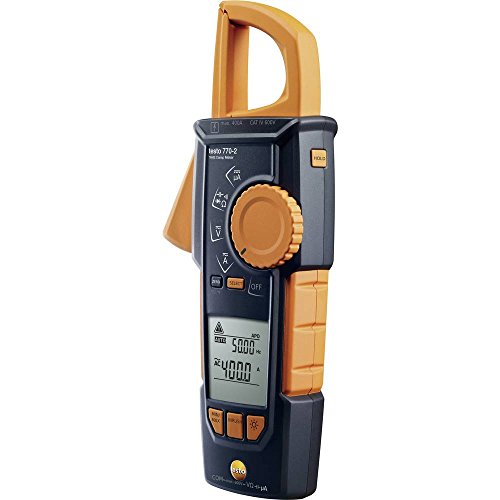
Testo 770-2 Clamp Meter Review: The Hook-Clamp That Decides the Job
A mechanism-first review of the Testo 770-2 hook-clamp meter, including what the listing states, what it omits, and where the hook design stops being the right answer.
Read More→