As an Amazon Associate, Akermin earns from qualifying purchases. Product links on this page are affiliate links.

Fluke · Fluke 177 True-RMS Digital Multimeter
View on AmazonPrice and availability are shown on Amazon and can change at any time.
The Fluke 177 is a true-RMS handheld multimeter. Its listing publishes the display architecture (6000 counts, four digital updates per second, a 33-segment bar graph updating forty times per second), Min/Max/Average memory, Auto Hold and a two-minute auto power-off. It does not publish basic accuracy, voltage or current ranges, input impedance, safety category or battery type. Buy it if you need a true-RMS meter with fast bar-graph response and recording of minimum and maximum readings, and you can obtain the missing electrical specifications from the full datasheet before purchase. Do not buy it on the strength of this listing alone if you need to know its CAT rating or its accuracy on a specific range.
From test lead to display: the measuring chain inside a true-RMS meter
A multimeter does not measure voltage directly. It measures a small current that a known resistance draws from the test signal, or it measures the voltage drop across a known resistance carrying the current you want to know. In the Fluke 177 the input signal passes through a range-setting network, is scaled to a level the analog-to-digital converter can handle, and is then digitised. The listing does not publish the input impedance, the converter resolution in bits, or the accuracy of any range, so the internal scaling cannot be reconstructed from the supplied text. What the listing does publish is the output end of that chain: 6000 counts on the digital display, updated four times per second, and a 33-segment analog bar graph updated forty times per second.
The true-RMS part matters for any waveform that is not a clean sine. A cheap averaging meter rectifies the signal and multiplies by a correction factor that is only correct for a sine wave. A true-RMS converter squares the signal, averages it, and takes the square root, so the reading tracks the heating equivalent of the waveform. That is the number that matters when you are measuring the output of a variable-frequency drive, a dimmer, or a switched-mode power supply. The listing states True-RMS in the product title. It does not state the crest factor the meter can handle, which is the ratio of peak to RMS value at which the RMS conversion stops being accurate. Buyers measuring pulsed loads should treat that as an open question.
The bar graph is not decoration. Forty updates per second is faster than the eye can follow a changing digital number, and it lets you see a trend, a dip or a spike while the digits are still settling. In practice the bar graph is what you watch while probing a terminal that may or may not be live; the digits are what you read once the probe is steady.
What 6000 counts and four updates per second mean at the probe tip
Counts describe the highest number the display can show before it changes range. A 6000-count meter on a 6.000 V range resolves 1 mV; the same meter on a 60.00 V range resolves 10 mV. The listing does not publish the actual ranges, so the resolution at any given voltage cannot be worked out from the supplied text. What can be said is that 6000 counts is a mid-range display resolution: enough to see a 1 mV change on a low-voltage range, not enough to resolve microvolts. The four-per-second digital update is roughly the speed at which a human can read a changing number; the forty-per-second bar graph covers the gap between digital updates.
Minimum, maximum and average memory is the feature that turns a meter into a poor man’s recorder. Press Min/Max and the meter holds the lowest, highest and running average of the readings it has taken. This is useful for catching a voltage sag on a circuit that is switched on and off, or a current spike when a motor starts. It is not a data logger: the listing publishes no memory capacity, no timestamping and no way to export the stored values. If you need a record over hours, this is the wrong instrument class. If you need to know whether a rail ever dropped below a threshold while you were watching, Min/Max is exactly the tool.
Auto Hold is a different behaviour. The display freezes the present reading until the meter detects a new stable input, then beeps and shows the new value. That is useful when the display is not in your line of sight while you are holding probes on a terminal. The listing does not state how long the meter waits before deciding an input is stable, so the delay before the beep is unknown.
The lead reminder, the auto power-off, and the habits they encode
When the rotary switch is moved to or from any amps position, the word Lead appears briefly on the display. This is a reminder that the red test lead must be moved from the voltage socket to the current socket, or back again. It is a small feature that addresses a common failure: measuring current with the lead still in the voltage socket, or measuring voltage with the lead in the current socket and blowing the internal fuse. The listing does not state whether the meter detects the lead position electrically or simply infers it from the switch, so the reminder should be treated as a prompt rather than a guarantee.
The meter turns itself off after two minutes to save battery life, and the listing states that this timeout can be disabled by a power-up option. The two-minute interval is short enough that it will interrupt a slow measurement, so anybody using Min/Max over a longer period will want to disable it. The listing does not publish the battery type or the expected battery life, so the cost of leaving the meter on cannot be estimated from the supplied text.
None of these features change the measurement. They change the probability of a mistake. A lead reminder reduces the chance of a blown fuse; an auto power-off reduces the chance of a flat battery; Auto Hold reduces the chance of misreading a display you cannot see clearly. That is the right way to judge them: as error-reduction, not as accuracy.
Where the listing stops: accuracy, safety category and ranges
The listing publishes no basic DC accuracy, no AC accuracy, no voltage or current ranges, no input impedance, no safety category and no fuse rating. These are the specifications that decide whether a meter is safe and suitable for a given job. A CAT III rating, for example, describes the transient energy the meter can withstand when connected to distribution wiring; a meter without a published rating should not be assumed to have one. The Fluke 177 may well carry a full set of ratings on its datasheet, but this listing does not publish them, and they cannot be inferred from the brand or the model number.
The same applies to the current ranges. The listing mentions amps positions on the rotary switch and the Lead reminder, but it does not state the maximum current, the resolution on each range, or whether there is a separate microamp or milliamp range. A buyer who needs to measure 4-20 mA loop current cannot tell from this listing whether the meter covers it.
The honest position is that this page can describe the mechanism and the display behaviour, and cannot confirm the electrical specifications. Before buying, obtain the full datasheet and check the accuracy on the ranges you will actually use, the safety category for your environment, and the current range if you need one. For a broader view of how these specifications fit together, see how to choose a digital multimeter and what true RMS means on a multimeter.
How the 177 sits against other meters on this site
The Fluke 177 is a general-purpose true-RMS handheld. It is not a clamp meter, so it cannot measure current around a conductor without breaking the circuit; the Fluke 323 clamp meter covers that job for AC current. It is not a power quality analyser, so it cannot record harmonics or three-phase power; the ETCR 8430 listed elsewhere on the site is that class of instrument. It is not a PV-specific meter; the Fluke 283FC PV kit covers photovoltaic commissioning. The 177 is the meter you reach for when you need to know whether a voltage is present, what its RMS value is, and whether it stayed within limits while you were not watching.
Within the Fluke handheld range, the listing does not publish enough to place the 177 precisely against the 117 or the 179. The 177’s distinguishing published features are the 6000-count display, the 33-segment bar graph, Min/Max/Average memory and Auto Hold. A buyer comparing it with the Fluke 117 should check the missing specifications on both datasheets rather than assume a hierarchy from the model numbers.
Should you buy the Fluke 177 on the strength of this listing?
Buy the Fluke 177 if you want a true-RMS handheld meter with a fast bar graph, Min/Max/Average memory and a lead reminder, and you are willing to obtain the accuracy, range and safety specifications from the full datasheet before you spend. The published features are genuinely useful for troubleshooting: the forty-per-second bar graph shows trends the digits miss, and Min/Max catches events that happen between glances. Do not buy it on this listing alone if your work depends on a known safety category or a specific current range, because neither is published here. And do not buy it if you need a logger, a clamp meter or a power quality analyser; those are different instruments, and the 177 does not replace them.
Recommended Tools


Products shown because their documented specifications fit this guide. Price and availability are on Amazon and can change.
Frequently Asked Questions
Does the Fluke 177 measure true RMS?
Yes. True-RMS is stated in the product title. The listing does not publish the crest factor the meter can handle, so accuracy on highly distorted waveforms is not specified in the supplied text.
What is the accuracy of the Fluke 177?
Not stated in the listing bullets. No basic DC or AC accuracy figure is published. Obtain the full datasheet before relying on the meter for a measurement where tolerance matters.
What safety category is the Fluke 177 rated for?
Not stated in the listing bullets. No CAT rating is published. Do not assume a rating from the brand or model number; check the datasheet or the meter's own markings.
Can the Fluke 177 measure current?
The listing mentions amps positions on the rotary switch and a Lead reminder when moving to or from them, so current measurement is present. The maximum current, the resolution and whether there is a dedicated milliamp range are not stated in the listing bullets.
Does the auto power-off interfere with Min/Max recording?
The meter turns off after two minutes by default. The listing states the timeout can be disabled by a power-up option, which is what you would do before leaving the meter in Min/Max mode for a longer period.
Is the Fluke 177 a data logger?
No. It stores minimum, maximum and average readings, but the listing publishes no memory capacity, no timestamping and no export method. For a record over time you need a logging instrument.
Affiliate disclosure: Akermin earns a commission from qualifying Amazon purchases made through links on this page. Our editorial picks are based on documented specifications and owner feedback, not commissions.
Related Guides
Meter With Data Logging vs One Without: Which Do You Actually Need?
A guide to what data logging adds to an electrical meter, what it does not, and when the plain meter is the smarter purchase.
Read More→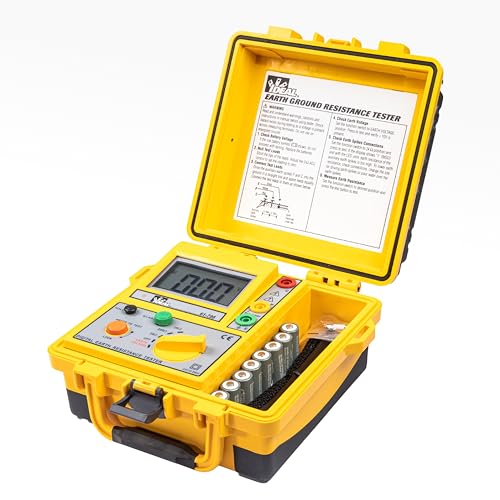
Ideal Industries 3-Pole Ground Resistance Tester: One Trade-Off Decides the Owner
A mechanism-first review of the Ideal Industries 3-pole ground resistance tester, covering the Fall of Potential trade-off, the unpublished specifications, and where the instrument stops being useful.
Read More→
Hioki PD3129 Review: A Non-Contact Phase Rotation Meter and Its Ownership Costs
A single-product review of the Hioki PD3129, focused on its non-contact measurement method, published CAT III 600V rating, and the consumable and maintenance questions the listing does not answer.
Read More→