As an Amazon Associate, Akermin earns from qualifying purchases. Product links on this page are affiliate links.
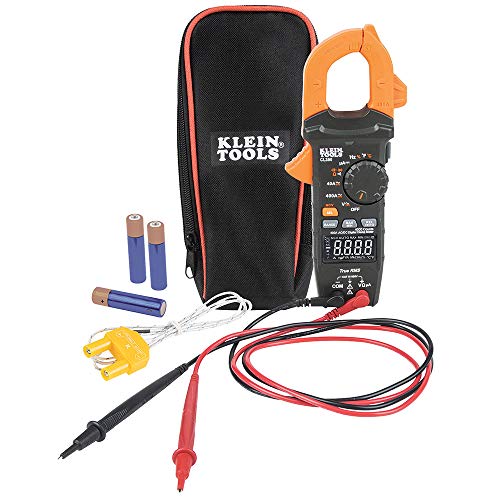
KLEIN TOOLS · Klein Tools CL390 AC/DC Digital Clamp Meter, Auto-Ranging, 400 Amp | NCVT Tester, Hi-Viz LCD Display, TRMS, Continuity Resistance, Temperature and More
View on AmazonPrice and availability are shown on Amazon and can change at any time.
Verdict
The Klein CL390 is a wide-function clamp meter rather than a specialist one. The listing states AC and DC current through the jaw to 400 A, non-contact voltage detection built into the jaw, and, through the test leads, AC and DC voltage, resistance, continuity, frequency and duty cycle, DC microamps, diode test and capacitance, plus temperature with a thermocouple. That combination covers general electrical work, HVAC service and basic automotive diagnosis with one instrument, which is the argument for buying it. If your work is narrow, a cheaper or more focused meter will serve you as well.
Documented Specifications
| Item | Manufacturer listing |
|---|---|
| Current through the jaw | AC and DC, auto-ranging, 400 A |
| Non-contact voltage | NCVT integrated into the clamp jaw |
| Via test leads | AC and DC voltage, resistance, continuity, frequency and duty cycle, DC microamps, diode test, capacitance |
| Temperature | Thermocouple input |
| Display | High-visibility reverse-contrast LCD |
The listing does not publish accuracy figures, jaw opening, safety category rating or resolution. Those are on the datasheet, and the safety rating in particular should be confirmed against the circuits you intend to work on.
DC Current Is the Specification That Dates a Clamp Meter
Ten years ago an AC-only clamp covered most electrical work. It no longer does. Solar arrays, battery storage, electric vehicle equipment, inverter-driven motors and DC control circuits are all growing, and none of them can be measured with an AC clamp. A meter bought today that cannot read DC current through the jaw is a meter that will need replacing, which is why the CL390 stating AC and DC is the first thing worth noting about it.
Auto-ranging matters here too. A clamp that has to be told which range to use slows you down and produces over-range displays at the wrong moment. On a meter with this many functions, taking one decision away from the user is worth having.
The DC Microamp Range Tells You Who This Is For
A DC microamp function appears on very few general purpose meters, and there is essentially one reason it appears on this one: flame rod current on gas heating equipment. A furnace proves its flame by measuring the tiny current the flame conducts, typically a handful of microamps. When that current drops, the furnace shuts down and locks out, and the fault can be a dirty sensor, a poor ground, a cracked insulator or a failing control board.
Without a microamp range you cannot tell those apart, and the usual outcome is replacing the cheapest part and hoping. With one, the diagnosis takes a minute. If you service heating equipment at all, this single function is a strong argument for the CL390 over an otherwise similar clamp.
Non-Contact Voltage in the Jaw
Integrating the voltage detector into the jaw is a small design choice with a practical consequence: the screening step and the measuring step use the same motion. Bring the jaw to the conductor, see whether it lights, then clamp. It replaces the habit of carrying a separate pen detector and, more importantly, it makes the screening step likely to actually happen.
Treat it as a screening tool rather than proof. Non-contact detectors respond to the field around a conductor, so shielded cable, conduit and grounded sheaths can suppress a real signal, and induced voltage on a nearby conductor can produce a false one. Nothing is confirmed dead until a contact measurement says so.
The Long Function List, Used Honestly
Capacitance finds failed motor start and run capacitors, which is one of the most common faults in air conditioning and appliance repair. Frequency and duty cycle confirm whether a circuit is fed from the mains or from a drive, and read PWM control signals. Temperature with a thermocouple covers supply and return air or a component surface. Diode test and continuity cover the basics. None of these are unusual individually; having all of them in one clamp is the point.
Practical Notes
- A clamp reads one conductor. Two conductors of the same circuit in the jaw cancel and read near zero, which is the most common beginner mistake.
- For appliance cords, use a line splitter rather than trying to separate conductors inside the cord.
- Zero the DC current function before measuring. Hall effect sensors drift and a non-zero baseline becomes an error in every reading.
- Confirm the published safety category rating against the installation category you are working in before using it on service equipment.
Strengths
- AC and DC current in the jaw, which keeps the meter relevant for solar, battery and automotive work.
- DC microamps for flame rod diagnosis, rare at this level.
- Non-contact voltage built into the jaw rather than carried separately.
- Reverse-contrast display, which suits dim panels and crawl spaces.
Limitations
- No accuracy figures, jaw opening or safety rating in the listing bullets.
- 400 A is fine for residential and light commercial work and not enough for large services.
- A rigid jaw cannot reach busbars or crowded bundles; that needs a flexible probe.
- No inrush capture stated, which some motor work wants.
How It Compares
The Fluke 323 and 325 are AC-only at the same current rating, so the CL390 covers ground neither can. The Fluke 902 FC and Extech EX623A are the dedicated HVAC clamps, adding thermistor ranges and dual thermocouple inputs. For large conductors and wireless logging, the Fluke 376 FC steps up to 1000 A with a flexible probe. Our ranking is in the clamp meter roundup.
How We Research
Every figure above comes from the manufacturer listing and Klein’s published documentation. We did not run laboratory tests and publish no measurements of our own. Where the listing states nothing, this review says so rather than estimating.
Recommended Tools


Products shown because their documented specifications fit this guide. Price and availability are on Amazon and can change.
Frequently Asked Questions
Does the CL390 measure DC current?
Yes. The listing states AC and DC current through the clamp, which is the specification that separates it from AC-only clamps such as the Fluke 323. DC current matters for solar, battery, automotive and control circuits.
What is the DC microamp range for?
Flame rod current on gas heating equipment, which is measured in microamps. Most general purpose meters cannot resolve it, and without it you end up replacing furnace parts on suspicion.
Is the non-contact voltage detector separate?
No. The listing states NCVT is integrated into the clamp jaw, so the same movement that clamps a conductor can screen it for voltage first.
What is a reverse-contrast display?
Light digits on a dark background. The listing describes it as improving viewability in all lighting conditions, and in practice it is easier to read in a dim panel than a standard dark-on-light LCD.
Affiliate disclosure: Akermin earns a commission from qualifying Amazon purchases made through links on this page. Our editorial picks are based on documented specifications and owner feedback, not commissions.
Related Guides
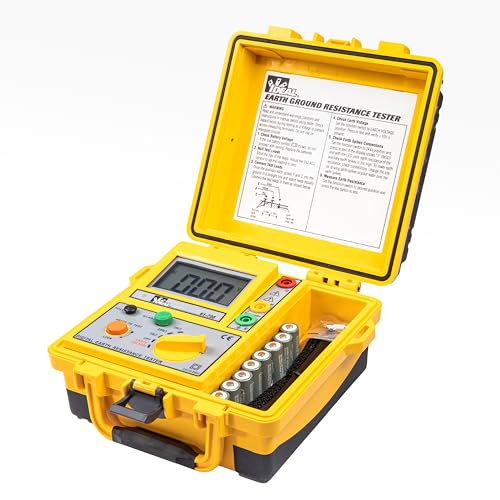
Ideal Industries 3-Pole Ground Resistance Tester: One Trade-Off Decides the Owner
A mechanism-first review of the Ideal Industries 3-pole ground resistance tester, covering the Fall of Potential trade-off, the unpublished specifications, and where the instrument stops being useful.
Read More→
Fluke 177 True-RMS Digital Multimeter: How It Measures, and What the Listing Leaves Out
A plain explanation of how the Fluke 177 turns a test signal into a reading, what its display and memory features are for, and which specifications buyers must confirm elsewhere.
Read More→
Hioki PD3129 Review: A Non-Contact Phase Rotation Meter and Its Ownership Costs
A single-product review of the Hioki PD3129, focused on its non-contact measurement method, published CAT III 600V rating, and the consumable and maintenance questions the listing does not answer.
Read More→