As an Amazon Associate, Akermin earns from qualifying purchases. Product links on this page are affiliate links.
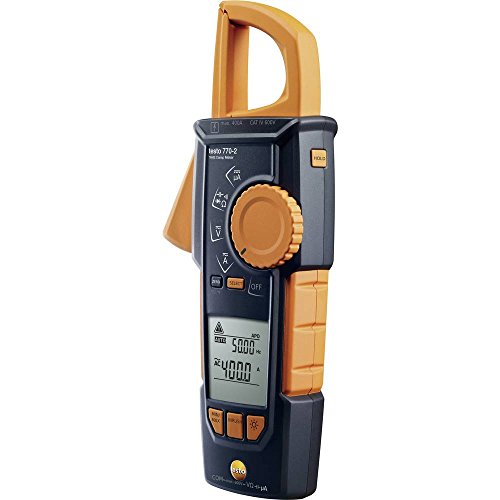
Testo · Testo 770-2 Digital Clamp Meter – Multimeter T-RMS for Hands-Free HVAC Measurements, Current, and Frequency Testing – Voltage Tester incl. Automatic Range Detection and thermocouple Adapter, Black
View on AmazonPrice and availability are shown on Amazon and can change at any time.
The Testo 770-2 is the clamp meter to consider when the deciding problem is access: the listing describes a unique hook-on function that grabs hard-to-access wires without using hands, with a retractable post that releases the wires after testing. It also states True RMS, frequency, inrush, resistance and temperature measurement, and includes a type K thermocouple adapter. The listing does not publish current ranges, jaw size, accuracy figures or a CAT safety rating, so it cannot be matched to a specific panel or feeder from the published data alone. Buy it for HVAC troubleshooting where the hook mechanism earns its place; look elsewhere if you need published current limits or a safety category before you commit.
The hook-on jaw is the specification that decides the job
Most clamp meter reviews start with current range. This one starts with the jaw, because the listing makes the hook-on function the centre of the product. The manufacturer states that the clamp can grab hard-to-access wires without using hands, and that a retractable post releases the wires after testing. That is a mechanical claim, and it changes which jobs the instrument suits before any electrical specification matters.
A conventional clamp meter needs two hands in practice: one to hold the meter and one to open the jaw, or one to hold the jaw open while the other positions the wire. In a crowded control panel, a compressor terminal box or a bundle of capillary tubes, that is often the moment the job becomes awkward. The hook design is aimed at exactly that moment. If your work is mostly accessible feeder cables, the hook adds little. If your work is reaching a single conductor behind a fan motor or inside a packaged unit, the hook is the reason to pick this meter over a cheaper conventional clamp.
The listing does not publish jaw opening dimensions, so you cannot confirm from the published data whether a given busbar or bundle will fit. That is a real gap. Measure the conductor and the space around it before you rely on the hook.
What the listing states about measurement, and what it leaves out
The published bullets describe True RMS readings, frequency, inrush, resistance and temperature measurement. They also state that the meter includes a type K thermocouple adapter, three AAA batteries and a set of measuring cables. Those are the functions a HVAC technician expects from a clamp meter used for electrical troubleshooting alongside temperature checks.
True RMS matters because motor drives, inverters and electronic controls produce non-sinusoidal waveforms. A averaging meter misreads those waveforms; a True RMS meter is designed to report the equivalent heating value. The listing states TRMS, so that function is claimed. Inrush measurement matters for compressor and fan motor starting currents, and the listing states inrush is covered.
What the listing does not publish is just as important. There is no current range, no voltage range, no resistance range, no temperature range, no accuracy specification, no resolution, no jaw opening and no CAT safety rating. Those are the figures a buyer normally uses to match a meter to a task. Their absence does not mean the meter lacks them; it means this review cannot state them, and you should not assume a value from a similar-looking product. If you need a published current limit before you buy, this listing does not give you one.
Where the hook mechanism changes how you work
The retractable post is the part that distinguishes this from a gimmick. The listing states that the post releases the wires after testing. That implies the jaw can be hooked over a conductor and then opened to release it, rather than pulled off. In practice, that suits conductors that are bundled, short or surrounded by other wires, where pulling a conventional jaw free risks snagging.
The trade-off is that a hook-on clamp is a different physical habit. Technicians used to a traditional jaw will need to learn the release action before it becomes quick. The listing gives no indication of how much force the post needs or how the jaw behaves on small conductors, so the ergonomics beyond the stated mechanism are not published.
For work where the conductor is easy to reach, a conventional clamp is simpler and often cheaper. The hook earns its place only when access is the bottleneck. That is the honest dividing line for this instrument.
Temperature and frequency: useful additions, with published gaps
The listing states temperature measurement and includes a type K thermocouple adapter. For HVAC work, that means the same instrument can check supply and return air temperatures or a pipe surface temperature alongside electrical readings. The adapter is a separate part, so the meter is not relying on a built-in sensor.
The listing also states frequency measurement. Frequency is useful when checking motor drives and controls, but the listing does not publish the frequency range or the minimum signal level at which it will read. Those figures matter: a frequency function that needs a strong signal behaves differently from one that reads low-level signals. The listing is silent, so no claim can be made here.
The same gap applies to temperature: the listing states temperature measurement and a type K adapter but does not publish the temperature range or accuracy. A buyer who needs a calibrated temperature reading for a compliance record should not treat the published bullet as sufficient. The adapter is included; the performance figures are not published.
What the Testo 770-2 does not tell you, and why that matters
The most consequential omission is the safety rating. Clamp meters used on electrical systems are classified by CAT rating, which describes the transient energy the meter is designed to withstand. The listing does not state a CAT rating. That does not mean the meter is unsafe; it means this review cannot confirm its suitability for a given panel or feeder from the published data. If you work on industrial power circuits, a published CAT rating is normally a minimum requirement before purchase.
The listing also does not publish current ranges, voltage ranges, resistance range, accuracy, resolution or jaw size. Those are the figures a buyer would use to compare this meter with alternatives. Where the listing is silent, this review says so rather than filling the gap from general knowledge about similar products.
The listing repeats the reliable measurement bullet twice. That is a listing artefact, not a second specification. The scope of delivery is stated once: the 770-2 hook-clamp meter, three AAA batteries, one set of measuring cables and one type K thermocouple adapter.
If you need a meter with published current limits for DC motor checks, a dedicated guide such as clamp meters for DC motor checks will be more useful than this listing. If your work is choosing between clamp and multimeter, multimeter vs clamp meter explains the division of labour.
Where the hook clamp stops being the right answer
The hook design is a solution to access, not to every measurement problem. If you need to log current over time, a clamp meter alone does not do that; a power recorder such as the ETCR8430 covered elsewhere on the site is the different instrument for that job. If you need to check a three-phase system for power quality, the same applies.
If you need a meter that also serves as a general multimeter for bench work, the hook jaw is bulkier than a standard test lead meter and the listing does not publish the full measurement ranges. A dedicated multimeter may be the better second instrument. The guide to multimeters for home and DIY covers that category.
If your work is confined to accessible domestic wiring, the hook mechanism is unlikely to pay for itself. The honest recommendation is to buy the hook only when the access problem is real and recurring.
Finally, the meter is not an alarm and not a substitute for a safety device. It reports readings when you use it; it does not warn you of a hazardous condition on its own.
Verdict: buy the hook, not the badge
The Testo 770-2 is a credible choice when the deciding problem is reaching a conductor in a cramped HVAC enclosure. The listing states a hook-on jaw with a retractable release post, True RMS, frequency, inrush, resistance and temperature measurement, and includes a type K adapter, cables and batteries. It does not publish current ranges, jaw size, accuracy or a CAT rating, so it cannot be matched to a specific panel from the published data alone. Buy it for the access mechanism; if you need published electrical limits before purchase, this listing does not provide them.
Recommended Tools


Products shown because their documented specifications fit this guide. Price and availability are on Amazon and can change.
Frequently Asked Questions
Does the Testo 770-2 measure DC current as well as AC?
The listing does not state whether DC current is measured. It states True RMS, frequency, inrush, resistance and temperature measurement, which are commonly AC-oriented functions, but the listing does not publish a DC current specification. Do not assume DC current capability from the published bullets.
What is the maximum current this clamp meter can read?
The listing does not publish a current range. No maximum current figure can be stated from the supplied data. If you need a known current limit before buying, this listing does not give you one.
Is the Testo 770-2 suitable for industrial panels?
The listing does not publish a CAT safety rating. Without a published rating, this review cannot confirm suitability for a given panel or feeder. For industrial power circuits, a published CAT rating is normally a minimum requirement.
What is included in the box?
The listing states the scope of delivery includes the 770-2 hook-clamp meter, three AAA batteries, one set of measuring cables and one adapter for type K thermocouples.
Can the hook jaw fit around a bundled cable?
The listing does not publish the jaw opening dimensions. The hook-on function is stated to grab hard-to-access wires, but the maximum bundle size is not published. Measure the conductor and the surrounding space before relying on the hook.
Does it measure temperature without a separate probe?
The listing states temperature measurement and includes a type K thermocouple adapter. It does not state that a thermocouple probe is included, so a probe may be needed. The temperature range and accuracy are not published.
Affiliate disclosure: Akermin earns a commission from qualifying Amazon purchases made through links on this page. Our editorial picks are based on documented specifications and owner feedback, not commissions.
Related Guides

Klein Tools RT110 Outlet Tester Review: What the Listing Does Not Say
A close reading of the Klein Tools RT110 listing, covering the published specifications, the missing fault-code table, and where a three-light tester stops being the right tool.
Read More→
Fluke FLUKE-369 FC Leakage Current Clamp Meter Review: What the Listing Leaves Out
A source-led review of the Fluke 369 FC that highlights the unpublished specifications and their practical consequences.
Read More→
HiLetgo LCR-T4 Component Tester Review: The First Hour
A first-hour review of the HiLetgo LCR-T4 kit, covering what it measures, what the listing leaves out, and when a different instrument is the better answer.
Read More→