As an Amazon Associate, Akermin earns from qualifying purchases. Product links on this page are affiliate links.
Verdict
The Classic Plus is the PurpleAir Classic, the dual-counter outdoor sensor that built the PurpleAir map, with an SD card slot added so that readings are logged locally as well as uploaded. That one feature is why research groups and air agencies have deployed it: a sensor at a rural site or a school with patchy Wi-Fi still produces a complete dataset that can be collected on a card. For a homeowner with reliable Wi-Fi the local logging is rarely needed, and the newer Flex with its replaceable modules is the more practical purchase. The Classic Plus is not listed on Amazon US; PurpleAir sells it directly. The closest listed alternative for a permanent outdoor station is the IQAir AirVisual Outdoor.
Who It Is For
- Researchers, students and agencies who need a local record independent of the cloud.
- Sites with unreliable Wi-Fi where gaps in the map data would be a problem.
- Projects that want to keep raw per-channel data for their own analysis.
Documented Specifications
| Item | Documentation |
|---|---|
| Particle sensing | Two laser particle counters, reported as separate channels |
| Reported values | PM1, PM2.5, PM10 estimates and particle counts by size |
| Environment | Temperature, relative humidity, atmospheric pressure |
| Local logging | SD card slot, readings written locally |
| Connectivity | 2.4 GHz Wi-Fi to the PurpleAir map and app |
| Power | Low-voltage USB via outdoor cable |
| Availability | Direct from PurpleAir; not listed on Amazon US |
What Local Logging Changes
A Wi-Fi-only sensor is only as complete as its connection. The Classic Plus writes each reading to the SD card, so an outage, a router reboot or a site with no network at all still yields a continuous file. For a study comparing a sensor with a regulatory monitor over a season, that completeness is essential. It also sidesteps the question of historical data access from PurpleAir’s servers, which now runs on a points-based system: the card holds your data regardless. The trade-off is a maintenance visit to collect the card, which is fine for a research site and unnecessary for a back garden. See choosing an air quality data logger for the general case.
The Dual Counters and Corrections
Like every PurpleAir sensor, the Classic Plus runs two optical counters and reports both. Agreement between channels is the quality check; a divergence marks a counter that needs cleaning or replacement. Because the modules in the Classic design are not user-replaceable, a failed channel eventually means a new sensor, which is the main reason the Flex exists. Optical counters read high in humid air, and public agencies have published correction equations specifically for PurpleAir data; anyone using the SD files for research should apply them. Background is in choosing a PM2.5 monitor.
Installation Notes
Mount under an eave or in a sheltered spot with the inlet facing down, away from vents, chimneys and cooking exhaust, and within Wi-Fi range if you want the map feed as well as the card. Power is low-voltage USB over an outdoor-rated cable. For a study, co-locate the sensor with a reference monitor for a period at the start and end so the correction can be checked for the site. Plan a card-collection schedule that matches the card capacity and the logging interval, and label each sensor and card so files from a fleet do not get mixed up. A spare card per site means the sensor never sits without one while data is being copied.
Strengths
- Complete local record on SD card regardless of connectivity.
- Dual counters with per-channel data for analysis.
- Widely used in published research, so methods and corrections exist.
Limitations
- Not listed on Amazon US.
- Sensor modules are not user-replaceable, unlike the Flex.
- Wi-Fi only; no wired or cellular option.
- No gas sensing and no display.
How It Compares
The PurpleAir Flex trades SD logging for replaceable modules. The PurpleAir Zen is the indoor-or-outdoor consumer model. The IQAir AirVisual Outdoor is the listed alternative with Ethernet, optional cellular and an optional CO₂ module, at a higher price.
How We Research
This review is based on PurpleAir’s published product documentation, published evaluations of PurpleAir sensors by air quality agencies, and owner reports. The Classic Plus is not listed on Amazon US. We did not run laboratory tests.
Recommended Tools
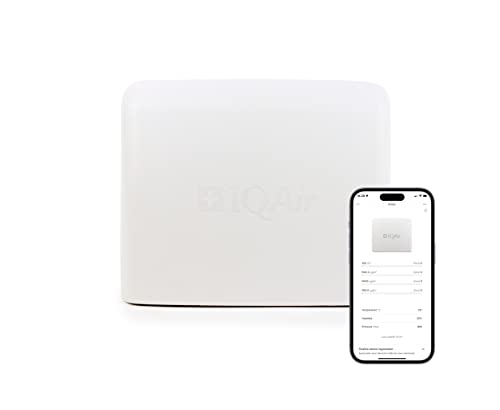
Products shown because their documented specifications fit this guide. Price and availability are on Amazon and can change.
Frequently Asked Questions
What does Plus add to the Classic?
On-board SD card logging. Readings are written to the card as well as sent over Wi-Fi, so a site with poor connectivity still keeps a complete record.
Is it on Amazon US?
Not at the time of writing. PurpleAir sells it directly. The IQAir AirVisual Outdoor is the closest listed alternative.
Should I buy the Classic Plus or the Flex?
The Flex has user-replaceable sensor modules; the Classic Plus has local SD logging. Choose the Flex for long service life and the Classic Plus for sites where Wi-Fi is unreliable and a local record matters.
Does it measure gases?
No. Particles plus temperature, humidity and pressure only.
Affiliate disclosure: Akermin earns a commission from qualifying Amazon purchases made through links on this page. Our editorial picks are based on documented specifications and owner feedback, not commissions.