As an Amazon Associate, Akermin earns from qualifying purchases. Product links on this page are affiliate links.
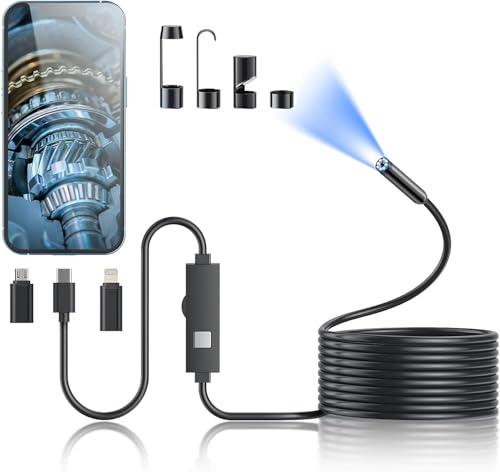
For a technician starting from nothing, the Kinpthy 1920P phone borescope, 16.4 ft is the only complete tool here: a 1920P phone-connected borescope with a semi-rigid 16.4 ft cable and an IP67 probe that the listing says operates underwater to 3.28 ft for one hour. The Teslong triple lens replacement cable, 7.9 and the Teslong dual lens replacement cable, 5.5 are replacement cables for the Teslong NTS500 and NTS300 monitors, so they are picks only if you already own that monitor. Among the two, the Teslong triple lens replacement cable, 7.9 has the longer 10 ft metal gooseneck and a triple lens head at 7.9 mm; the Teslong dual lens replacement cable, 5.5 is the slimmer 5.5 mm dual lens probe for tight access. Buy the Kinpthy 1920P phone borescope, 16.4 ft if you need a working camera today; buy the Teslong triple lens replacement cable, 7.9 or the Teslong dual lens replacement cable, 5.5 if you are extending a Teslong kit you already carry.
Why a replacement probe is not a camera
Two of the three listings here are cables. That sounds like a technicality until you are standing at a job with a probe in your hand and no way to see the image. The Teslong triple lens replacement cable, 7.9 and the Teslong dual lens replacement cable, 5.5 both state plainly that they are replacement camera cables only, that they cannot be used alone, and that they must be compatible with the NTS500 or NTS300 monitor. If you do not own one of those monitors, neither listing gives you a working inspection tool. The cable carries the camera head and the light; the monitor does the imaging, the recording and the battery.
This matters for field work because the failure mode of a borescope is usually the probe, not the screen. The cable gets kinked, the lens gets scratched, the connector corrodes. A technician who already carries a Teslong monitor can replace the probe and keep working. A technician who does not is buying a spare part for a tool they do not have.
If you are building a kit from scratch, look at complete systems rather than probes. Our guide to plumbing inspection cameras covers the standalone options, and the same logic applies to any trade where the camera has to arrive working.
Probe diameter, cable length and the access they decide
Probe diameter is the specification that decides whether a job is possible at all. The Teslong triple lens replacement cable, 7.9 is 7.9 mm, the Teslong dual lens replacement cable, 5.5 is 5.5 mm, and the Kinpthy 1920P phone borescope, 16.4 ft is 7.9 mm. A 5.5 mm head will pass through gaps that a 7.9 mm head will not, which is why the Teslong dual lens replacement cable, 5.5 exists as a separate product rather than a longer version of Teslong triple lens replacement cable, 7.9. If you are looking into a narrow bore, a small valve body or a tight engine crevice, the 5.5 mm probe is the one that fits. If you are inspecting a larger cavity, the wider head usually carries more light and more sensor area.
Cable length sets how far you can reach without moving the machine. The Teslong triple lens replacement cable, 7.9 gives 10 ft, the Kinpthy 1920P phone borescope, 16.4 ft gives 16.4 ft, the Teslong dual lens replacement cable, 5.5 gives only 3.3 ft. The short the Teslong dual lens replacement cable, 5.5 cable is a deliberate trade: a shorter metal gooseneck is stiffer and easier to aim in a tight space, while a long semi-rigid cable like the Kinpthy 1920P phone borescope, 16.4 ft’s can be fed down a pipe or over a duct but is harder to steer precisely at the far end.
The cable material matters as much as the length. The Teslong triple lens replacement cable, 7.9 and the Teslong dual lens replacement cable, 5.5 use a metal gooseneck that folds to shape and holds it, so the probe stays where you point it. The Kinpthy 1920P phone borescope, 16.4 ft uses a semi-rigid cable that the listing says bends freely and remains semi-rigid, unrolling and rolling up quickly. Both approaches are legitimate; the gooseneck holds a shape better, the semi-rigid coil packs away faster.
Water, weather and what IP67 actually promises
All three listings carry an IP67 rating on the probe. IP67 means dust-tight and protected against temporary immersion, but the listings differ in how far they push that claim. The Kinpthy 1920P phone borescope, 16.4 ft states the camera can operate underwater up to 3.28 feet for one hour. The Teslong triple lens replacement cable, 7.9 and the Teslong dual lens replacement cable, 5.5 state the probe is water safe for use in pools, plumbing and the rain, and that the connector is an aerospace type. None of the three listings publishes a depth or duration figure for the Teslong triple lens replacement cable, 7.9 or the Teslong dual lens replacement cable, 5.5, so treat the IP67 on those two as a weather and wet-environment rating rather than a diving rating.
The connector is the part that fails first in the field. A probe rated IP67 at the head can still let water in at the plug if the seal is dirty or the connector is not fully seated. The Teslong triple lens replacement cable, 7.9 and the Teslong dual lens replacement cable, 5.5 both call out an aerospace connector that is water safe, which is the manufacturer’s claim about the joint, not a separate rating. The Kinpthy 1920P phone borescope, 16.4 ft does not describe its connector, so the listing does not publish that detail.
For work in rain, drains or wet plant rooms, the IP67 claim is the one to check against the actual job. A camera that survives a splash is not the same as a camera you leave submerged. If your work involves standing water, the stated one-hour immersion figure on the Kinpthy 1920P phone borescope, 16.4 ft is the only depth and duration the group publishes.
The three listings, and who each one is actually for
Teslong triple lens replacement cable, 7.9 mm, 10 ft
A 10 ft metal gooseneck replacement probe with a triple lens head, for technicians who already run a Teslong NTS500 or NTS300 monitor and want a longer reach or a wider field of view. It is a cable, not a camera system, and the listing is explicit that it cannot be used alone.
Kinpthy 1920P phone borescope, 16.4 ft semi-rigid
The only standalone inspection camera in this group. It connects to iOS 9.0+ or Android 7+ devices through an app, streams 1920×1440 stills and video, and carries a 16.4 ft semi-rigid cable with eight adjustable LEDs. This is the pick for a technician who needs a complete tool with no existing monitor.
Teslong dual lens replacement cable, 5.5 mm, 3.3 ft
The slim-access option. A 5.5 mm dual lens probe with a 90 degree side view that switches while the head stays in place, on a short 3.3 ft metal gooseneck. Again a replacement cable for the NTS500 or NTS300, so it only makes sense as an addition to that kit.
Side view, front view and the triple lens head
The lens count changes what you can see without moving the probe. The Teslong dual lens replacement cable, 5.5 uses a dual lens head with a front camera and an extra 90 degree side camera, and the listing says you can switch between them while keeping the borescope inside the inspection area. That is the whole point of a side view: you find a feature with the front lens, then switch to the side lens to look at the wall of the pipe or the face of the component without withdrawing and re-inserting the probe.
The Teslong triple lens replacement cable, 7.9 goes further with a triple lens head. The listing says it gives more field of view and a clearer image, and that one of the side cameras is a close focus camera for nearer details. That is a useful distinction: a standard side camera is focused further out, so a close focus side lens lets you examine a defect at short range that would otherwise be soft.
The Kinpthy 1920P phone borescope, 16.4 ft is a single lens camera. It has no side view, so any inspection of a pipe wall or a cavity face requires you to rotate or withdraw the probe and re-aim it. That is not a defect in the product, it is a different tool. The listing is honest about it: single lens, 1920×1440 stills and video, eight adjustable LEDs for dark spaces.
If side viewing is central to your work, the mechanism to understand is that a side camera sees at 90 degrees to the shaft, which is exactly the angle you cannot get by pushing a front-view probe forward. Our comparison of borescopes for home inspection goes into when that matters in a building.
The three listings on stated specifications
| Specification | Teslong triple lens replacement cable, 7.9 | Kinpthy 1920P phone borescope, 16.4 ft | Teslong dual lens replacement cable, 5.5 |
|---|---|---|---|
| Type | Replacement cable only | Complete camera | Replacement cable only |
| Probe diameter | 7.9 mm / 0.3 inch | 7.9 mm | 5.5 mm / 0.21 inch |
| Cable length | 10 ft | 16.4 ft | 3.3 ft |
| Cable type | Metal gooseneck | Semi-rigid | Metal gooseneck |
| Lens configuration | Triple lens | Single lens | Dual lens, 90 degree side view |
| Resolution | Not stated in the listing bullets | 1920×1440 stills and video | Not stated in the listing bullets |
| Lighting | Not stated in the listing bullets | 8 adjustable LEDs | Not stated in the listing bullets |
| Waterproof rating | IP67 | IP67, underwater to 3.28 ft for 1 hour | IP67 |
| Requires a monitor | Yes, NTS500 or NTS300 | No, connects to iOS 9.0+ or Android 7+ | Yes, NTS500 or NTS300 |
The table shows the split clearly. The Kinpthy 1920P phone borescope, 16.4 ft is the only row that answers every question on its own. The Teslong triple lens replacement cable, 7.9 and the Teslong dual lens replacement cable, 5.5 leave resolution and lighting unstated because those live in the monitor, not the cable. If you are comparing on specifications alone, the Kinpthy 1920P phone borescope, 16.4 ft is the only listing with a complete published picture.
Where this category stops being the right answer
A borescope is a reach tool. It is the right answer when the problem is physical access: you cannot see inside the pipe, the cavity or the machine without taking it apart. It is the wrong answer when the problem is heat, gas or a measurement you need to record as a number.
None of these three cameras detects temperature. If your job is finding a hot joint, a failing bearing or a leak behind a wall, you need a thermal imager, not a visible-light probe. Our guide to thermal cameras for electrical maintenance covers that class of work. None of these three detects gas either, and none is an alarm. A camera shows you what is there; it does not warn you.
There is also a practical limit to how much you should spend on a probe for a job that a mirror and a torch would solve. If the access gap is wide, the target is lit and you only need a glance, a cheap inspection mirror is faster to deploy than any of these. The camera earns its place when the access is narrow, the target is dark, or you need an image to show somebody else.
Recommended Tools


Products shown because their documented specifications fit this guide. Price and availability are on Amazon and can change.
Frequently Asked Questions
Can I use the Teslong triple lens replacement cable, 7.9 or the Teslong dual lens replacement cable, 5.5 on their own?
No. Both listings state they are replacement camera cables only, that they cannot be used alone, and that they must be compatible with the NTS500 or NTS300 monitor. Without one of those monitors there is no screen, no battery and no recording, so the cable has nothing to connect to.
Which pick has the best chance of surviving a wet job?
All three probes are rated IP67. The Kinpthy 1920P phone borescope, 16.4 ft is the only listing that publishes a depth and duration: underwater up to 3.28 feet for one hour. The Teslong triple lens replacement cable, 7.9 and the Teslong dual lens replacement cable, 5.5 state the probe is water safe for pools, plumbing and rain, and that the connector is an aerospace type, but they do not publish a depth or a time. For standing water, the Kinpthy 1920P phone borescope, 16.4 ft has the only stated immersion figure.
What does the triple lens on the Teslong triple lens replacement cable, 7.9 actually give me over the dual lens on the Teslong dual lens replacement cable, 5.5?
The listing says the triple lens gives more field of view and a clearer image, and that one of the side cameras is a close focus camera for nearer details. The Teslong dual lens replacement cable, 5.5's dual lens gives a front view and a 90 degree side view that you can switch between without moving the probe. The practical difference is that Teslong triple lens replacement cable, 7.9 adds a second side perspective and a close focus channel; the Teslong dual lens replacement cable, 5.5 gives you one side view.
Is 5.5 mm on the Teslong dual lens replacement cable, 5.5 meaningfully different from 7.9 mm?
Yes, for access. The smaller head passes through gaps the 7.9 mm head on the Teslong triple lens replacement cable, 7.9 and the Kinpthy 1920P phone borescope, 16.4 ft will not. That is why the Teslong dual lens replacement cable, 5.5 exists as a separate cable rather than a variant of Teslong triple lens replacement cable, 7.9. The trade is that a smaller head usually carries less light and a smaller sensor, though neither listing publishes lighting or resolution figures for the cable, so the practical difference in image quality is not stated.
Do any of these record video I can show a client?
the Kinpthy 1920P phone borescope, 16.4 ft states it captures 1920x1440 high-quality video and stills through the phone app. The Teslong triple lens replacement cable, 7.9 and the Teslong dual lens replacement cable, 5.5 do not publish resolution or recording details because the imaging happens in the NTS500 or NTS300 monitor, not in the cable. Whether you can record with those two depends on the monitor you pair them with, which the listing does not describe.
What is the biggest mistake buyers make with this group?
Buying the Teslong triple lens replacement cable, 7.9 or the Teslong dual lens replacement cable, 5.5 without owning the Teslong monitor. The listings warn about it in the first bullet, but the product titles read like a complete camera. The second mistake is assuming IP67 means you can leave the probe submerged. Only the Kinpthy 1920P phone borescope, 16.4 ft publishes an immersion depth and time; the other two state weather and wet-environment use.
Affiliate disclosure: Akermin earns a commission from qualifying Amazon purchases made through links on this page. Our editorial picks are based on documented specifications and owner feedback, not commissions.