As an Amazon Associate, Akermin earns from qualifying purchases. Product links on this page are affiliate links.
Short answer: take the CD100A for the 18 inch gooseneck, the tip light and the explicit list of gases, which makes it the better tool for reaching awkward fittings. Take the ET120 for the published ppm range and two sensitivity modes, which make it the better tool for closing in on a leak you have already found.
What Each Listing States
| Item | UEi CD100A | Klein ET120 |
|---|---|---|
| Stated gases | Acetone, ammonia, butane, methane, natural gas, LPG, jet fuel | Range quoted on a methane basis |
| Stated range | Not given in the bullets | About 50 to 10,000 ppm |
| Sensitivity modes | Not stated | High 50 to 1,000 ppm, low 1,000 to 10,000 ppm |
| Probe | 18 inch flexible gooseneck with tip light | Not detailed in the bullets |
| Alarms | Audible and visual, tic rate increases with concentration | Five red LEDs and an 85 dB alarm that intensifies |
| Warm-up | About 10 seconds in open air | Not stated in the bullets |
Reaching and Localising Are Different Problems
Gas leak work has two phases. First you have to get a sensor near the fitting, which in a real house means behind a range, under a water heater, inside a cabinet or along a pipe run in a joist bay. Then you have to work out which of several nearby joints is the source, which means reducing sensitivity until only the hottest spot alarms.
The CD100A is built for the first phase with an 18 inch gooseneck and a light at the tip. The ET120 is built for the second with two sensitivity bands and a five-LED bar that shows relative concentration rather than just alarming. Neither is deficient; they simply lead with different strengths, and most technicians end up using the technique the tool encourages.
Warm-Up Is the Step People Get Wrong
The CD100A listing gives clear instruction: turn on, let it warm up for 10 seconds in open air, then point the gooseneck. That phrase “in open air” is the important half. A combustible gas sensor sets its zero during warm-up, so a detector switched on inside a cupboard that already smells of gas will treat that concentration as normal and stay silent as you sweep. Every sniffer behaves this way. Warm up outside or in a room you are confident about, then bring it to the suspect area.
What the PPM Numbers Mean
The ET120 range of roughly 50 to 10,000 ppm sounds low until you convert it. Methane will not burn until around 50,000 ppm, which is 5 percent by volume, so the entire range of this instrument sits below a tenth of the explosive limit. That is correct and deliberate: a sniffer is for finding leaks long before anything is dangerous, and a detector that only responded near the explosive limit would be useless for the job. See ppm versus LEL in gas detection for the full conversion.
Both Are Locating Tools, Not Alarms
Neither of these instruments watches your house. They are handheld, they are switched off most of the time, and they auto-zero in whatever air they were started in. A property with gas appliances needs a fixed alarm as well, as handheld versus fixed gas detector explains. If you can smell gas strongly, the correct response is to leave and call the utility, not to fetch a sniffer.
Who Buys Which
- HVAC and plumbing service, awkward access: CD100A, for the long gooseneck and tip light.
- Anyone tracing a known leak to a specific joint: ET120, for the two sensitivity bands.
- Homeowner checking accessible fittings: either, or a pocket unit such as the TopTes PT199.
- Anyone who also needs oxygen, CO and H2S: neither; you need a four gas monitor.
How We Research
All figures are quoted from the manufacturer listings. We did not run laboratory tests and publish no measurements of our own. Ranking in the handheld gas leak detector roundup.
Recommended Tools

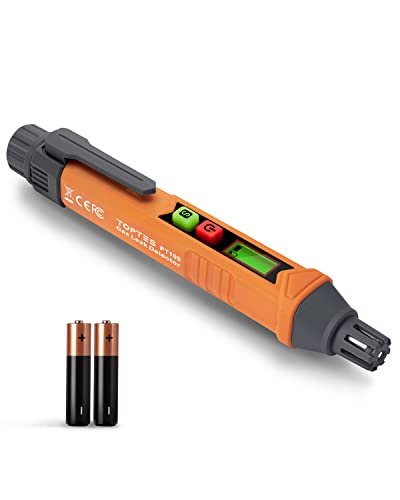
Products shown because their documented specifications fit this guide. Price and availability are on Amazon and can change.
Frequently Asked Questions
Which detects more gases?
The CD100A listing names acetone, ammonia, butane, methane, natural gas, LPG and jet fuel. The ET120 listing states a detection range based on methane and does not enumerate other gases, although combustible gas sensors of this type generally respond to the same family.
What are the ET120 sensitivity modes?
High covers roughly 50 to 1,000 ppm and low covers roughly 1,000 to 10,000 ppm, per the listing. Dropping to low sensitivity in an area where gas is already present is how you walk a leak down to the specific joint.
How long is the warm-up?
The CD100A listing states about 10 seconds in open air. Warm-up matters because the sensor sets its baseline during it, so warming up in contaminated air gives you a detector that ignores the very gas you are hunting.
Which has the better probe?
The CD100A states an 18 inch flexible gooseneck with a tip light. That is a long probe by the standards of this category and the light genuinely helps in a dark cabinet or under an appliance.
Affiliate disclosure: Akermin earns a commission from qualifying Amazon purchases made through links on this page. Our editorial picks are based on documented specifications and owner feedback, not commissions.
Related Guides

Elitech ILD-100H vs Fieldpiece DR58: Two Heated Diode Leak Detectors
Both use heated diode sensors. The Elitech states maximum sensitivity of 0.1 oz per year with three sensitivity levels and a TFT screen; the Fieldpiece states below 0.03 oz per year, IP54 and a 300 hour sensor life.
Read More→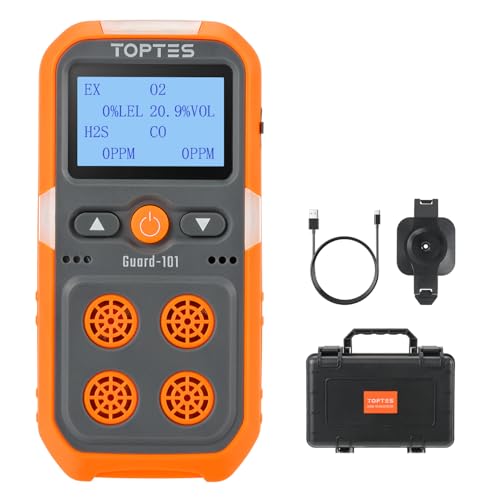
TopTes Guard-101 vs Forensics Detectors 4 Gas Meter: Which Four Gas Monitor?
Both monitor oxygen, carbon monoxide, hydrogen sulfide and combustibles. The Guard-101 states a 14 hour battery and alarm record storage; the Forensics unit states NIST calibration and zero and span calibration options.
Read More→
Klein ET120 vs TopTes Guard-101: A Leak Finder and a Personal Monitor Are Not the Same Tool
The ET120 finds combustible gas leaks from 50 to 10,000 ppm. The Guard-101 is a wearable four gas monitor for H2S, CO, LEL and oxygen with a stated 14 hour battery.
Read More→