As an Amazon Associate, Akermin earns from qualifying purchases. Product links on this page are affiliate links.

VVV-Group · Hot Wire Anemometer AM-286, CFM/CMM HVAC Airflow Meter, Telescopic Probe | 0-30 m/s Air Velocity, CFM/CMM Air Volume, Temperature; Bendable Probe, MAX/MIN/AVG, Data Hold & USB PC Software
View on AmazonPrice and availability are shown on Amazon and can change at any time.
The VVV-Group AM-286 is a hot wire anemometer aimed at duct and vent airflow work, with a remote telescopic probe, airflow volume calculation in CFM or CMM, and USB PC software. The listing publishes the functions and the supported wind speed units but does not publish the measurement range, resolution, accuracy, probe dimensions, operating temperature limits, or whether a calibration certificate is supplied. That silence matters more than the feature list: without a stated accuracy figure you cannot know whether the meter is suitable for commissioning records, and without a stated range you cannot know whether it will read the low velocities where hot wire sensing is supposed to help. Buy it if you need a low-speed duct probe and can obtain the missing specifications from the seller before purchase; do not buy it on the strength of the listing alone if your work requires documented accuracy.
The functions the listing does publish, and the ones it does not
The listing is clear about what the AM-286 is for. It is an airflow meter for technicians measuring inside ducts, vents and exhaust systems, and it is positioned for balancing ventilation, verifying airflow performance and diagnosing weak airflow. It measures air velocity and calculates airflow volume in CFM or CMM once duct area is entered. It has a remote telescopic and bendable probe for reaching into ducts and ceiling diffusers. It uses a hot wire sensor, which the listing says gives stable measurement at low air velocity where vane anemometers lose sensitivity. It supports m/s, km/h, ft/min, knots and mph.
What the listing does not publish is the part a buyer needs to make a decision. There is no air velocity range, no airflow volume range, no resolution, no accuracy figure, no temperature measurement range or accuracy, no probe diameter or maximum extension length, no operating temperature or humidity limits, no battery type or runtime, no storage temperature, no weight or dimensions, and no statement about whether a calibration certificate is included. The title mentions temperature measurement, but the bullets do not give a temperature specification at all.
This is not a small omission. An anemometer is a measuring instrument, and the value of a measuring instrument is bounded by its accuracy and its range. The listing tells you the meter can produce a number. It does not tell you how close that number is to the truth, or over what span of air speeds it is valid.
Why an unpublished accuracy figure is the central problem
Airflow balancing is a comparison task. You measure a diffuser, compare it with a design figure, and adjust a damper until the measured value is close enough. The instrument’s accuracy sets the smallest difference you can trust. If the meter is accurate to plus or minus 3 percent of reading, a 10 percent change is meaningful. If it is accurate to plus or minus 5 percent of full scale on a 20 m/s range, the uncertainty at low speed is large in absolute terms and small adjustments become indistinguishable from instrument noise.
The AM-286 listing gives no accuracy figure at all. It also gives no resolution. That means you cannot calculate the uncertainty of a single reading, and you cannot state a tolerance on a commissioning sheet. For informal diagnostics, such as checking whether a bedroom extract is moving any air, that may be acceptable. For handing a report to a client or a building control inspector, it is not. The listing does not publish the information needed to make that distinction for you, so you have to ask the seller for the accuracy specification and decide whether the answer is good enough for your work.
The same silence applies to the airflow volume calculation. The meter multiplies velocity by duct area, so the volume error inherits the velocity error and adds any error in the area you enter. The listing does not say how area is entered, in what units, or whether the meter stores duct dimensions. Those details affect how repeatable the CFM and CMM figures are between visits.
The low-speed claim and the range that is not stated
The strongest technical statement in the listing is that the hot wire sensor provides stable measurement at low air velocity where vane anemometers lose sensitivity. That is a real property of thermal anemometry: a heated wire loses heat to the passing air, and the small cooling effect at low speed is easier to sense electrically than the slow rotation of a vane. It is the reason hot wire probes are used for face velocity checks on fume hoods and for low-flow diffusers.
But the benefit only exists within a stated range. The listing does not publish the minimum or maximum air velocity the AM-286 can measure. A hot wire sensor that reads down to 0.1 m/s is a different instrument from one that starts at 0.5 m/s, and the listing does not let you tell which you are buying. Nor does it publish the maximum velocity, which determines whether the meter survives a high-velocity duct reading without saturating or being damaged.
This is the point where the listing’s silence is most costly. The low-speed advantage is the reason to choose hot wire over vane. If the minimum readable velocity is not published, the buyer cannot confirm that the advantage applies to the low speeds they actually need to measure. Ask for the velocity range before purchase, and treat any answer that gives only a display resolution as incomplete.
The telescopic probe: reach, diameter and the duct access question
The listing says the probe is extendable and bendable, which lets you measure deep inside ducts, ceiling diffusers and ventilation outlets while keeping the display visible. That is a genuine workflow benefit: a fixed probe forces you to hold the meter body inside the airstream or to guess at the probe position, and a remote probe lets you place the sensor at the measurement point and read the display from outside the duct.
What the listing does not publish is the probe diameter, the minimum and maximum extension length, or the bend radius. Those numbers decide whether the probe will pass through a small test hole in a duct, whether it will reach the centre of a large plenum, and whether the bendable section can negotiate a short radius without kinking. The listing also does not state whether the probe is detachable or permanently fitted, which affects replacement cost if the sensor is damaged.
For routine diffuser work the lack of these figures is inconvenient rather than disqualifying. For duct traverse work, where the probe must reach a set of traverse points through a small access hole, the probe diameter and length are the difference between a usable instrument and one that stays in the case. The listing does not give you the information to make that call.
USB software, temperature and the documentation gap
The title mentions USB PC software and temperature measurement, but the bullets do not describe either in any detail. There is no statement of what the software does, whether it logs, whether it exports, what operating system it runs on, or what cable is supplied. There is no temperature range or temperature accuracy. A buyer planning to record readings over time, or to use the meter for both velocity and temperature, is being asked to accept a function on the strength of a phrase in the title.
The same applies to calibration. The listing does not state whether a calibration certificate is included, whether the meter can be user-calibrated, or what the recommended calibration interval is. For a hot wire sensor this matters because the wire is exposed and can be contaminated or damaged by dust, and its calibration can drift. An instrument without a stated calibration path is harder to trust in any application where the readings are recorded.
If you need a documented calibration out of the box, look at how other instruments in this category handle it. The differential pressure meters used for HVAC work are often supplied with a certificate, and the same question should be asked of any anemometer before it is used for commissioning records.
Where the AM-286 fits, and where it does not
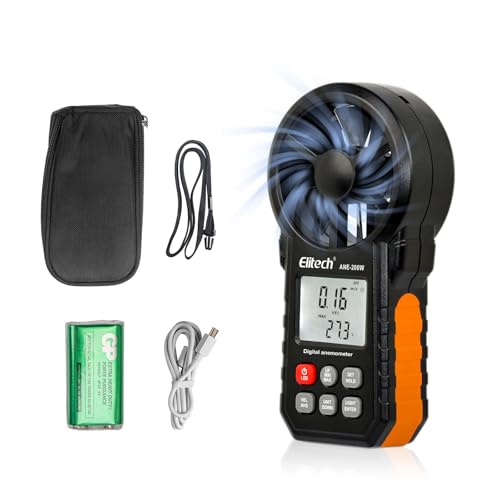
The AM-286 is a reasonable candidate for a technician who needs a low-speed duct probe with a remote telescopic head and airflow volume calculation, and who is willing to obtain the missing specifications from the seller before relying on the readings. It is aimed at the same work as the other HVAC anemometer on this site, the Elitech ANE-200W, which the listing describes as an air flow and temperature meter with Bluetooth. The AM-286’s distinguishing stated feature is the hot wire sensor and the telescopic probe; the Elitech’s stated feature is Bluetooth. The listings do not publish enough common specifications to compare accuracy or range between the two.
It is not the right instrument if you need a calibration certificate supplied as standard, if you need a published accuracy figure to put on a report, or if you need to know the velocity range before you buy. In those cases the listing’s silence is a genuine obstacle, not a marketing gap. The broader question of which sensing technology suits which HVAC task is covered in how to choose an anemometer for HVAC work, and the AM-286 should be judged against that framework rather than against its feature list alone.
For room-level air quality work rather than duct airflow, an anemometer is the wrong class of instrument entirely; the environmental monitoring devices covered elsewhere on the site address a different measurement problem. The AM-286 measures velocity in a duct. It does not measure air quality, and the listing makes no such claim.
The verdict on a meter sold without its numbers
The VVV-Group AM-286 is a plausibly useful HVAC anemometer whose listing withholds the specifications that would let a buyer judge it. The hot wire sensor, telescopic probe and CFM/CMM calculation are the right functions for duct and vent work, and the low-speed claim is consistent with how thermal anemometry behaves. But the listing publishes no velocity range, no accuracy, no resolution, no temperature specification, no probe dimensions and no calibration statement. That silence makes the AM-286 a conditional buy: suitable for informal diagnostics where the user can obtain the missing figures from the seller, and unsuitable for commissioning or reporting work until those figures are known and acceptable. Do not treat the feature list as a substitute for the accuracy specification, because for a measuring instrument it is not.
Recommended Tools


Products shown because their documented specifications fit this guide. Price and availability are on Amazon and can change.
Frequently Asked Questions
Does the listing state the air velocity range of the AM-286?
No. The listing describes the hot wire sensor as suitable for low air velocity but does not publish a minimum or maximum velocity. Without that range you cannot confirm whether the meter reads the low speeds where hot wire sensing is supposed to help.
What accuracy does the AM-286 have?
The listing does not publish an accuracy figure. That means you cannot calculate the uncertainty of a reading or state a tolerance on a commissioning sheet. Ask the seller for the accuracy specification before relying on the meter for documented work.
Is a calibration certificate included?
The listing does not say. It also does not describe a user calibration procedure or a recommended calibration interval. For a hot wire sensor, which is exposed to dust and can drift, the absence of a stated calibration path is a real limitation.
Does the AM-286 measure temperature?
The title says temperature measurement, but the bullets publish no temperature range or accuracy. The function is named without being specified, so treat the temperature feature as unconfirmed until the seller provides the figures.
What does the USB PC software do?
The listing does not describe it. There is no statement of logging, export, operating system support or supplied cable. The software is mentioned in the title only.
How does it compare with the Elitech ANE-200W?
Both are HVAC anemometers, but the listings do not publish enough common specifications to compare accuracy or range. The AM-286's stated distinguishing feature is the hot wire sensor and telescopic probe; the Elitech's is Bluetooth. Choose on the feature you need and on the specifications you can obtain from each seller.
Affiliate disclosure: Akermin earns a commission from qualifying Amazon purchases made through links on this page. Our editorial picks are based on documented specifications and owner feedback, not commissions.