As an Amazon Associate, Akermin earns from qualifying purchases. Product links on this page are affiliate links.
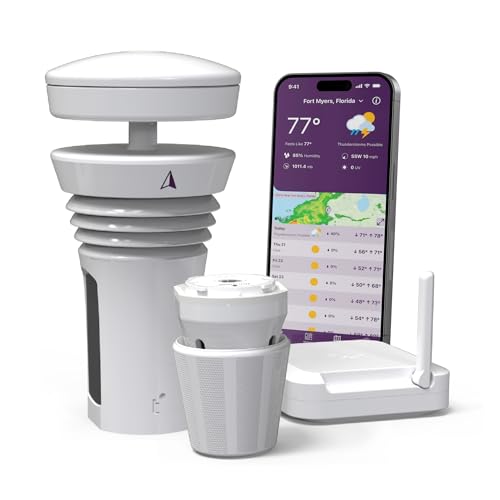
WeatherFlow · Tempest Weather Station with Built-in Wind Meter, Rain Gauge, and Accurate Weather Forecasts, Wireless, App and Alexa Enabled
View on AmazonPrice and availability are shown on Amazon and can change at any time.
A single solar powered outdoor unit reporting temperature, humidity, barometric pressure, wind speed and direction, dew point, solar radiation, UV index, lightning strikes and rainfall, built with no moving parts, transmitting wirelessly over more than 1,000 feet with updates every 3 seconds, and integrating with Alexa, irrigation controllers and automation platforms. The design decision in the fourth bullet is the interesting one, because removing the moving parts changes how two of those quantities are sensed. The gap is that five bullets name ten quantities and publish no range, resolution or accuracy for a single one of them.
No moving parts changes the measurement, not just the servicing
The fourth bullet sells the absence of moving parts as maintenance: years of near zero attention and reliable performance in any environment. That is true as far as it goes, and it undersells what has actually happened.
A conventional station measures wind with a cup anemometer and a vane, and rain with a tipping bucket. All three are mechanical, and all three fail in known ways. Cup bearings dry out and read progressively low. Vanes stick in the direction they were last pushed. Tipping buckets block with leaves, grit and insects, and freeze.
Remove the moving parts and those failure modes go with them. In their place come different measurement methods with different characteristics, which is why this is a metrology decision rather than a durability one. Wind is timed acoustically. Rain is inferred from impacts. Neither behaves quite like the mechanism it replaced, and a buyer comparing this against a cups and bucket station is comparing methods, not just build quality. Our overview of ultrasonic anemometers covers the wind side in more depth.
Rain without a bucket has to be inferred
Of the two substitutions, rainfall is the one that deserves scrutiny, because the mechanical version is so direct.
A tipping bucket is a volumetric measurement. Water lands in a funnel of known area, fills a chamber of known volume, and the chamber tips. Count the tips and you have measured collected water, which is as close to a primary measurement as a garden instrument gets. Its weaknesses are mechanical and well understood: it undercounts in very heavy rain while the bucket is in motion, and it stops entirely when blocked.
An impact sensor measures something else. Each drop striking the housing produces a small vibration, and rate and accumulation are derived from the pattern of those events. The appeal is obvious, since there is no funnel to block, nothing to freeze and nothing to level. The consequence is that the output depends on a model of what a drop looks like when it hits, which is why mounting rigidity matters, why wind driven rain arriving at an angle is harder, and why hail is a different signal from rain.
None of that makes it a worse instrument. It makes it an inferential one, and the listing publishes no rainfall accuracy, no resolution and no statement of behaviour in heavy rain or hail, which is exactly where the method differs most from a bucket. Anyone who needs rainfall totals to be defensible should ask for those figures. See rain gauges for the mechanical alternative.
Ten quantities, and not all of them are sensors
The second bullet reads as a sensor list, and it is not quite that. It is a list of outputs, which is a different thing.
- Dew point is calculated, not measured. It follows from temperature and relative humidity through a standard formula, so it adds no sensor and inherits the error of the humidity channel. Our note on calculating dew point shows the arithmetic.
- UV index is a weighted scale rather than a physical unit. It comes from a sensor, then from a weighting that describes how different wavelengths affect skin, so two instruments can disagree while both measure correctly.
- Lightning strikes are counted events, not a measured quantity. Consumer detection works by sensing the electromagnetic impulse of a discharge, and the honest specification for such a thing is a detection range and a false count behaviour. Neither is stated.
- Temperature, humidity, pressure, wind and solar radiation are direct measurements, and they are the five that would carry accuracy figures if any were published.
Separating these matters because a long list of outputs reads as a long list of instruments. Ten entries here rest on a smaller number of sensors plus some processing, and that is normal and worth knowing rather than scandalous.
Three seconds is a wind specification
Updates every 3 seconds sounds like an app feature and is really about gusts.
Wind is not a steady quantity. It arrives in bursts, and the difference between a mean speed and a gust is the difference between a pleasant afternoon and a damaged fence. The meteorological convention for a gust is a short duration peak, conventionally averaged over about three seconds, precisely because that is the timescale over which a burst of wind does work on a structure. A station reporting at that cadence can therefore capture gusts rather than smoothing them away, which a station reporting a one minute average cannot.
What is missing is the surrounding detail: whether the figure reported is an instantaneous value or an average, over what period the mean wind is computed, and how a gust is defined in the data. Those definitions are what make two stations comparable, and none of them appear. The same applies to the wireless figure, where more than 1,000 feet is stated with no indication of the conditions, which for an unlicensed radio link means line of sight across open ground rather than through two walls and a hedge.
One housing for every sensor
| Specification | Published in the listing |
|---|---|
| Quantities reported | Temperature, humidity, barometric pressure, wind speed, wind direction, dew point, solar radiation, UV index, lightning strikes, rainfall |
| Construction | No moving parts, single device |
| Power | Solar powered outdoor sensor |
| Wireless range | More than 1,000 feet |
| Update interval | Every 3 seconds |
| Integrations | Amazon Alexa, Rachio, IFTTT and other smart home platforms |
| Accuracy, any quantity | Not stated in the listing bullets |
| Measuring range, any quantity | Not stated in the listing bullets |
| Rainfall resolution | Not stated in the listing bullets |
| Lightning detection range | Not stated in the listing bullets |
| Radiation shielding or ventilation of the temperature sensor | Not stated in the listing bullets |
| Gust and mean wind averaging definitions | Not stated in the listing bullets |
| Local access or storage without the service | Not stated in the listing bullets |
| Data export and history retention | Not stated in the listing bullets |
| Operating temperature limits | Not stated in the listing bullets |
The row worth dwelling on is shielding. One housing has to do four incompatible things: sit in the open air for the anemometer, present a panel to the sun for power, catch rain for the gauge, and keep a thermometer out of the sun. The first two argue for exposure and the last argues for shade, and every all in one station resolves that tension somehow. This listing does not say how, which makes siting and shading the buyer problem and makes a sanity check against a shaded thermometer worthwhile after installation.
It is also fair to note what the first bullet spends itself on. Press mentions and a user count occupy the position where a specification table would normally start, and across all five bullets the word accurate appears without a number attached to it anywhere.
The garden this earns its place in
For a household that wants its own weather rather than the airport version, this is a strong proposition and the no moving parts design is the reason. Nothing to clean, nothing to oil, nothing to unblock, one mounting job, and a reading cadence fast enough to catch the gust that took the parasol. The integrations make it genuinely useful rather than decorative, since irrigation that skips a cycle after real rain in your own garden saves more water than any forecast.
For anyone who needs the numbers to be defensible, whether that is a grower making spray decisions, a site recording conditions against a contract, or a citizen science network feeding a database, the absence of any published accuracy, range or resolution is the obstacle, and the rainfall channel is where it matters most. Establish those figures in writing first, and compare against the mechanical options in our weather station guide.
Recommended Tools


Products shown because their documented specifications fit this guide. Price and availability are on Amazon and can change.
Frequently Asked Questions
How does a station with no moving parts measure wind?
By timing sound rather than by turning. A sonic anemometer sends ultrasonic pulses between fixed transducers and measures how long each takes to arrive. Air moving along the path speeds the pulse one way and slows it the other, and the difference gives both speed and direction with nothing to spin. The gains are real: no bearings to seize, no cups to shed, no vane to stick, and no stall speed below which light airs read as calm. The listing states the design has no moving parts and does not publish a wind range or accuracy.
How is rainfall measured without a tipping bucket?
By sensing impacts. A tipping bucket is a tiny mechanical scale: rain fills a chamber, the chamber tips at a known volume, and the station counts tips, so the measurement is of collected water. An impact sensor instead detects each drop striking the housing and infers rate and total from the pattern of those strikes. It needs no funnel and cannot block or freeze solid, which is a genuine advantage. It is also sensitive to how rigidly the unit is mounted, to wind driven spray and to hail, and this listing publishes no rainfall accuracy figure to judge it by.
Is dew point measured or calculated?
Calculated. Dew point is the temperature at which the air currently in front of the sensor would become saturated, and it follows directly from temperature and relative humidity through a standard formula. No separate sensor is involved, which means the dew point figure inherits every error in the humidity reading and amplifies it at the extremes. That is worth knowing when reading the bullet that lists ten quantities, because the list mixes sensed values with derived ones and does not distinguish between them.
Does an all in one station need a radiation shield?
Every thermometer outdoors does. Direct sun warms a housing well above air temperature, and a sensor inside that housing reports the housing rather than the air, which is why meteorological thermometers sit inside ventilated screens. An all in one unit has a harder problem than a separate screen, because the same enclosure also has to present a solar panel to the sun, hold an anemometer in clear air and catch rain. The listing does not state what shielding or ventilation is used, so siting matters: shade for the sensor, exposure for the wind, and those two pull in opposite directions.
What works without the app or an internet connection?
The bullets do not say. They describe app and Alexa operation plus integrations with irrigation and automation platforms, all of which imply a service between the sensor and the display. What is not stated is whether readings can be seen or stored locally if that service is unreachable, nor how much history is retained or in what form data can be exported. For a station bought to build a record of a particular garden or field, those are the questions to settle before buying rather than after.
Affiliate disclosure: Akermin earns a commission from qualifying Amazon purchases made through links on this page. Our editorial picks are based on documented specifications and owner feedback, not commissions.