As an Amazon Associate, Akermin earns from qualifying purchases. Product links on this page are affiliate links.
Indoor air is often worse than outdoor air for a simple reason: a building is a small enclosed volume with many sources inside it and a slow exchange with the outside. People add CO₂ and moisture, cooking adds particles and nitrogen dioxide, furniture and cleaning products add VOCs, and soil adds radon, while only a fraction of the air is replaced each hour. Outdoors, the same emissions disperse into an effectively infinite volume. The result is that CO₂ and VOC levels indoors are almost always higher than outside, and particle levels are higher whenever there is an indoor source.
Volume and air-change rate
A typical home holds 200 to 400 m³ of air. Modern homes exchange roughly 0.3 to 0.5 of that volume with outdoors per hour through leakage and ventilation; older, draftier homes exchange more; sealed offices and bedrooms with the door shut exchange far less. Anything emitted indoors is diluted only by that slow trickle. Outdoors, wind replaces the air around a source continuously.
The sources
- People: CO₂, water vapor, and a mix of organic compounds from breath and skin. Two adults raise a closed bedroom to 2,000 ppm overnight; see why indoor CO₂ rises overnight.
- Cooking: PM2.5 from frying and roasting, CO₂ and nitrogen dioxide from gas flames. Cooking is the largest particle source in most homes; see can cooking affect a CO₂ monitor reading.
- Combustion: candles, incense, wood stoves and unvented heaters produce particles, CO and CO₂.
- Materials: pressed-wood furniture, carpet, paint, adhesives and vinyl release formaldehyde and other VOCs for months.
- Cleaning and personal care: solvents and fragrances; see why air quality changes after cleaning.
- Soil: radon seeps through floors and accumulates in ground-floor and basement rooms.
- Moisture: showers, cooking, drying laundry and breathing raise humidity, which encourages mold and dust mites.
The tight-building effect
Energy-efficiency retrofits and modern construction seal the leaks that used to ventilate homes accidentally. That is good for heating bills and bad for air unless ventilation is added deliberately. Homes built or renovated to high airtightness standards without mechanical ventilation are the ones where monitors show the highest CO₂ and VOC readings.
When outdoor air is worse
Beside a major road, near industry, or during wildfire smoke and winter inversions, outdoor PM2.5 can be far higher than indoor levels. Then the building’s slow exchange works in your favor: closed windows and a purifier keep indoor particles down while CO₂ rises. Deciding which matters is the core trade-off of ventilation; see CO₂ vs PM2.5.
Typical indoor versus outdoor numbers
| Pollutant | Typical outdoor (clean day) | Typical indoor (occupied, closed) |
|---|---|---|
| CO₂ | 420 ppm | 800 to 2,500 ppm |
| PM2.5 | 5 to 15 µg/m³ | 5 to 15 µg/m³ baseline; 50 to 300 while cooking |
| Formaldehyde | Under 5 µg/m³ | 20 to 100 µg/m³ in newer or furnished homes |
| Radon | Near zero | Highly variable; 20 to 200+ Bq/m³ depending on ground and floor |
| Relative humidity | Weather-dependent | Often 50 to 70% in bedrooms and bathrooms |
What to measure
CO₂ first, because it tracks the air-change rate that governs everything else. Then PM2.5 if you cook indoors or live near traffic, VOC if the home is new or recently furnished, radon on ground floors, and humidity everywhere. Combination monitors that read several of these are compared in the office air quality guide and the best CO₂ monitors guide.
Recommended Tools

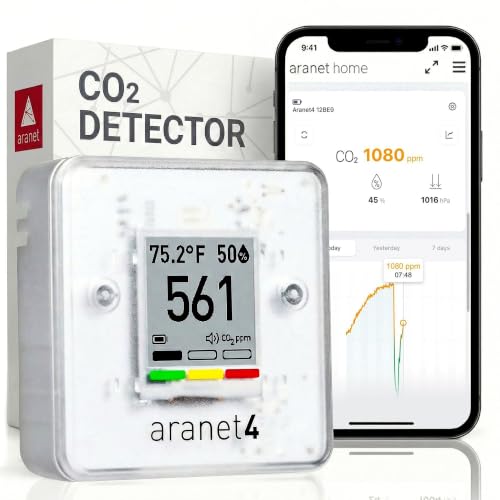
Products shown because their documented specifications fit this guide. Price and availability are on Amazon and can change.
Frequently Asked Questions
Is indoor air really worse than outdoor air?
For CO₂ and VOCs, almost always. For particles it depends on location: indoor air is usually cleaner beside a busy road or during smoke events, and dirtier during cooking or candle use.
Why do newer homes have worse indoor air?
They are built tighter for energy efficiency, so less outdoor air leaks in. Without deliberate ventilation, everything produced indoors accumulates.
Which single measurement best shows indoor air problems?
CO₂. It tracks air exchange directly and rises with every other indoor pollutant that people and their activities produce.
Affiliate disclosure: Akermin earns a commission from qualifying Amazon purchases made through links on this page. Our editorial picks are based on documented specifications and owner feedback, not commissions.