As an Amazon Associate, Akermin earns from qualifying purchases. Product links on this page are affiliate links.
For tracking smoke itself, the Temtop M100 2nd with P1 sensor is the strongest pick because it pairs a stationary PM2.5, PM10 and CO2 hub with a portable PM2.5 sensor you can carry to a different room or into a car, and both particle channels are stated in the listing. The Airthings 2960 View Plus is the better choice if you want one always-on unit that also watches radon and VOCs, since it measures PM2.5 alongside CO2 and volatile organic compounds. The AirWhisper 16-in-1 Indoor Air Quality Monitor is the budget option for spot checks, with PM1.0, PM2.5 and PM10 on a rechargeable handheld. The Aranet4 Indoor Air Quality Monitor is not a smoke monitor at all: it measures CO2, temperature, humidity and pressure, which is the right instrument for the sealed-window ventilation problem that smoke season creates, not for the particles themselves.
Why smoke tracking is a particle job, not a CO2 job
Wildfire smoke is a mixture, but the part that travels hundreds of miles and gets into a house is fine particulate matter, mostly in the PM2.5 band and below. That is the fraction that penetrates closed windows, settles into soft furnishings, and is small enough to reach the deep lung. So the instrument that answers the question is smoke getting in has to have a particle sensor, and it has to be a real optical particle counter rather than an inferred air quality index.
This is where most indoor monitors fail the task. Plenty of units sold as air quality monitors measure CO2, temperature, humidity and total VOC, and then display a composite score they call AQI. That score can move when smoke arrives, because some smoke compounds register as VOCs, but it is a proxy. It cannot tell you the particle concentration, it cannot tell you whether a filter is working, and it cannot be compared with the outdoor PM2.5 number your local authority publishes. If you want to match indoor readings against an outdoor smoke plume, you need a PM2.5 channel.
The CO2 side is not irrelevant. Once you close the windows to keep smoke out, the room stops ventilating, and CO2 climbs. That is a real health and comfort problem, and it is the one thing a particle-only monitor will not show you. The honest framing is that smoke season creates two measurement jobs: particles coming in, and stale air building up because you sealed the house. Very few instruments do both well. Of the four here, the Airthings 2960 View Plus and the Temtop M100 2nd with P1 sensor cover both; the AirWhisper 16-in-1 Indoor Air Quality Monitor covers both in a handheld; the Aranet4 Indoor Air Quality Monitor covers only the second.
What the listings actually publish, and what they do not
None of these listings publish a particle measurement accuracy figure, a lower detection limit, or a calibration method. That is normal for consumer instruments and it matters, because it means you should read the numbers as trend data, not as reference measurements. A monitor that reads 8 micrograms per cubic metre in a clean room and 60 when the plume arrives is doing its job even if the absolute value is off by a few micrograms. Do not buy any of these expecting to certify a space.
The Airthings 2960 View Plus states PM2.5 only, with the sensor type listed as electrochemical, which is the chemistry normally used for the gas channels rather than for particles. The listing does not break out a separate particle sensor type. It also states an operating temperature of 4 to 40 degrees Celsius, which is worth noting: a unit left on a porch in cold weather is outside its stated range.
The Temtop M100 2nd with P1 sensor states PM2.5 and PM10 on both the M100 2nd hub and the portable the Airthings 2960 View Plus, and describes the Airthings 2960 View Plus as lab-grade, which is a marketing phrase rather than a published specification. The AirWhisper 16-in-1 Indoor Air Quality Monitor states PM1.0, PM2.5 and PM10 and a 1.5 second sampling interval, which is the update rate of the display, not an accuracy claim. The Aranet4 Indoor Air Quality Monitor states no particle channel at all, which is the point of listing it here.
One more thing the listings do not publish: any of these units’ response to humidity. Optical particle sensors are known to be affected by high humidity, because water droplets scatter light much as smoke particles do. In a damp house during a smoke event, readings can drift upward. Nothing in the supplied data addresses this, so treat it as a known limitation of the technology rather than a fault of any one product.
The picks, and what each one is actually for
Aranet4 Indoor Air Quality Monitor
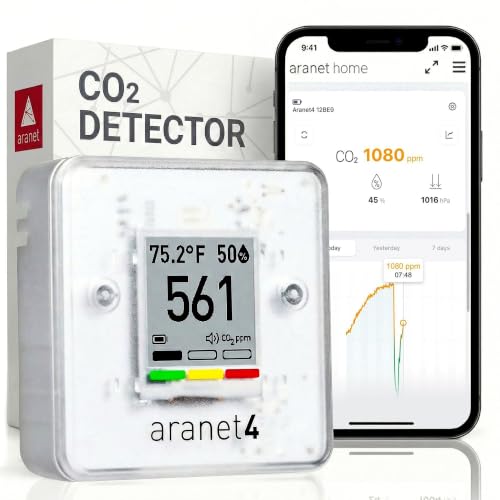
Not a smoke detector. It measures CO2, temperature, humidity and atmospheric pressure, which is what you need once the windows are shut and you want to know whether the room is still ventilated. The e-ink display and up to four-year battery life mean it can sit on a shelf through a smoke event without a cable or a charger.
Airthings 2960 View Plus
The always-on option that covers both halves of the problem. It measures PM2.5 for the smoke, plus CO2 and VOCs for the stuffy-room side, and adds radon, humidity, temperature and pressure. It needs mains-free placement but also needs WiFi and the Airthings app, and an account, to work at all.
Temtop M100 2nd with the Airthings 2960 View Plus sensor kit
The only pick here with two particle sensors in the box. The M100 2nd is the plugged-in hub with a 7-inch touchscreen showing PM2.5, PM10, CO2, TVOC, temperature, humidity and AQI; the Airthings 2960 View Plus is a battery portable that reports PM2.5, PM10 and humidity to the same screen over LoRa. That lets you compare the room you are in with the room you are not.
AirWhisper 16-in-1 Indoor Air Quality Monitor
A handheld for spot checks. It reports PM1.0, PM2.5, PM10, CO2, TVOC, HCHO, temperature and humidity on a colour screen, samples every 1.5 seconds, and runs 4 to 5 hours on a charge over USB-C. Useful for walking a house and finding which room is leaking smoke, less useful as a permanent fixture.
Comparison of the four picks
| Pick | Particle channels | Gas and other channels | Power | Connectivity |
|---|---|---|---|---|
| Airthings 2960 View Plus | PM2.5 | Radon, CO2, VOC, humidity, temperature, pressure | Battery powered, stated operating range 4 to 40 C | WiFi, requires app and account, cloud storage |
| Aranet4 | None stated | CO2, temperature, humidity, atmospheric pressure | Up to 4 years on e-ink display | Smartphone app, up to 90 days history |
| Temtop M100 2nd kit | PM2.5 and PM10 on both hub and portable | CO2, TVOC, temperature, humidity, AQI on hub; humidity on portable | Hub plugged in with 4 hour battery; portable 2000 mAh | LoRa link between hub and portable |
| AirWhisper 16-in-1 | PM1.0, PM2.5, PM10 | CO2, TVOC, HCHO, temperature, humidity | 4 to 5 hours per charge, USB-C | Not stated |
The table is the quick version. The longer version is that Temtop M100 2nd with P1 sensor is the only pick whose listing describes two separate particle-sensing locations, which is the capability that matters when smoke infiltration differs room to room. The Airthings 2960 View Plus is the only pick that adds radon, which is a separate long-term concern rather than a smoke-season one, but it means the unit earns its shelf space all year. The AirWhisper 16-in-1 Indoor Air Quality Monitor is the only handheld. The Aranet4 Indoor Air Quality Monitor has no particle channel and is in the comparison because the sealed-house problem is real and a CO2 reading is the cheapest way to see it.
The mistake buyers make in smoke season
The common error is buying a monitor when the problem is filtration. A monitor tells you the particle count; it does not reduce it. If a PM2.5 reading of 40 inside a closed house bothers you, the fix is a HEPA purifier sized to the room, or a box fan with a filter, not a better sensor. The DREO PM25 in the supplied data is exactly that kind of product: a purifier with a stated CADR of 158 CFM, coverage of 245 square feet at 4.8 air changes per hour, a three-stage filter that the listing says captures PM2.5 and smoke, and a built-in PM2.5 sensor with an AQI display from 1 to 999. It is not a monitoring instrument in the sense the other four are, and it is excluded from the picks for that reason, but it is the correct purchase for a reader whose question is how do I get the number down rather than what is the number.
The second mistake is trusting a single room’s reading. Smoke infiltration follows the leak paths: window seals, door frames, extractor fans, chimney flues. A monitor in the living room can read clean while the bedroom above a leaky window frame reads three times higher. That is the argument for a portable particle sensor, and it is why the Temtop M100 2nd with P1 sensor’s two-sensor kit and the AirWhisper 16-in-1 Indoor Air Quality Monitor’s handheld both earn a place. Walk the house during a smoke event, note which rooms spike, and seal or filter those first.
The third mistake is comparing indoor and outdoor numbers without accounting for what the indoor number includes. Cooking, candles, and a toaster all produce particles. A spike at dinner time is not necessarily smoke. Look at the pattern over hours, not the instantaneous figure.
Maintenance, placement and the limits of the category
Optical particle sensors drift as the optical chamber accumulates dust. None of these listings publish a cleaning interval or a calibration schedule, so the practical advice is to keep the unit out of direct dust sources, away from the kitchen, and to treat a slowly rising baseline in a clean room as a sign the sensor needs attention rather than a sign the air is getting worse. A unit that reads 15 in a room that used to read 3 is suspect.
Placement matters more than most buyers expect. Put the monitor at breathing height, away from windows, doors and air vents, and away from the purifier’s outlet. A sensor sitting in the clean airstream of a purifier will report the filtered air, not the room. For a smoke-tracking setup, the useful position is the middle of the room you occupy, at seated height.
Where the category stops being the right answer: if you need a legal record, a compliance measurement, or a number you can hand to a landlord or an insurer, consumer monitors are not the instrument. They are not calibrated to a traceable standard, they do not log in a tamper-evident way, and their accuracy is not published. For those jobs you need a reference-grade particle counter, which is a different purchase entirely. For deciding whether to close a window, run a purifier, or move a child’s bed, the instruments here are proportionate.
If your smoke-season concern is really about ventilation once the house is sealed, the CO2 side deserves its own reading. Our guide to CO2 monitors for home and office covers that ground, and the wildfire smoke monitor selection guide walks through the particle-versus-gas decision in more detail. Readers who also work with dust-generating tools may find the particle monitor comparison useful, since the sensor requirements overlap.
Recommended Tools


Products shown because their documented specifications fit this guide. Price and availability are on Amazon and can change.
Frequently Asked Questions
Can a CO2 monitor detect wildfire smoke?
No. CO2 and smoke particles are different things, and a CO2 sensor responds to exhaled air, not to combustion particles. What a CO2 monitor does tell you is how well the room is ventilated once you have closed the windows to keep smoke out. Rising CO2 in a sealed room is a signal to ventilate or filter, but it is not a smoke measurement. The Aranet4 Indoor Air Quality Monitor in this comparison is that instrument.
Is PM2.5 the right measurement for smoke?
It is the standard one. Wildfire smoke is dominated by fine particles in the PM2.5 band and smaller, which is why outdoor air quality indices during smoke events are built on PM2.5. A monitor that reports PM2.5 lets you compare your indoor number with the outdoor figure your local authority publishes. The Airthings 2960 View Plus, the Temtop M100 2nd with P1 sensor and the AirWhisper 16-in-1 Indoor Air Quality Monitor all state a PM2.5 channel; the Aranet4 Indoor Air Quality Monitor does not.
Why is the DREO PM25 excluded from the picks?
the DREO PM25 is an air purifier with a built-in PM2.5 sensor, not a monitoring instrument. Its listing states a CADR of 158 CFM, coverage up to 245 square feet at 4.8 air changes per hour, and an AQI display from 1 to 999. It is a legitimate purchase for reducing particles, and it is mentioned in the body for that reason, but it does not belong in a list of monitors.
Do these monitors need WiFi or an app?
It varies. The Airthings 2960 View Plus requires the Airthings app, an account and internet access for both the monitor and the app, with data stored in the cloud. The Temtop M100 2nd with P1 sensor links its portable sensor to the hub over LoRa, which is a local radio link rather than WiFi. The Aranet4 Indoor Air Quality Monitor uses a smartphone app for history but the unit itself displays readings without one. The AirWhisper 16-in-1 Indoor Air Quality Monitor's connectivity is not stated in the listing.
Can I use one of these outdoors?
the Airthings 2960 View Plus's listing states an operating temperature range of 4 to 40 degrees Celsius, so it is an indoor instrument and cold weather is outside its stated range. The other listings do not publish an outdoor operating range. If you want to compare indoor and outdoor air, the outdoor figure is usually available from a local authority monitoring station, and our outdoor monitor comparison covers instruments built for that job.
How accurate are the particle readings?
None of the four listings publishes a particle accuracy figure, a detection limit or a calibration method. That is typical for consumer instruments. Treat the numbers as trend data: useful for spotting a spike, comparing rooms, and judging whether a filter is working, but not suitable as a compliance or legal record. If you need a traceable measurement, you need a reference-grade particle counter, which is a different class of instrument.
Affiliate disclosure: Akermin earns a commission from qualifying Amazon purchases made through links on this page. Our editorial picks are based on documented specifications and owner feedback, not commissions.
Related Guides

Airthings Corentium Pro Radon Monitor Review: The Consumable Question
A listing-led review of the Airthings Corentium Pro that leads with the maintenance and consumable question the specification bullets do not answer.
Read More→
Extech VFM200 Review: One Handset, Six Readings, and the Trade-off That Comes With It
A buying review of the Extech VFM200 covering its sensor technologies, datalogging, display, and the practical limits of a multi-parameter handset.
Read More→
TEKCOPLUS CO2 Meter Review: One NDIR Sensor, Three Readings
A mechanism-first review of the TEKCOPLUS portable CO2 meter, its NDIR sensor, alarm threshold and stated accuracy limits.
Read More→