Best iPhone Thermal Cameras: USB-C and Wireless Picks for iOS
The iPhone thermal camera market split when Apple moved to USB-C. Modules now state iPhone 15 and newer, USB-C with a Lightning adapter, or a wireless link that does not care which port the phone has. This guide sorts the iOS listings by that first, then by native detector and stated sensitivity.
As an Amazon Associate, Akermin earns from qualifying purchases. Product links on this page are affiliate links.
Our Top Picks
iOS modules were compared on connector and stated iPhone support, native detector resolution, upscaled output where quoted, stated NETD, refresh rate, field of view, accuracy and app features, all from manufacturer listings. We did not run laboratory tests or side-by-side imaging; figures are the manufacturers' own and Not stated marks the gaps.
Best Overall
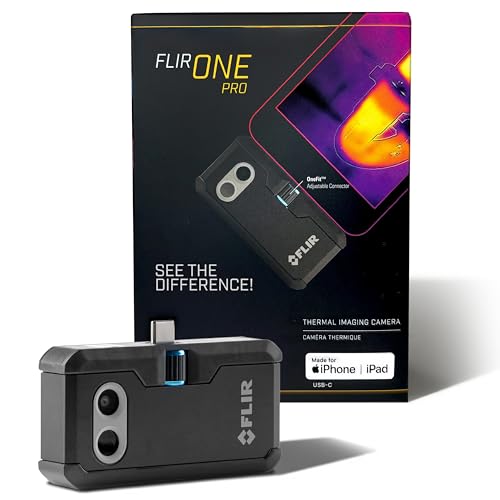
FLIR ONE Pro for iOS (USB-C)
Built for iPhone 15 and newer, with MSX, Vivid IR and guided inspections.
160 x 120 native detector; 480 x 360 is Vivid IR upscaling
Plugs into the USB-C charging port of iPhone 15 and newer
MSX merges thermal and visible images; FLIR ONE app includes step-by-step inspection guides for air leaks and moisture
Accuracy of plus or minus 3 C or 5 percent within a stated ambient and scene range; 1.5 m drop rating
All values come from the manufacturers' Amazon listings at the time of research. The Seek listings say iOS but do not name the connector; check the exact listing against your iPhone port. Upscaled figures are software output and are not comparable with native counts.
How to Choose an iPhone Thermal Camera
Four points decide it:
Port Before Pixels
USB-C modules fit iPhone 15 and newer. Lightning iPhones need a module with a Lightning adapter, such as the TC001 Max or the P1, or the Bluetooth Edge Pro.
Native Detector
The FLIR modules and the P1 are 160 x 120; the TOPDON modules are 256 x 192; the Seek CompactPRO states 320 x 240 with no upscale. The 480 x 360 and 512 x 384 figures are software.
Stated Sensitivity and Refresh
TOPDON and Thermal Master state 40 mK and 25 Hz. Seek states under 9 Hz and, on the CompactXR, under 70 mK. FLIR states neither on its listings.
Overlay and Guidance
MSX and the guided FLIR ONE app help a first-time user read the image. The TOPDON and Seek apps offer measurement tools instead.
I have an iPhone with a Lightning port. Which of these will work?
The FLIR Edge Pro, because it connects by Bluetooth. Among the plug-in modules, TOPDON states USB-C and Lightning adapters with the TC001 Max, and Thermal Master states that a Type-C to Lightning adapter, sold separately, is needed for the P1. The FLIR ONE Pro listing states iPhone 15 and newer only; the Seek listings do not name the connector, so check them directly.
Why does the FLIR ONE Pro state iPhone 15 and newer?
Because it plugs into the USB-C charging port, which iPhones gained with the 15. Earlier iPhones have a Lightning port and need a different module or an adapter the FLIR listing does not describe. The Android version of the FLIR ONE is a separate USB-C product with a smaller 80 x 60 detector.
Is the Seek CompactXR suitable for home inspection?
It is built for the outdoors. Seek states a 206 x 156 sensor, a narrow 20-degree field of view for finding people and animals at up to 1,800 feet, a focusable lens and sensitivity under 70 mK. That narrow lens makes scanning a wall slow; the CompactPRO, with a 320 x 240 sensor and a 32-degree field of view, is the Seek module for building work.
How does the GOYOJO 192 x 192 detector compare to the others?
It sits between the 160 x 120 FLIR modules and the 256 x 192 TOPDON modules in element count, and the listing states it as native with no upscaled figure, plus a 12 micrometer pixel pitch, a 50-degree field of view and a -4 to 752 F range with plus or minus 2 percent accuracy. NETD and refresh rate are not stated. It lists USB-C support for iPhone 15, 16 and 17 series.
Will these modules work on an iPad?
TOPDON states the TC002C Duo works with USB-C tablets on iOS and names iPad in the TC001 Max title, and the Edge Pro connects to any iOS device by Bluetooth. The FLIR ONE Pro listing names iPhone 15 and newer only. An iPad screen makes a large thermal display, which is useful for showing a client the finding on site.
Reviews
FLIR ONE Pro for iOS (USB-C) Best Overall
The FLIR ONE Pro is the module FLIR built for the current iPhone, and the listing is explicit that it fits iPhone 15 and newer through the USB-C charging port. FLIR states a 160 x 120 detector upscaled to 480 x 360 by Vivid IR, MSX merging thermal and visible images in real time, and a FLIR ONE app with step-by-step inspection guides that walk the user through typical faults such as air leaks and moisture buildup.
The stated accuracy is plus or minus 3 C or 5 percent when the module is within 15 to 35 C and the scene is within 5 to 120 C, and the module is rated for a 1.5 m drop and described as commercial grade for home inspection, automotive and machinery use.
The TOPDON TC002C Duo has a larger native detector and states NETD and refresh rate where FLIR does not; the FLIR ONE Pro answers with MSX and the guided app. Owners of Lightning iPhones need a different module. Our FLIR ONE Pro review has the full picture.
FLIR Edge Pro Wireless Thermal Imaging Camera Best Wireless
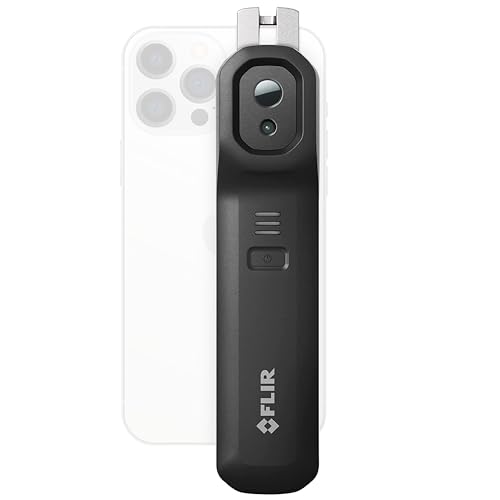
The Edge Pro is the answer for a Lightning iPhone, a USB-C iPhone and an iPad in the same household, because FLIR states a Bluetooth connection to all iOS or Android devices and the port never enters into it. It is also the module for reaching: the wireless design lets the camera be held into tight spaces or around corners, behind a dryer, above a drop ceiling or over a parapet, while the image is watched on the phone.
MSX blends visible edges into the thermal image, images upload to Ignite cloud from a Wi-Fi connected camera for organizing and sharing, and the stated accuracy is plus or minus 3 C or 5 percent within the listed conditions.
The detector is 160 x 120 native, the same as the FLIR ONE Pro, upscaled to 480 x 360, and the listing states no NETD, temperature range, refresh rate or battery runtime. As a wireless camera it has its own battery to charge, which the plug-in modules do not. Our FLIR Edge Pro review covers it in detail.
TOPDON TC002C Duo Thermal Camera for USB-C Best Value
The TC002C Duo is the value pick for a USB-C iPhone because it puts the largest native detector of the three picks on the phone: 256 x 192, which is 49,152 pixels against the 19,200 in the FLIR modules. TOPDON also states 25 Hz refresh and 40 mK sensitivity, the two figures FLIR leaves off its listings, a range of -4 to 1022 F with accuracy within plus or minus 2 C or 2 percent, and measurement from a stated distance of up to 16.4 ft.
The module works on all USB-C smartphones and tablets across iOS, Android and Windows, so it moves from an iPhone 15 to an iPad or an Android phone without an adapter, weighs 1.1 oz and runs through the TopInfrared app with waveform temperature display, customizable limits and photo and video recording.
It has no visible camera, so there is no MSX-style edge overlay, and no guided inspection. The listing excludes Mac and, at the time of writing, Android 16; check the current note before buying. Our TOPDON TC002C review covers the earlier version.
Strengths
256 x 192 native, the largest of the picks
25 Hz and 40 mK stated
Any USB-C iPhone, iPad, Android or Windows device
Stated range and accuracy
Limitations
No visible camera or overlay
Not for Lightning iPhones without an adapter, which the listing does not mention
Short answer: the FLIR ONE Pro is the iPhone thermal camera for an iPhone 15 or newer, with MSX, Vivid IR and the guided inspections of the FLIR ONE app; the FLIR Edge Pro is the wireless pick for any iPhone or iPad, Lightning or USB-C, with the camera free to reach behind and above things; and the TOPDON TC002C Duo is the value pick for a USB-C iPhone or iPad, with a 256 x 192 native detector, 25 Hz and 40 mK stated.
The USB-C split
Apple moved the iPhone to USB-C with the iPhone 15, and the thermal module market split with it. The FLIR ONE Pro states iPhone 15 and newer and nothing else. The TOPDON TC002C Duo and Thermal Master P1 are generic USB-C modules that list iOS among their platforms; the P1 adds that a Lightning iPhone needs a Type-C to Lightning adapter sold separately, and the TC001 Max states both USB-C and Lightning adapters in the box. The GOYOJO GW192A names iPhone 15, 16 and 17 series. The two Seek modules say iOS and do not name the connector at all, which means checking the exact listing against the phone before ordering. The Edge Pro removes the question by connecting over Bluetooth to all iOS or Android devices. Anyone with a Lightning iPhone should start from that list and not from the detector table. The smartphone thermal camera guide covers the connector question across both platforms.
Native detectors on iOS
The three picks span two detector classes and the wider table adds two more. The FLIR ONE Pro and Edge Pro are 160 x 120 native, 19,200 pixels, with 480 x 360 described as Vivid IR upscaling; the Thermal Master P1 is the same 160 x 120 class under a 320 x 240 X3 headline. The TOPDON TC002C Duo and TC001 Max are 256 x 192, 49,152 pixels, with 512 x 384 as TISR output. The GOYOJO states 192 x 192 native with no upscale. The Seek CompactPRO states a 320 x 240 sensor, 76,800 pixels, the largest native count on this page, and the CompactXR 206 x 156. Every listing that quotes an upscaled figure labels it, so the information is there; the trap is reading the headline and stopping. At close range on a phone screen all of these show a warm breaker or a cold window frame. From across a room the 256 x 192 and 320 x 240 detectors resolve what the 160 x 120 ones smear.
Sensitivity and refresh: read the whole listing
The figures that describe how a module behaves are stated by the smaller brands and skipped by FLIR on Amazon. TOPDON states 40 mK and 25 Hz for the TC002C Duo and 40 mK or lower and 25 Hz for the TC001 Max; Thermal Master states 0.04 C, which is 40 mK, and 25 Hz for the P1; Seek states a frame rate under 9 Hz on both modules and sensitivity under 70 mK on the CompactXR. The FLIR ONE Pro and Edge Pro listings state resolution, MSX, accuracy and drop rating but no NETD and no refresh rate. FLIR publishes both in its datasheets, so a buyer choosing between a FLIR module and a TOPDON module on sensitivity should read the datasheet rather than assume. The under 9 Hz figure on the Seek modules is the one to weigh carefully: at that rate the image updates slowly while panning, which suits a spotting scope more than a wall scan.
Wireless: the Edge Pro case on iOS
A plug-in module lives on the bottom of the phone, and on an iPhone that means the camera is exactly where the screen is. FLIR states that the Edge Pro connects wirelessly by Bluetooth and can be held into tight spaces or around corners, which turns the phone into a monitor and the camera into a probe: behind a refrigerator, above a suspended ceiling, into a crawl space hatch, over a roof edge. It also solves the Lightning problem outright. The costs are a battery of its own, whose runtime the listing does not state, and the same 160 x 120 detector as the FLIR ONE Pro. MSX carries over, and images upload to Ignite cloud from a Wi-Fi connected camera. Our FLIR Edge Pro review goes through it in detail.
The Seek pair: building work or the outdoors
Seek sells two iOS modules with different jobs. The CompactPRO states a 320 x 240 thermal sensor, a 32-degree field of view, a focusable lens, a -40 to 626 F detection range, spot and high-low temperature readings, threshold mode, nine palettes, adjustable span and level and four emissivity presets, and Seek names contractors, inspectors and homeowners as its users. The CompactXR states a 206 x 156 sensor, a narrow 20-degree field of view that Seek describes as providing detection at up to 1,800 feet, sensitivity under 70 mK and a waterproof case, and Seek names hunters, hikers, boaters and homeowners. Both draw power from the phone and neither states its connector on the listing. For scanning walls and ceilings the CompactPRO is the one; the CompactXR is a spotting tool.
Accuracy, emissivity and what the module cannot see
The accuracy figures on these listings all come with conditions. FLIR states plus or minus 3 C or 5 percent only when the module is within 15 to 35 C and the scene within 5 to 120 C, so a module that has been in a hot car reads worse until it settles. TOPDON states plus or minus 2 C or 2 percent, GOYOJO plus or minus 2 percent and Thermal Master plus or minus 3.6 F. All of them depend on emissivity being set for the surface: shiny metal reads low and reflects the room, so a bare copper pipe or an aluminum frame shows cold and may carry a warm reflection of the user. Read a strip of tape on the metal instead. A phone module reads surface temperature and cannot see through a wall; a cool patch on a ceiling is a leak only once a moisture meter says so.
iOS modules were compared on manufacturer listing statements: stated iPhone and iPad support and connector, native detector resolution, upscaled output where quoted, stated NETD, refresh rate, field of view, temperature range and accuracy, visible camera and overlay, and app features. Owner feedback was reviewed for recurring comments on port fit, case clearance and app stability. We did not run laboratory tests or side-by-side imaging and publish no measurements. Amazon data supplies images, availability and links only.
Multiplying the two sides of a grid produces a number that grows as the square of the thing buyers care about, so a fourfold pixel count is only a twofold improvement in how finely the scene is sampled.
A detector reports one radiance weighted average for everything inside its cone, so a part smaller than that cone reads cold, and computing extra pixels from those averages cannot recover what was never sampled.
The native array size appears in one of four places when it appears at all, and the method for extracting it works the same way on any instrument whose decisive hardware figure a listing would rather not print.