Best Smartphone Thermal Cameras: Plug-In and Wireless Picks for iPhone and Android
A phone thermal camera is a detector, a lens and a connector; the phone supplies the screen, the battery and the processing. That makes the connector and the platform the first filter, the native detector the second, and the headline super-resolution number the last thing to read. These picks were sorted that way from manufacturer listings.
As an Amazon Associate, Akermin earns from qualifying purchases. Product links on this page are affiliate links.
Our Top Picks
Phone modules were compared on platform and connector, native detector resolution, upscaled output where quoted, stated NETD, refresh rate, field of view, phone power draw and app features, all from manufacturer listings. We did not run laboratory tests or side-by-side imaging; figures are the manufacturers' own and Not stated marks the gaps.
Best Overall
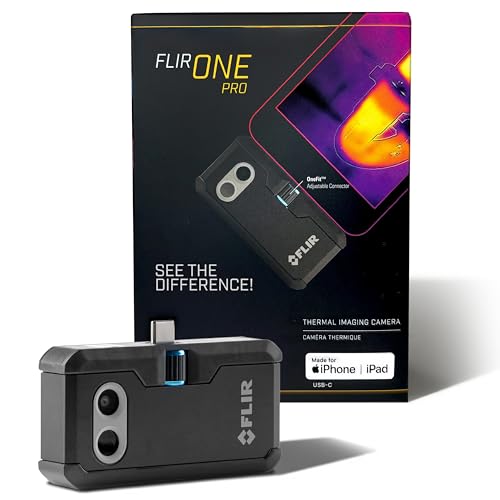
FLIR ONE Pro for iOS (USB-C)
The iPhone 15 and newer module with MSX, Vivid IR and guided inspections in the app.
160 x 120 native detector; 480 x 360 is Vivid IR upscaling
Plugs into the USB-C charging port of iPhone 15 and newer
MSX merges thermal and visible images; FLIR ONE app includes step-by-step inspection guides
Accuracy of plus or minus 3 C or 5 percent within a stated ambient and scene range; 1.5 m drop rating
All values come from the manufacturers' Amazon listings at the time of research. The two Thermal Master P1 listings describe the same 160 x 120 detector with X3 upscaling to 320 x 240; the headline resolution differs only in wording. Upscaled figures are software output and are not comparable with native counts.
How to Choose a Smartphone Thermal Camera
Four filters, in order:
Platform and Connector
USB-C iPhone 15 and newer, USB-C Android, Lightning via adapter, or Bluetooth for any phone. Read the exclusions; several listings name phones they do not support.
Native Detector
80 x 60, 160 x 120, 256 x 192 and 320 x 240 are the real counts in this table. 480 x 360 and 512 x 384 are software.
Stated NETD and Refresh
TOPDON, Thermal Master and RISION state 35 to 40 mK and 25 Hz. FLIR states neither on Amazon. Seek states under 9 Hz.
What the Phone Pays
Plug-in modules run on phone power; only Thermal Master and TOPDON TC001 state a draw or runtime. A wireless camera has its own battery to charge.
Will a plug-in thermal module work without removing my phone case?
It depends on the module and the case. TOPDON states that the TC001 Max works without removing most phone cases, and Thermal Master states an extended USB-C plug on the P1 for the same reason. Modules with a short plug may need the case off or an extension cable; the TC001 Plus, TC001 and P1 all ship with one.
How much phone battery does a plug-in thermal camera use?
The modules that state it draw very little: Thermal Master states 0.32 W and 5 to 8 hours of continuous use on the P1, TOPDON states 0.35 W and 4 to 7 hours on a 3000 to 5000 mAh phone for the TC001 and TS001, and the P4 states up to 5 hours. The screen at full brightness uses more than the module. FLIR and Seek do not state a draw.
What is the difference between the FLIR ONE Pro and the FLIR ONE for Android?
The detector. FLIR states a 160 x 120 native detector upscaled to 480 x 360 on the FLIR ONE Pro for iOS, and an 80 x 60 native detector upscaled to 240 x 180 on the FLIR ONE for Android USB-C. Both use MSX and the same app with inspection guides. The Android module has a quarter of the detector elements.
Does the Seek CompactPRO fit a USB-C iPhone?
The listing says it is for iOS and states a 320 x 240 sensor, but does not name the connector. Check the connector on the exact listing against your iPhone before buying; a Lightning module needs a Lightning port. It is also the only module here that states a frame rate under 9 Hz.
How accurate is a phone thermal camera for temperature readings?
FLIR states plus or minus 3 C or 5 percent for the FLIR ONE Pro and Edge Pro within a given ambient and scene range; TOPDON states plus or minus 2 C or 2 percent for the TC002C Duo and TC001 Max, and Thermal Master plus or minus 3.6 F for the P1 and P4. All depend on setting emissivity for the surface. They are diagnostic tools for finding a difference, not reference thermometers.
Reviews
FLIR ONE Pro for iOS (USB-C) Best Overall
The FLIR ONE Pro is the overall pick because it is the most complete package for the phone most US buyers now hold: an iPhone with a USB-C port. FLIR states a 160 x 120 detector, upscaled to 480 x 360 by Vivid IR, MSX merging of thermal and visible images in real time, and a FLIR ONE app with step-by-step inspection guides for typical faults such as air leaks and moisture buildup. That guide is what separates it from modules that simply show a palette and a spot reading.
The listing states accuracy of plus or minus 3 C or 5 percent when the module is within 15 to 35 C and the scene is within 5 to 120 C, a 1.5 m drop rating and a commercial-grade intent covering home inspection, automotive and machinery use.
The native detector is smaller than the 256 x 192 in the TOPDON modules, the listing states no NETD, refresh rate or battery figure, and it fits only iPhone 15 and newer; older Lightning iPhones need a different module. Our FLIR ONE Pro review has the detail.
FLIR Edge Pro Wireless Thermal Imaging Camera Best Wireless
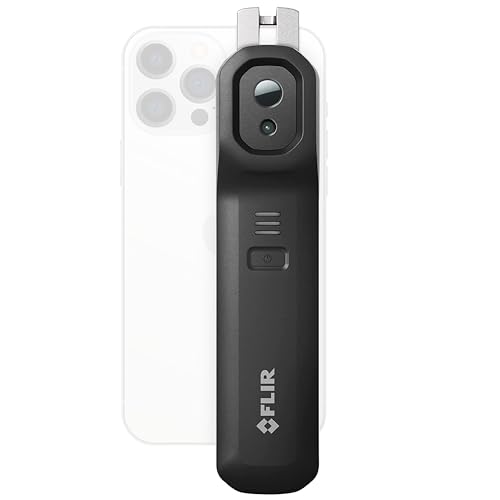
The Edge Pro answers the two complaints buyers have about plug-in modules: the module is stuck to the phone, and the module only fits one platform. FLIR states a wireless Bluetooth connection to all Android or iOS devices, so one camera serves an iPhone and an Android tablet, and the wireless design lets the camera be held into tight spaces or around corners, behind an appliance, above a ceiling tile or over a parapet, while the image is watched on the phone.
MSX blends the visible edges into the thermal image, the stated accuracy is plus or minus 3 C or 5 percent within the listed conditions, and images upload to Ignite cloud from a Wi-Fi connected camera for organizing and sharing.
The detector is the same 160 x 120 native as the FLIR ONE Pro, upscaled to 480 x 360, and the listing does not state NETD, temperature range, refresh rate or battery runtime, the last of which matters more on a wireless camera than on a plug-in. Our FLIR Edge Pro review has more.
TOPDON TC002C Duo Thermal Camera for USB-C Best Value
The TC002C Duo is the value pick because one module covers every USB-C phone in a household or a crew. TOPDON states compatibility with all USB-C smartphones and tablets on iOS, Android and Windows, with two exclusions at the time of the listing, Mac and Android 16, that a buyer should check before ordering.
The detector is stronger than the FLIR modules on paper: 256 x 192 native, 49,152 pixels against 19,200, with 512 x 384 described as TISR super resolution, plus 25 Hz refresh and 40 mK sensitivity, both stated where FLIR states neither. The range of -4 to 1022 F with accuracy within plus or minus 2 C or 2 percent, waveform display of temperature change, customizable limits and photo and video recording are all in the TopInfrared app. At 1.1 oz it is barely noticeable on the phone.
There is no visible camera in this module, so no MSX-style overlay, and no guided inspection in the app. Our TOPDON TC002C review covers the earlier version.
Strengths
256 x 192 native, the largest detector among the picks
One module for USB-C iPhone, Android and Windows
25 Hz and 40 mK stated
Stated range and accuracy
Limitations
No visible camera or edge overlay
Mac and Android 16 excluded at the time of listing
Short answer: the FLIR ONE Pro is the smartphone thermal camera for an iPhone 15 or newer, with MSX, Vivid IR and step-by-step inspection guides in the app; the FLIR Edge Pro is the wireless pick that connects to any iOS or Android device by Bluetooth and lets the camera reach where the phone cannot; and the TOPDON TC002C Duo is the value pick, a single USB-C module for iPhone, Android and Windows with a 256 x 192 native detector, 25 Hz and 40 mK stated.
Connector first, then everything else
A phone thermal camera is only as useful as the phone it fits, so the first filter is the connector and the platform, and the listings are specific about both. The FLIR ONE Pro fits iPhone 15 and newer with USB-C only. The FLIR ONE for Android is USB-C Android only. The TOPDON TC001 Plus and TC001 and the Thermal Master P4 are Android and Windows and say so; the TC001 Plus adds that not every Android phone supports its TISR upscale. The TOPDON TC002C Duo, TC001 Max, Thermal Master P1 and RISION Magic are USB-C modules that state iOS, Android and Windows, with named exclusions such as Mac or Android 16 that were current when the listings were written and should be rechecked. The Seek CompactPRO says iOS but does not name the connector. The FLIR Edge Pro sidesteps all of that with Bluetooth. The smartphone thermal camera selection guide covers the connector question in more depth.
The native detector behind the headline number
Every module in this table except the Seek quotes a resolution larger than its detector, and every one of those listings labels the larger figure as Vivid IR, TISR, X3, QuadIR or super resolution. The native counts are what matter. The FLIR ONE for Android is 80 x 60. The FLIR ONE Pro, Edge Pro, RISION Magic and both Thermal Master P1 listings are 160 x 120, which is 19,200 pixels; the P1 listing titled 320 x 240 describes the same 160 x 120 detector upgraded by X3 as the listing titled 160 x 120, so the two are the same class of camera under different headlines. The TOPDON TC002C Duo, TC001 Plus, TC001 Max and Thermal Master P4 are 256 x 192, which is 49,152 pixels. The Seek CompactPRO states a 320 x 240 sensor, 76,800 pixels, with no upscale attached, and pairs it with a frame rate under 9 Hz and a focusable lens. How to compare thermal camera resolution explains why the upscaled number adds smoothness but no new measurements.
Sensitivity and refresh: where the smaller brands say more
NETD is the smallest temperature difference the detector distinguishes, in millikelvin, lower being better, and refresh rate decides whether the image follows the phone while you pan. The Thermal Master P4 states under 35 mK, the TC002C Duo, TC001 Max, RISION Magic and both P1 listings state 40 mK, and all of them state 25 Hz. FLIR states neither NETD nor refresh rate on any of its phone-module listings, and Seek states under 9 Hz with no NETD. That is a listing gap rather than a verdict on the FLIR hardware, and FLIR publishes both figures in its datasheets, but on the listings alone the TOPDON and Thermal Master modules are the ones that put numbers on the table. For a home user hunting drafts the difference will rarely be decisive; for a technician looking for a slightly warm breaker it can be.
Wired or wireless
A plug-in module is small, light and has no battery of its own; the TC002C Duo states 1.1 oz and the P1 0.62 oz, and the Thermal Master modules state a draw of 0.32 W for 5 to 8 hours of use on phone power. The cost is that the camera is wherever the phone is, which is awkward behind an appliance, above a ceiling tile or over the edge of a roof, and that a phone case may need to come off; TOPDON states the TC001 Max works with most cases on and Thermal Master gives the P1 an extended plug. The Edge Pro is the wireless answer: FLIR states a Bluetooth link to any iOS or Android device and the ability to see into tight spaces or around corners with the camera held away from the phone. It has its own battery, whose runtime the listing does not state, and the same 160 x 120 detector as the FLIR ONE Pro.
What the phone gives and what it takes
The phone supplies a screen far larger and sharper than any pocket thermal camera, the storage and sharing of every image, and apps that do more than most handheld menus: the TOPDON app offers waveform temperature graphs and 3D analysis, the Thermal Master app isotherms, alarms and 15x digital zoom, and the FLIR ONE app step-by-step inspection guides. It takes the battery, which is why the stated draws above matter, and the outdoor readability of a glass screen in sun. It also decides accuracy conditions: FLIR states plus or minus 3 C or 5 percent only when the module is between 15 and 35 C, so a module that has been in a hot truck reads worse until it settles.
Emissivity, reflections and the surface-only rule
Every module here reads surface temperature and cannot see through a wall; the Thermal Master listings say so outright. Shiny metal reads low because its emissivity is low and it reflects the room, so a bare copper pipe, an aluminum frame or a stainless appliance front shows cold and may show a reflection of the person holding the phone as a warm patch. Set the emissivity for the surface where the app allows it, the RISION, Thermal Master and TOPDON apps state adjustable emissivity, or put a strip of tape on the metal and read the tape. Step sideways: a defect stays, a reflection moves.
Related guides
Platform-specific shortlists are in the iPhone thermal camera guide and the Android thermal camera guide, which go deeper on connector exclusions and the TOPDON and Thermal Master ranges. A full FLIR ONE Pro review is also available.
How We Research
Phone modules were compared on manufacturer listing statements: supported platforms and connectors with any named exclusions, native detector resolution, upscaled output where quoted, stated NETD, refresh rate, field of view, temperature range and accuracy, phone power draw or runtime, visible camera and overlay, and app features. Owner feedback was reviewed for recurring comments on app stability and case compatibility. We did not run laboratory tests or side-by-side imaging and publish no measurements. Amazon data supplies images, availability and links only.
Multiplying the two sides of a grid produces a number that grows as the square of the thing buyers care about, so a fourfold pixel count is only a twofold improvement in how finely the scene is sampled.
A detector reports one radiance weighted average for everything inside its cone, so a part smaller than that cone reads cold, and computing extra pixels from those averages cannot recover what was never sampled.
The native array size appears in one of four places when it appears at all, and the method for extracting it works the same way on any instrument whose decisive hardware figure a listing would rather not print.