Best Solar Power Meters: 3 Reliable Picks for Accurate Energy Measurement
Solar power meter means four different things depending on where in the system you stand. This hub separates DC-side watt meters, module-level testers, AC-side energy monitors and MPPT controllers with built-in logging, so you buy the one that measures at the point you actually care about.
As an Amazon Associate, Akermin earns from qualifying purchases. Product links on this page are affiliate links.
Our Top Picks
These eight instruments all report power, and they connect at four different points in a solar system. Three sit on the DC side between array and battery or across a module, two plug in on the AC side and measure what a load or an inverter output consumes, and three are MPPT charge controllers that display the same values on an installed system. The Type and Where it connects columns keep those apart, because a plug-in energy monitor and a 200 A DC shunt meter answer completely different questions.
Best Overall
whcusmm 200A Digital Watt Meter and Power Analyser
The DC-side meter that stays in circuit and accumulates energy as well as power.
Measures voltage, current, power and discharge capacity
200 A stated capacity
Described as a solar panel power analyser
Permanent or semi-permanent installation on the DC side
The last three rows are MPPT charge controllers rather than dedicated meters. They are included because they measure and display the same DC quantities on a system that is already installed, and because buyers searching for a solar power meter frequently arrive at them. All figures are quoted from the manufacturer listings; no listing on this page publishes a measurement accuracy figure, so that column does not exist.
How to Choose a Solar Power Meter
The first decision is geographical, not technical:
Which Side of the Inverter
DC-side meters measure what the array and battery are doing. AC-side monitors measure what the house consumes. Neither can see the other, and most people eventually want both.
Power or Energy
Watts are instantaneous and change with every cloud. Watt hours and amp hours accumulate and are what a battery bank is actually sized against. A meter that only shows live power answers the less useful question.
Fixed or Portable
Shunt meters and controllers are wired in and watch one system forever. Handheld testers move from module to module and from job to job. Buying the wrong form factor is the commonest error here.
Current Headroom
Check the real maximum current at the point of installation, including parallel strings and peak charge rates, and choose a shunt or controller rating above it rather than at it.
DC to understand the array and the battery, AC to understand the household. A DC shunt meter between controller and battery shows what was harvested and stored. An AC plug-in monitor shows what an appliance consumes. Comparing the two also exposes conversion losses, which are real and often larger than owners expect.
Why does my inverter display disagree with my meter?
Because they measure at different points and often in different ways. An inverter reads its own input or output and applies its own averaging; a shunt meter reads current through a resistor at a different place in the circuit. Cable losses, standby draw and the sampling interval all contribute. A consistent offset between two instruments is normal; a growing one is worth investigating.
Do I need a shunt, and what size?
Shunt-based DC meters need one, and it has to be rated above the highest current that will ever pass through it, including peak charging and any parallel strings. Undersizing it produces heat, drift and eventually failure. Install it in the negative conductor where the design calls for that, and follow the manufacturer wiring diagram rather than improvising.
Can a clamp meter do this job instead?
For a spot check, yes, provided it measures DC current, which many clamp meters do not. What a clamp cannot do is accumulate energy over a day or a season, because it only reads while you hold it there. For continuous accounting you need something wired in.
Is a charge controller display accurate enough to rely on?
It is usually good enough to spot trends, which is what it is for. None of the controller listings here publishes an accuracy figure for its measurements, and the display is a secondary function of a device whose main job is regulating charge. For a number you intend to act on or quote, verify it against a dedicated meter.
Reviews
whcusmm 200A Digital Watt Meter and Power Analyser Best Overall
The most useful measurement in a small solar system is rarely instantaneous power. It is accumulated energy: how many amp hours or watt hours went into the battery today, and how many came back out. A shunt-based DC watt meter is the instrument for that, and it works by staying in circuit rather than being brought out for a reading.
This one states voltage, current, power and discharge capacity as its measured quantities, with a 200 A stated capacity, which covers the DC side of any domestic off-grid or caravan system comfortably. Wired between the charge controller and the battery it shows charging power and accumulated charge; wired on the load side it shows consumption. Either way the number builds over the day instead of being a snapshot taken when you happened to be looking.
The listing is thin on the details that matter for precision work. There is no stated accuracy, no stated voltage ceiling, no resolution figure and no description of whether the display retains totals through a power interruption. Treat it as an energy accounting instrument for a system you own rather than a test instrument you carry between jobs, and check the shunt rating against the real maximum current before wiring it in.
Strengths
Accumulates energy rather than only showing live power
200 A stated capacity covers domestic DC systems
Stays in circuit for continuous accounting
Lowest tier instrument on the page
Limitations
Accuracy not stated
Voltage ceiling not stated
Needs permanent wiring with a shunt, not a portable reading
ALLmeter Solar Power Meter and PV Tester Best at the Module
A shunt meter tells you what the array produced. It does not tell you which module let the side down. For that you need an instrument that connects to one panel at a time and finds its maximum power point by sweeping an electronic load across it, and the ALLmeter is the best-documented of those here.
It states a Voc window of 3 to 90 V and an Isc window of 0 to 40 A, and reports Pmax alongside the open-circuit voltage and short-circuit current. Working along a row of panels in stable sun, those three figures per module expose the common faults quickly: one panel producing noticeably less power at normal voltage points at soiling or a shaded cell, a panel with a healthy voltage and collapsed current points at a connection problem, and a panel with no voltage at all points at an open circuit.
It is a diagnostic instrument, not a monitoring one. It reads while you hold it and records nothing, and the 90 V ceiling keeps it to single modules and the shortest strings. For a system owner the shunt meter is the better first purchase; for whoever comes out when the yield drops, this is the one that finds the cause.
Strengths
Voltage and current windows both published
Finds the maximum power point rather than reading the ends
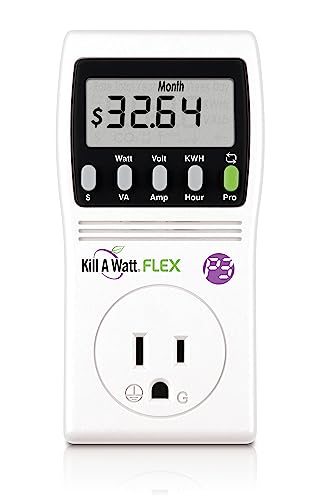
P3 International P4456 Kill A Watt Flex Best on the AC Side
Sizing or troubleshooting a solar installation is half a generation question and half a consumption question, and most people measure only the first. A plug-in energy monitor answers the second. The Kill A Watt Flex is the current version of a long-running design, described by P3 as the next-generation upgrade to the P4400, with enhanced tracking and stored data.
Used properly it changes decisions. Leaving it on a fridge for a week produces a real daily figure instead of a nameplate rating, which is the number an off-grid battery bank actually has to cover. Doing the same on the three or four biggest loads in a house usually reveals that one of them dominates, and that reducing or rescheduling it is cheaper than adding panels. The stored data matters because appliances with thermostats and compressors cycle, so a spot reading of watts is close to meaningless.
What it cannot do is anything on the DC side, and it cannot measure a hard-wired load or a whole house. The listing states no accuracy figure and no storage duration. It is a household instrument that belongs in a solar toolkit rather than a solar instrument, and it is the cheapest genuinely useful thing on this page.
Strengths
Measures real consumption over time rather than nameplate ratings
Short answer: the whcusmm 200A watt meter is the DC-side instrument to fit if you want to know how much energy the system actually harvested and stored; the ALLmeter solar power meter is the handheld that finds which module is underperforming; and the P3 Kill A Watt Flex answers the other half of the question by measuring what the loads really consume, which is what the array has to cover.
Four meters wearing one name
Search for a solar power meter and four unrelated devices come back. A DC shunt watt meter wires permanently into the circuit between array, controller, battery and load, and accumulates energy over time. A handheld module tester clips onto one panel, sweeps an electronic load and reports the maximum power that panel can deliver right now. An AC plug-in monitor sits between a wall socket and an appliance and measures household consumption. An MPPT charge controller regulates charging and displays the same DC quantities as a side effect. Each is the right answer to a different question, and the table above sorts them by where they connect for exactly that reason. Deciding which question you have is more than half of choosing well.
Watts, watt hours and why the difference matters
Instantaneous power is the number these devices show most prominently and the number that matters least. A solar array output swings with every passing cloud, so a watts reading is a snapshot of one second of weather. Energy, expressed in watt hours or amp hours, is the accumulated total, and it is the quantity that battery banks are sized in, that bills are calculated in and that tells you whether yesterday was a good day. Three of the eight entries here accumulate something: the whcusmm states discharge capacity, the MECHEER states kilowatt hours, and the Victron logs yield through its app. The handheld testers accumulate nothing by design, because they exist to make a comparison in the moment. If the question is how is my system doing, buy something that accumulates. If the question is which panel is broken, buy something that does not.
Installing on the DC side without creating a hazard
Everything on the DC side of a solar system is live whenever there is light on the array, and photovoltaic DC sustains an arc in a way mains AC does not. Shunt-based meters and charge controllers are wired in, which means the array must be isolated and covered or disconnected before the work starts, connections made to the manufacturer diagram rather than improvised, and every conductor sized for the real current rather than the average one. The shunt in particular must be rated above the highest current the circuit can produce, counting parallel strings and peak charge current together. Fuse the battery side close to the battery, because a battery bank will deliver hundreds of amps into a short without complaint. Our guide to clamp meters with DC power measurement covers the non-invasive alternative for spot checks.
Why measuring consumption changes the answer
Most solar disappointment is not a generation problem. An owner sizes a system against nameplate ratings, installs it, and finds the battery empty by morning because the actual consumption was never measured. A plug-in energy monitor left on a fridge for a week costs almost nothing and produces the single most useful figure in the whole exercise: the real daily kilowatt hours of the load that runs around the clock. Repeat on the next three largest loads and the household energy profile becomes a short list rather than a guess. Both AC monitors here do this, the MECHEER with a more detailed readout listing power, kilowatt hours, voltage, frequency, current and power factor, and the Kill A Watt Flex with stored data across time. Neither sees the solar side at all, which is exactly why they belong in the same toolkit as the DC meters rather than instead of them.
For a system you own, fit the DC meter first, because it turns the installation from a black box into something with a daily number. Add a plug-in monitor next, because it is cheap and it usually explains the battery. Buy the handheld module tester only when something goes wrong, or not at all if a contractor maintains the array. For anyone servicing other people’s systems the order reverses entirely: the handheld earns its keep on the first call-out, and the fixed meters belong to the owner.
How We Research
Instruments were compared on manufacturer listing text: the quantities each listing states it measures, stated current and voltage ranges, the connection point in the system, and whether any form of data storage or accumulation is described. Entries that are charge controllers rather than dedicated meters are labelled as such in the Type column. No listing on this page publishes a measurement accuracy figure, so none is reported. We ran no tests, monitored no installations and publish no measurements of our own. Amazon data supplies images, availability and links only.
A solar insulation resistance tester that works on energised PV strings up to DC 1000 V, with test voltages of 125, 250, 500 and 1000 V, a range to 4000 megohms, automatic discharge, 1000 stored result sets and USB or Bluetooth transfer.
A 12 volt battery, cranking and charging system tester covering 100 to 2000 CCA that reports state of health, state of charge, voltage, current and CCA, drawing its own power from the battery under test.
A handheld solar irradiance meter reading 0 to 1999 watts per square metre or 0 to 634 BTU per square foot per hour, with a selectable 199.9 or 1999 scale, maximum and minimum tracking, data hold and manual zeroing.