As an Amazon Associate, Akermin earns from qualifying purchases. Product links on this page are affiliate links.
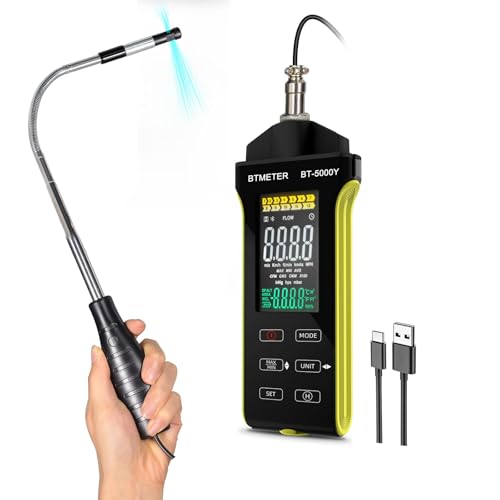
BTMETER · BTMETER Hot Wire Anemometer - CFM/CMM Air Flow Meter Measuring 0.2-67 Mph | Wind Speed Meter Accuracy ±5%,Thermal Anemometer with 360°Revolve Telescopic Probe, USB Recharge for HVAC Duct Air Vent 5000Y
View on AmazonPrice and availability are shown on Amazon and can change at any time.
The BTMETER BT-5000Y is the hot wire anemometer to consider when you need low-speed duct readings and a probe that reaches into tight spaces. The listing publishes a 0.2 to 67 mph air speed range, plus or minus 5 percent accuracy, a 0 to 999900 ft3/min airflow display and a 32 to 113 F temperature range. Its telescopic probe is the feature that separates it from a vane meter, which struggles at low velocity. Compared with the AM-286 already covered on this site, the BTMETER is the simpler single-purpose instrument: it publishes its speed range and accuracy, while the AM-286 listing does not. If your work is mostly at grilles and registers rather than inside ducts, a vane anemometer is the more natural tool; see the vane versus hot wire comparison before deciding.
The 0.2 mph floor is the reason to buy a hot wire meter
A hot wire anemometer measures air speed by holding a heated element in the airstream and watching how much current it takes to keep that element at a constant temperature. Moving air carries heat away, so the current needed to hold temperature rises with velocity. That mechanism is sensitive at very low speeds, which is why the BTMETER listing can quote a floor of 0.2 mph. A rotating vane meter has to overcome bearing friction and inertia before it turns at all, so it tends to be vague below roughly 1 mph. If your work involves checking whether a bathroom extract is pulling at all, or balancing a low-flow terminal, the hot wire element is the right sensor.
The same mechanism is the weakness at the top end. A fine heated wire is fragile, and the probe needs a protective cover when it is not in the duct. The listing states the probe includes a cover and is dustproof and waterproof, which matters because a hot wire element contaminated with dust will drift. Treat the cover as part of the instrument, not packaging.
What the listing publishes, and what it leaves out
The published air speed range is 0.2 to 67 mph, with accuracy of plus or minus 5 percent. Units include m/s, km/h, ft/min, knots and mph. Airflow volume is displayed in CFM or CMM over 0 to 999900 ft3/min, and temperature over 32 to 113 F. The display shows max, min and average values, and there is data hold, unit conversion and a low battery alert. The battery is a built-in 600 mAh Li-ion cell charged by USB Type-C, with the listing quoting about 2.5 hours to charge and an auto power-off to extend runtime.
Several figures a buyer would want are not published. The listing does not state the resolution of the speed reading, the response time of the probe, the operating temperature range of the electronics, or whether the plus or minus 5 percent accuracy applies across the whole range or only part of it. It also does not publish a calibration interval or say whether a certificate is supplied. Those gaps matter in commissioned work, where you may be asked to show that the instrument is within tolerance.
CFM on the screen still needs a duct area from you
The CFM and CMM display is a calculator, not a sensor. The instrument measures velocity; to show volume flow it must multiply that velocity by a cross-sectional area. The listing does not publish how the area is entered, whether the meter stores more than one duct size, or whether it prompts for dimensions. In practice you will need to key in or select a duct area before the CFM figure means anything, and a wrong area gives a confidently wrong number. For round ducts the area comes from the diameter; for rectangular ducts, from width times height. The meter cannot know either.
This is also where a hot wire meter differs from a capture hood. A hood measures volume flow directly at a grille and averages across the face, while a single-point hot wire reading assumes the velocity at the probe tip represents the whole duct. In a short straight run that assumption is reasonable; downstream of an elbow or a damper it is not. The listing does not publish a traverse function or a averaging grid, so plan to take several readings yourself and average them using the max/min/average display.
The telescopic probe and the ducts it can and cannot reach
The listing gives the probe dimensions as 11.75 by 1.61 by 0.93 inches and describes it as telescopic, reaching ducts, vents and confined spaces. That is the practical advantage over a fixed-head vane meter: you can extend the sensing tip into a branch duct or past a register without your hand blocking the opening. The probe is described as dustproof and waterproof, with a protective cover.
What the listing does not publish is the extended length, the minimum duct diameter the probe will enter, or the cable length between probe and display. Those are the numbers that decide whether the instrument reaches the back of a deep plenum. If access is your main problem, compare with the vane versus hot wire guide, because a large vane head will not fit where a slim hot wire probe will. The BTMETER’s probe cross-section is the smallest of the airflow tools discussed here, but the listing stops short of giving a figure you can check against a specific duct.
Where it sits against the AM-286 and the vane option
The other hot wire anemometer on this site is the VVV-Group AM-286. Its listing does not publish an accuracy figure or a speed range, which makes direct comparison difficult. The BTMETER publishes both: 0.2 to 67 mph and plus or minus 5 percent. If you need to state a tolerance in a report, the BTMETER gives you something to state. The AM-286 may have features the BTMETER lacks, but without published figures you cannot judge its measurement performance from the listing alone.
Against a vane meter, the choice is about speed regime and access. A vane meter is more robust and better suited to open grilles and large ducts at moderate to high velocity. The hot wire BTMETER is the low-speed and tight-access instrument. For whole-building work that includes air quality as well as airflow, the environmental monitoring devices guide covers the wider set of instruments. For the BTMETER brand’s other meter on this site, see the BT-100 review, which covers a different measurement task entirely.
Who the BTMETER hot wire anemometer is for
Buy the BTMETER BT-5000Y if your work needs low-speed duct readings and a probe that fits into tight openings, and if you want a published accuracy figure to quote. The 0.2 mph floor, the telescopic probe and the plus or minus 5 percent accuracy are the three specifications that justify it. Do not buy it expecting a calibration certificate, a published resolution or a documented duct-area entry method; the listing does not provide them. If your airflow work is at open grilles and registers at normal velocities, a vane anemometer is the more durable choice. If you need a logged record over time, check the environmental data loggers guide, because the BTMETER listing does not publish a logging or export function.
Recommended Tools


Products shown because their documented specifications fit this guide. Price and availability are on Amazon and can change.
Frequently Asked Questions
Does the BTMETER anemometer measure CFM directly?
It displays CFM and CMM, but the listing does not publish how duct area is entered or whether multiple duct sizes can be stored. The meter measures air velocity; the CFM figure depends on an area value you supply. Check the manual before relying on the CFM reading for a report.
Is plus or minus 5 percent accuracy good enough for commissioning?
The listing publishes plus or minus 5 percent but does not say whether that applies across the full 0.2 to 67 mph range or only part of it, and it does not publish a calibration certificate. For contractual commissioning you may need a certificate and a stated calibration interval, neither of which the listing provides. Ask the supplier before purchase.
Can the telescopic probe reach into a deep duct?
The listing gives the probe dimensions as 11.75 by 1.61 by 0.93 inches and calls it telescopic, but it does not publish the extended length or the minimum duct diameter. Measure your access opening against the probe's 1.61 by 0.93 inch cross-section, and ask for the extended length if reach is critical.
Does it log or export readings?
The listing does not publish a logging function, memory capacity, or a data export method. It shows max, min and average values on screen and has data hold. If you need a time-stamped record, this instrument as listed does not provide one.
How long does the battery last per charge?
The listing publishes a 600 mAh Li-ion battery and about 2.5 hours to charge, but it does not publish runtime per charge. It does state an auto power-off to extend runtime. Runtime will depend on display use, so treat the charge time as the only published battery figure.
Is it better than the AM-286 hot wire anemometer?
The BTMETER listing publishes an accuracy of plus or minus 5 percent and a range of 0.2 to 67 mph. The AM-286 listing does not publish either figure. That makes the BTMETER easier to specify, but it does not prove it is more accurate in use. Compare the features you need, and ask for published specifications from the AM-286 supplier.
Affiliate disclosure: Akermin earns a commission from qualifying Amazon purchases made through links on this page. Our editorial picks are based on documented specifications and owner feedback, not commissions.
Related Guides

Gain Express USB Temperature Data Logger Review: One Trade-off Decides the Job
A three-channel USB data logger with 16,000-record storage and built-in reporting software, reviewed around the Windows dependency that shapes ownership.
Read More→
Veanic 4-Pack Mini Indoor Temperature Humidity Meter Review
A close look at the Veanic 4-pack mini humidity and temperature gauge, what its stated accuracy can and cannot support, and where it stops being the right instrument.
Read More→
Ambient Weather WS-2000 Review: The First Hour and the First Believable Reading
A first-hour walkthrough of the Ambient Weather WS-2000, covering what the listing states, what it leaves out, and how to reach a first believable reading.
Read More→