As an Amazon Associate, Akermin earns from qualifying purchases. Product links on this page are affiliate links.
Verdict
The MO230 is a pocket-sized pin moisture meter: two pins, a digital display and a battery, designed to be pushed into wood, drywall or plaster to give a moisture reading at that spot. It is not currently listed on Amazon US, so this review is written from Extech’s documentation, with the listed Extech MO50 as the reference for what an Extech pocket pin meter provides: the MO50 listing documents a wood range of 5 to 50 percent, a building-material range of 1.5 to 33 percent, moisture droplet icons, an audible beeper and a self-test cap. Pin meters are the right tool when you need a number at a precise point, such as checking that framing is dry enough to close up or that flooring has acclimatised. They are the wrong tool for scanning a wall for hidden damp, which is a job for a pinless meter.
Who It Is For
- Carpenters and flooring installers checking wood before fixing or finishing.
- Homeowners and landlords confirming a leak has dried out.
- Restoration technicians who need a spot reading to complement a pinless scan.
Our guide to choosing between pin and pinless moisture meters explains when each type is appropriate.
Documented Specifications
| Item | Documentation |
|---|---|
| Type | Pin (resistance) moisture meter |
| Materials | Wood and building materials, with separate scales |
| Display | Digital |
| Pins | Replaceable |
| Amazon US listing | Not currently listed; MO50 is the closest listed model |
How a Pin Meter Reads Moisture
Dry wood is a poor electrical conductor and wet wood is a better one. A pin meter pushes two electrodes into the material and measures the resistance between them, then converts it to a moisture content percentage using a calibration curve for a reference wood species. Readings on other species and on building materials are relative rather than absolute, which is why Extech meters show a separate scale for drywall, plaster and concrete. The reading reflects the moisture at the depth of the pins, typically a few millimetres, so a surface that has dried while the core is still wet can read low. Pushing the pins in fully and reading at several points around a suspected area is the accepted technique. See using a moisture meter on wood for the species and temperature caveats.
Using It on Drywall and Framing
For drywall the pin holes are small and easily filled, so pin meters are commonly used to confirm whether a stain is active or historic. Pushing the pins through the paper into the gypsum, taking a reading, and comparing with an obviously dry area of the same wall gives a direct answer. On framing behind an opened wall, the pins go into the timber and the wood scale applies. Our article on using a moisture meter on drywall covers the technique and the thresholds that matter.
The MO50 as the Listed Alternative
Because the MO230 is not on Amazon US, the practical purchase is the MO50. Its listing documents wood from 5 to 50 percent, building materials from 1.5 to 33 percent, low, medium and high droplet icons, a beeper that speeds up with moisture, a self-test contact in the cap, replaceable stainless pins and a 9 V battery. Those are the features to expect from an Extech pocket pin meter, and a buyer who wanted the MO230 will find the MO50 covers the same jobs. Whichever model is bought, the useful habit is the same: take a reading on a piece of the same material that is known to be dry, then on the suspect area, and act on the difference rather than on the absolute number.
Strengths
- Direct reading at a precise point.
- Pocket size and simple operation.
- Replaceable pins.
Limitations
- Not currently listed on Amazon US.
- Pins leave holes; not for finished surfaces.
- Reads only at pin depth; cannot scan for hidden moisture.
How It Compares
The Extech MO50 is the listed pocket pin meter and the direct substitute. The Extech MO265 combines a pinless sensor with a remote pin probe for both scanning and spot checks. The Extech MO257 is pinless only, for scanning without marks. A buyer who does more than occasional checks is usually better served by the MO265.
How We Research
This review is based on Extech’s published documentation for the MO230, the Amazon listing for the MO50 as the closest listed model, and owner reports. We did not run laboratory tests. Range figures quoted are from the MO50 listing; confirm the MO230’s own figures on the Extech datasheet.
Recommended Tools
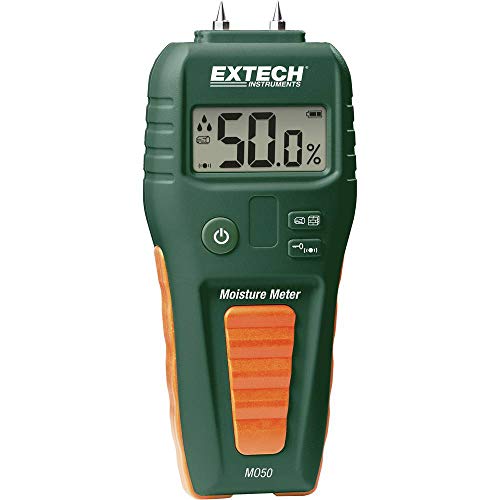

Products shown because their documented specifications fit this guide. Price and availability are on Amazon and can change.
Frequently Asked Questions
Is the MO230 on Amazon?
Not on Amazon US at the time of writing. The Extech MO50 is the listed pocket pin meter and is the closest equivalent.
How does a pin meter work?
Two pins are pushed into the material and the meter measures electrical resistance between them, which falls as moisture rises. The reading is converted to percent moisture content for wood or a relative scale for other materials.
Does it leave marks?
Yes. The pins leave two small holes. For finished surfaces a pinless meter such as the MO257 avoids that.
Can I calibrate it?
Extech pocket pin meters typically have a self-test contact in the cap to verify the electronics. Accuracy against true moisture content depends on the wood species and temperature.
Affiliate disclosure: Akermin earns a commission from qualifying Amazon purchases made through links on this page. Our editorial picks are based on documented specifications and owner feedback, not commissions.