As an Amazon Associate, Akermin earns from qualifying purchases. Product links on this page are affiliate links.
Both sensor types measure CO₂ by infrared absorption at 4.26 µm. A classic NDIR sensor shines infrared through a chamber and measures how much reaches a detector; a photoacoustic sensor pulses the infrared and listens with a microphone for the pressure wave the gas produces as it absorbs the energy. Compare monitors built on them by the stated accuracy (classic NDIR modules are typically a little tighter), size and battery life (photoacoustic wins), calibration behavior (both rely on automatic baseline correction), and price. Either is a genuine measurement; neither is an “eCO₂” estimate.
How each works
Classic NDIR
An infrared source, an optical path of a few centimeters, a filter at the CO₂ absorption wavelength, and a detector. More CO₂ absorbs more light; the detector signal falls. Dual-channel designs add a reference wavelength to cancel lamp aging. Modules: Senseair S8 and Sunrise, Sensirion SCD30, Cubic CM1106, Winsen MH-Z19. See how CO₂ monitors work.
Photoacoustic
The same infrared source is pulsed. CO₂ molecules absorb each pulse and heat slightly, producing a tiny pressure wave in the sealed measurement cell. A MEMS microphone measures the wave; its amplitude is proportional to CO₂ concentration. The optical path can be a few millimeters, so the module is a fraction of the size. Modules: Sensirion SCD40 and SCD41, and newer entrants.
Side by side
| Classic NDIR | Photoacoustic NDIR | |
|---|---|---|
| Stated accuracy (typical modules) | ±(30 to 40 ppm + 3%) | ±(40 to 50 ppm + 5%) |
| Range | 0 to 5,000 or 10,000 ppm | 400 to 2,000 ppm specified; extended to 5,000 with looser accuracy |
| Size | Roughly 30 × 20 × 10 mm and up | About 10 × 10 × 7 mm |
| Power | Higher per measurement; battery units sample every 1 to 10 min | Lower; supports compact battery designs and faster intervals |
| Response time | T63 about 1 to 3 min (diffusion) | Similar; some units update every 5 s in continuous mode |
| Drift and ABC | Dual-channel units drift less; ABC standard | Relies on ABC (ASC); manual forced recalibration available |
| Pressure compensation | Some modules; monitor may add a sensor | Built-in on SCD41 via external pressure input; monitors often include a barometer |
| Temperature and humidity | Separate sensor in the monitor | Integrated in the module |
| Cost | Higher | Lower |
| Example monitors | Aranet4 Home, Airthings View Plus, Temtop C1+ | GoveeLife H5140, SwitchBot Meter Pro CO₂ |
How to compare two monitors
- Identify the module if the maker names it; look up its datasheet.
- Convert stated accuracy to ppm at 1,000 and 2,000 ppm; see how to compare accuracy specifications.
- Check the specified range; photoacoustic modules are specified most tightly at 400 to 2,000 ppm.
- Check whether automatic calibration can be disabled and a manual calibration performed; see how to understand automatic baseline calibration.
- Weigh size, battery and price for your use.
Which to choose
For the tightest accuracy in a display-first, battery monitor, classic NDIR (Aranet4). For compact, affordable or plug-in Wi-Fi monitors with continuous sampling, photoacoustic sensors are the reason such devices exist at their price. For ventilation decisions the difference in accuracy is not decisive; the sensor being a real CO₂ sensor is. See how to check for a true NDIR sensor and best CO₂ monitors for home and office.
Recommended Tools
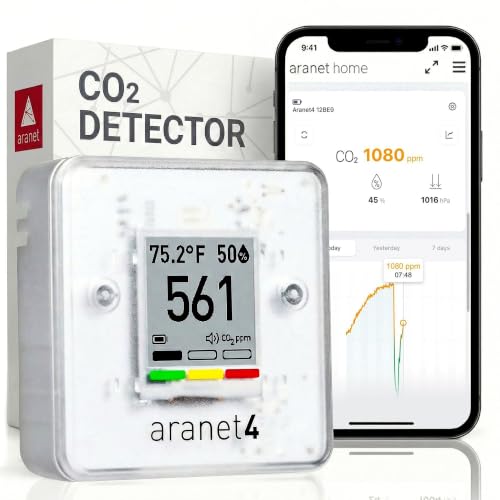


Products shown because their documented specifications fit this guide. Price and availability are on Amazon and can change.
Frequently Asked Questions
Is photoacoustic as accurate as NDIR?
The Sensirion SCD4x photoacoustic family states ±(40 to 50 ppm + 5%), slightly looser than the classic SCD30 or Senseair S8 at ±(30 to 40 ppm + 3%). For ventilation decisions both are adequate.
Why do manufacturers use photoacoustic sensors?
They are much smaller, cheaper and lower-power than classic NDIR modules, which allows compact battery monitors and lower prices with a genuine CO₂ measurement.
Which monitors use which?
Aranet4 uses a classic NDIR (Senseair). GoveeLife H5140, SwitchBot Meter Pro CO₂ and many newer compact monitors use Sensirion SCD4x photoacoustic sensors. Airthings and Temtop use NDIR modules of various makes.
Affiliate disclosure: Akermin earns a commission from qualifying Amazon purchases made through links on this page. Our editorial picks are based on documented specifications and owner feedback, not commissions.