As an Amazon Associate, Akermin earns from qualifying purchases. Product links on this page are affiliate links.
Automatic baseline calibration (ABC) records the lowest CO₂ reading over a rolling window, usually seven to eight days, assumes that reading was outdoor air, and adjusts the sensor so it reads about 400 to 420 ppm. To understand it for your monitor: find the setting (usually under device settings or calibration in the app), note the window length, ask whether the room genuinely reaches outdoor air each week, and if not, disable ABC and calibrate manually every two to three months. Verify either way with an outdoor check.
Step 1: Know what it assumes
NDIR sensors drift slowly. Rather than require regular manual calibration, sensor makers built in ABC: the module watches for its weekly minimum and re-zeros to it. The assumption is that the space empties and ventilates enough to reach roughly outdoor concentration at least once in the window. Homes with people out during the day and windows open at night meet it. Closed bedrooms, basements, greenhouses, 24-hour rooms and sealed offices do not, and ABC then drags the baseline down toward the room’s stale minimum, making every reading too low. See why automatic calibration can be wrong.
Step 2: Find the setting
| Monitor | Where ABC lives | Can it be disabled? |
|---|---|---|
| Aranet4 Home | Aranet Home app, device settings, calibration | Yes (automatic on/off); manual calibration available |
| Airthings View Plus / Wave | Handled internally; sensor status in app | Not user-exposed; the device self-calibrates |
| GoveeLife H5140 | Govee Home app, device settings, calibration | Manual calibration; check the app for automatic mode |
| SwitchBot Meter Pro CO₂ | SwitchBot app, device settings, calibration | Manual calibration; automatic mode per firmware |
| Temtop C1 / C1+ | Button combination per manual; app on C1+ | Manual calibration; automatic mode per model |
App layouts change; the manual for your firmware is authoritative. Where ABC cannot be disabled, the workaround is to give the monitor a weekly hour in fresh air.
Step 3: Decide by room
| Room | Reaches outdoor air weekly? | Recommendation |
|---|---|---|
| Living room, kitchen, office in a home that empties | Yes | ABC on |
| Bedroom, door closed at night | Rarely | ABC off; manual calibration every 2 to 3 months, or weekly airing with the monitor in the room |
| Meeting room, office with HVAC off overnight | Often yes (empty overnight, some leakage) | ABC on; verify outdoors quarterly |
| Classroom | Weekends usually | ABC on; verify each term |
| Basement, cellar, greenhouse, grow room | No | ABC off; manual calibration |
| 24-hour occupied space | No | ABC off; manual calibration |
Step 4: Verify
Once a quarter, put the monitor outdoors in shade for 15 minutes. Expect 400 to 450 ppm. If it is off by more than about 50 ppm, run a manual calibration then and there. See why outdoor CO₂ is useful for checking a monitor and how to calibrate a CO₂ monitor.
Signs ABC has misbehaved
- Readings under 400 ppm.
- A stuffy room reading 450 to 600 ppm.
- The reading returns to exactly 400 at the same time each day regardless of what happened.
- A persistent gap against a second, freshly calibrated monitor; see why two CO₂ monitors show different readings.
Monitors with clear calibration controls are noted in best CO₂ monitors for home and office.
Recommended Tools
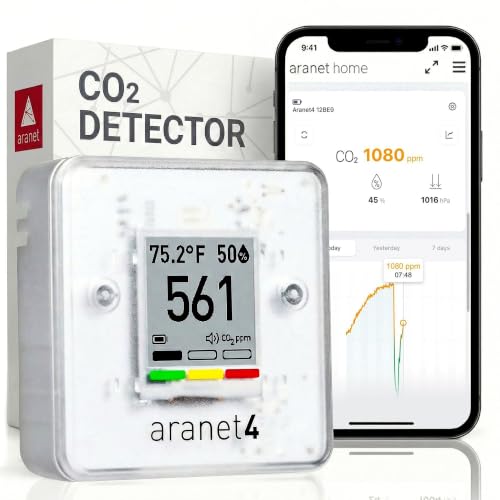

Products shown because their documented specifications fit this guide. Price and availability are on Amazon and can change.
Frequently Asked Questions
What does ABC stand for on a CO₂ monitor?
Automatic Baseline Calibration (or Correction), also called ASC, automatic self-calibration. The sensor assumes its lowest reading over a period, usually a week, was fresh air and adjusts to it.
Should I leave ABC on?
In rooms that are empty and ventilated for some hours each week, yes. In bedrooms with the door shut, basements, greenhouses and continuously occupied rooms, no; calibrate manually instead.
How can I tell whether ABC has been working?
Take the monitor outdoors for 15 minutes. About 400 to 450 ppm means it is fine. A reading under 400 or well over 500 means the baseline has moved.
Affiliate disclosure: Akermin earns a commission from qualifying Amazon purchases made through links on this page. Our editorial picks are based on documented specifications and owner feedback, not commissions.