As an Amazon Associate, Akermin earns from qualifying purchases. Product links on this page are affiliate links.
A portable CO₂ monitor runs on batteries, samples every minute to ten minutes to conserve them, and goes wherever you go: other rooms, the car, hotels, meetings. A wall-mounted (fixed) monitor is usually plug-in, samples continuously, and builds an unbroken record of one room. Buy portable if you want to survey many spaces or carry one monitor, and fixed if you want to understand and log one room. Many battery units do both jobs: carried when needed, hung on a hook the rest of the time.
Side by side
| Portable (battery) | Wall-mounted (plug-in) | |
|---|---|---|
| Power | AA or rechargeable; months to years | USB; continuous |
| Sampling | 1 to 10 minutes (battery trade-off) | Seconds |
| Connectivity | Usually Bluetooth | Usually Wi-Fi |
| Record | Snapshots of many rooms; gaps when moved | Unbroken history of one room |
| Settling after a move | 5 to 15 minutes each time | Not applicable |
| Display | Small; e-ink or LCD | Larger; backlit |
| Alerts | On device; app when in range | Device, app, email, automation |
| Placement freedom | Anywhere | Near a socket |
| Typical models | Aranet4 Home, Temtop C1+, SwitchBot Meter Pro CO₂ | GoveeLife H5140, Airthings View Plus (battery or USB) |
What a portable monitor is good for
- Surveying a house or office one room at a time to find the worst.
- Checking a car, a train, a hotel room, a venue, a friend’s house.
- Meetings: sit it on the far end of the table and watch the room fill.
- Testing placements before fixing a monitor permanently.
- Classrooms without sockets. See choosing a classroom monitor.
The trade-off is the settling delay: every move means 5 to 15 minutes before the reading is the new room’s. Note the time of the move and ignore readings until then. See why sensors need time to stabilize.
What a fixed monitor is good for
- A permanent record of a bedroom, office or meeting room, week after week.
- Continuous alerts and automation.
- Evaluating ventilation from plateaus and decays. See how to use CO₂ data to evaluate ventilation.
- Shared rooms where a large display matters.
The trade-off is the socket: the monitor goes where the power is, which is not always where it should read. Extension leads and USB power banks solve that.
Using one monitor both ways
A battery monitor with a hook mount can be fixed in the bedroom on weekdays and carried at weekends. Set a 2-minute interval for reasonable battery life and responsiveness. Export before and after trips so the history stays coherent.
Decision guide
- One monitor, many rooms, occasional checking: portable.
- One room, continuous record, alerts, automation: fixed.
- Whole office or school: a few fixed loggers in key rooms plus portable units for surveys.
- Travel and cars: portable, compact, with a fast sampling setting.
Both kinds appear in best CO₂ monitors for home and office; the connectivity side is covered in Bluetooth vs Wi-Fi monitors.
Recommended Tools
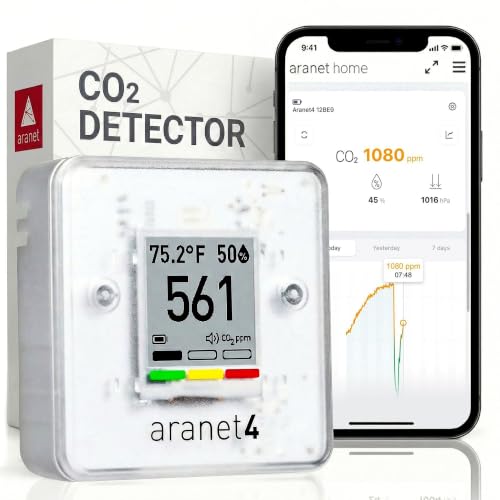


Products shown because their documented specifications fit this guide. Price and availability are on Amazon and can change.
Frequently Asked Questions
Can a portable CO₂ monitor be used as a fixed one?
Yes. A battery monitor on a wall hook is a fixed monitor with a slower sampling interval. Many people buy portable and mount it.
How long does a portable monitor need in a new room before the reading is valid?
Five to ten minutes for the sensor to catch up, longer if the room is much warmer or cooler than where it came from.
Is a portable monitor accurate in a car?
Yes; NDIR sensors work anywhere. Cars with recirculation on reach 2,000 to 4,000 ppm with several occupants, which is a common first surprise for portable monitor owners.
Affiliate disclosure: Akermin earns a commission from qualifying Amazon purchases made through links on this page. Our editorial picks are based on documented specifications and owner feedback, not commissions.