As an Amazon Associate, Akermin earns from qualifying purchases. Product links on this page are affiliate links.
Choose Bluetooth if the monitor will live where you can read it, you want years of battery and no cable, and you prefer data that stays on your phone. Choose Wi-Fi if you need to see readings and get alerts from elsewhere, want long online history and dashboards, or want the monitor to trigger a fan or purifier through a smart-home platform, and you can accept mains power and a cloud account. A Bluetooth monitor plus an optional gateway gives most of both.
Three questions
- Where will you read it? In the room: Bluetooth or the display alone. From another building: Wi-Fi.
- Is there a socket where the monitor should sit? No: Bluetooth on batteries. Yes: either.
- Do you want automation or a fleet dashboard? Yes: Wi-Fi.
Side by side
| Bluetooth | Wi-Fi | |
|---|---|---|
| Battery life | Months to years (Aranet4: up to 4 years) | Days to months; usually plug-in |
| Remote reading | Within about 10 m | Anywhere |
| Alerts away from home | No (unless via gateway) | Yes |
| History | On device, typically 30 to 90 days; synced to phone | Cloud, months to years |
| Export | From the phone app | From app or web dashboard |
| Account required | Often not | Yes |
| Privacy | Data on phone and device | Data on the maker’s servers |
| Smart-home triggers | Limited | Alexa, Google, IFTTT, Home Assistant on many |
| Multi-room fleet | Walk round with a phone | Dashboard |
| Setup | Pair once | Network credentials; 2.4 GHz usually required |
| Dependence on the maker | Low | High; the cloud service must keep running |
Bluetooth in practice
The phone connects when in range and pulls the stored history, so a monitor in a bedroom syncs each time you walk past with the app open. Alerts fire on the device (buzzer, color) rather than the phone. Manufacturers such as Aranet sell a gateway that listens to several Bluetooth monitors and uploads them, turning a battery fleet into a cloud dashboard where needed.
Wi-Fi in practice
The monitor joins the home or office network and streams to the cloud. Phone notifications work anywhere; dashboards show every room; integrations let a purifier or fan respond. The costs: a socket, a 2.4 GHz network the device can join, an account, and readings that live on someone else’s server. When the maker discontinues the service, the device may lose features. Locally hosted options (Home Assistant, Matter) reduce that risk on supported devices.
Use cases
- Bedroom: Bluetooth. Battery, no glow, no cable.
- Home office: either; the display is what you will use.
- Classroom: Bluetooth for the room; a few Wi-Fi units for the facilities team. See how to choose a CO₂ monitor for a classroom.
- Office meeting rooms: Wi-Fi with logging. See how to choose a CO₂ monitor for an office.
- Rental or holiday property: Wi-Fi, to check remotely.
- Portable checking (car, hotels, venues): Bluetooth. See portable vs wall-mounted.
Sensor first, radio second
Connectivity is secondary to the sensor. An NDIR sensor with a stated accuracy is the requirement; radio is convenience. See how to check for a true NDIR sensor. Models of both types are compared in best CO₂ monitors for home and office.
Recommended Tools
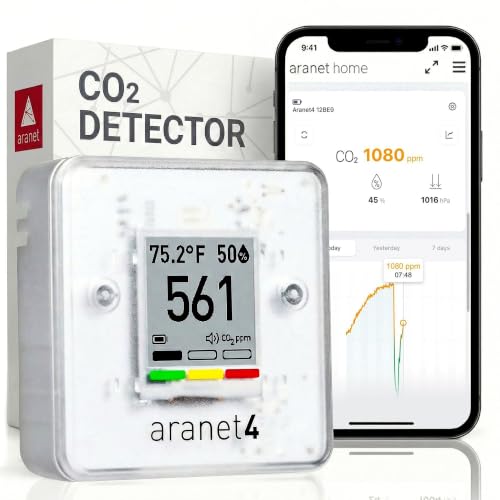


Products shown because their documented specifications fit this guide. Price and availability are on Amazon and can change.
Frequently Asked Questions
Does Wi-Fi drain a CO₂ monitor's battery?
Yes. Wi-Fi monitors are usually plug-in or last weeks to months; Bluetooth monitors on the same battery last years because the radio sleeps between readings.
Can I get alerts from a Bluetooth monitor when I am away?
Not directly. Bluetooth range is a room or two. Some makers sell a gateway or hub that bridges Bluetooth to the cloud, which adds Wi-Fi features to a battery monitor.
Which is more private?
Bluetooth, with data staying on the device and phone. Wi-Fi monitors normally send readings to the maker's cloud and require an account.
Affiliate disclosure: Akermin earns a commission from qualifying Amazon purchases made through links on this page. Our editorial picks are based on documented specifications and owner feedback, not commissions.