As an Amazon Associate, Akermin earns from qualifying purchases. Product links on this page are affiliate links.
Place the monitor across the room from the desk at about 1.5 m, or at the far edge of the desk, never beside the keyboard. Expect a closed 10 m² office with one person to pass 1,000 ppm within an hour. Set a working rule: amber at 1,000 ppm means open the door or crack a window at the next pause; red at 1,500 means do it now. Between calls, open the door; during calls, keep a window on a crack or a trickle vent open. The monitor’s trend also tells you when a break will help more than another coffee.
Setting up
- Placement: opposite wall or shelf, 1.2 to 1.5 m, at least a meter from your chair. See how to place a CO₂ monitor.
- Display: visible from the desk; a color indicator you can see in peripheral vision.
- Alerts: light at 1,000 ppm, light plus a single chime or phone notification at 1,500. See how to set useful alerts.
- Interval: 1 to 2 minutes; the room changes quickly.
What to expect
| Situation | Typical reading after 2 hours |
|---|---|
| Door and window closed, one person | 1,500 to 2,500 ppm |
| Door ajar to a ventilated house | 800 to 1,100 ppm |
| Window cracked, door closed | 700 to 1,000 ppm |
| Trickle vent open, door closed | 900 to 1,300 ppm |
| Two people in the same room | Roughly double the excess over outdoor |
The working rule
- Green (under 800): nothing.
- Amber (800 to 1,000): open the door at the next pause.
- Red (over 1,500): open the door and a window now; a five-minute purge with both open resets the room.
The bands and their basis are in what a good indoor CO₂ level is.
Calls and privacy
The door closes for calls, and that is when CO₂ climbs fastest. Options: a window on a restrictor crack for the duration; a trickle vent left permanently open; a short purge with door and window before each long call; a quiet extract fan. A fan pointed at yourself does nothing for CO₂; see can a fan lower CO₂ levels. Neither does an air purifier; see does an air purifier remove CO₂.
Using the trend
The afternoon dip in concentration that many people attribute to lunch often coincides with a room passing 1,500 ppm. Watch the chart for a few days: if the slump lines up with the red band, the fix is ventilation rather than caffeine. A purge at lunchtime and a door rule in the afternoon usually removes it.
Heating season
Cold weather encourages a sealed room. A window on the smallest crack in winter is more effective than in summer, because the temperature difference drives air exchange; see does opening a window always lower CO₂. The heat loss from a crack for a few hours is small compared with the comfort gain.
Monitors that suit
A compact display unit with a color indicator (Aranet4 Home, SwitchBot Meter Pro CO₂) or a plug-in logger (GoveeLife H5140) both work. See best CO₂ monitors for home and office.
Recommended Tools
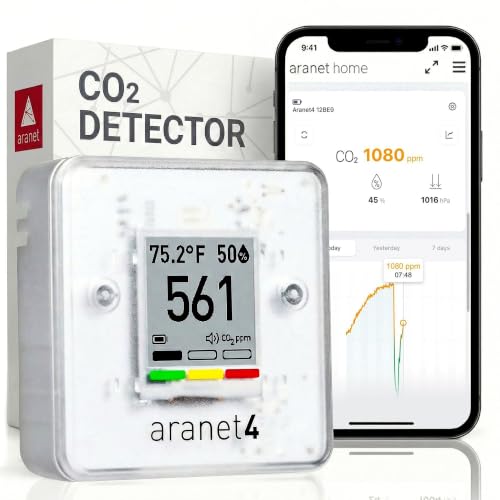

Products shown because their documented specifications fit this guide. Price and availability are on Amazon and can change.
Frequently Asked Questions
How fast does CO₂ rise in a home office?
One person in a closed 10 m² room adds several hundred ppm per hour. Starting from 600 ppm, most small offices pass 1,000 ppm within an hour and 1,500 within two or three.
Where should the monitor go?
Across the room from the desk at about 1.5 m, or at the far edge of a large desk. Beside the keyboard it reads your breath and overstates the room.
Can I keep the door shut for calls and still stay under 1,000 ppm?
With a window cracked or a trickle vent, usually. With the room sealed, no; plan a door-open break between calls.
Affiliate disclosure: Akermin earns a commission from qualifying Amazon purchases made through links on this page. Our editorial picks are based on documented specifications and owner feedback, not commissions.