As an Amazon Associate, Akermin earns from qualifying purchases. Product links on this page are affiliate links.
To use a sling psychrometer, wet the wick on the wet-bulb thermometer with distilled water, whirl the instrument for 60 to 90 seconds until the wet-bulb reading stops falling, and read the wet bulb immediately, then the dry bulb. The difference between them (the wet-bulb depression) gives relative humidity from a psychrometric chart or table, and from that dew point. A digital psychrometer replaces the whirling with an electronic RH sensor and computes wet bulb and dew point; HVAC technicians use it for coil and evaporative-cooling checks.
How it works
Water evaporating from the wet wick takes heat from the bulb. In dry air evaporation is fast and the wet bulb drops several degrees below the dry bulb; in saturated air nothing evaporates and both read the same. The depression is a function of humidity and air pressure, tabulated on the psychrometric chart. Because it depends only on two temperature readings, a good sling psychrometer is a reference instrument that never needs humidity calibration. See what relative humidity is.
Sling psychrometer procedure
- Fill the reservoir or wet the cotton wick with distilled water (tap water leaves minerals that change the reading over time).
- Check the wick is clean, snug and fully wetted; a dry or dirty wick reads high.
- Stand in the air to be measured, away from your body and any heat source.
- Whirl the instrument at about two revolutions per second for 60 seconds.
- Stop and read the wet bulb at once, before it warms; then read the dry bulb.
- Whirl for another 20 to 30 seconds and read again. If the wet bulb has fallen further, repeat until two consecutive readings agree.
- Note dry bulb, wet bulb and air pressure or altitude.
Getting RH and dew point
Enter dry-bulb and wet-bulb temperatures on a psychrometric chart (dry bulb along the bottom, wet bulb on the diagonal lines) and read RH from the curves and dew point along the saturation line. Tables in the instrument’s booklet do the same. Example at sea level: dry bulb 24 °C, wet bulb 18 °C, depression 6 °C → RH about 55 percent, dew point about 14.5 °C. The humidity checker converts an RH result to dew point.
Digital psychrometers
Instruments such as the testo 605i measure dry bulb and RH electronically and compute wet bulb and dew point. They are faster and need no water, and they are only as good as their RH sensor’s calibration. Use a sling psychrometer to check one; see how to calibrate a hygrometer.
Sources of error
| Error | Effect |
|---|---|
| Wick dry, dirty or mineral-encrusted | Wet bulb reads high; RH overstated |
| Insufficient airflow (not whirled long enough) | Wet bulb reads high |
| Reading too slowly after stopping | Wet bulb warms; RH overstated |
| Radiant heat on the bulbs | Both read high; depression distorted |
| Wrong pressure or altitude on the chart | RH error of a few percent at altitude |
| Thermometers not matched | Offset error; check both in the same water |
HVAC uses
- Evaporator performance: entering wet-bulb temperature sets the coil’s capacity; charge and airflow diagnostics use it.
- Evaporative coolers: output can approach but not go below the wet bulb; a high wet bulb means the cooler will not help.
- Comfort and dew point: wet bulb and dry bulb together give dew point for condensation checks on ducts and diffusers.
Environmental meters and probe thermohygrometers with wet-bulb functions are covered in how to choose an environmental meter; for the dew point arithmetic, see how to calculate dew point.
Recommended Tools
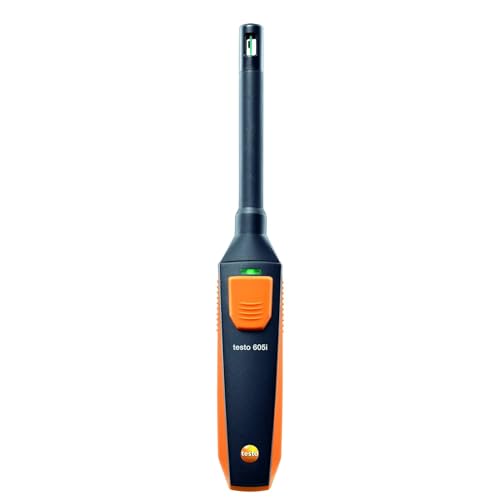

Products shown because their documented specifications fit this guide. Price and availability are on Amazon and can change.
Frequently Asked Questions
What is the wet-bulb temperature?
The temperature a thermometer reads when its bulb is covered by a wet wick and air moves over it. Evaporation cools it below the air temperature by an amount that depends on humidity: the drier the air, the larger the drop.
Do digital psychrometers still use a wet wick?
Most do not. They measure temperature and RH with electronic sensors and calculate wet bulb and dew point. A true wet-bulb reading needs a wetted sensor and airflow.
Why do HVAC technicians want wet-bulb temperature?
Air conditioner capacity and evaporator performance are specified against entering wet-bulb temperature, and evaporative coolers can only cool to near the wet bulb. It captures the total heat content of the air.
Affiliate disclosure: Akermin earns a commission from qualifying Amazon purchases made through links on this page. Our editorial picks are based on documented specifications and owner feedback, not commissions.
Related Guides

CPS LS790B Leak-Seeker Review: Non Combustible Is the Deciding Word
An ion pump refrigerant leak detector individually calibrated to find a leak rate better than a quarter of an ounce per year, with ten selectable sensitivity ranges, a water vapour filter and a bar graph plus tone display.
Read More→
BW Clip BWC2-H Review: Alarm Points Set Before the Clock Starts
A single gas hydrogen sulfide detector with one button operation, hibernation mode, automatic logging of the 35 most recent gas events and bump test results, and compatibility with IntelliDoX and MicroDock II docking.
Read More→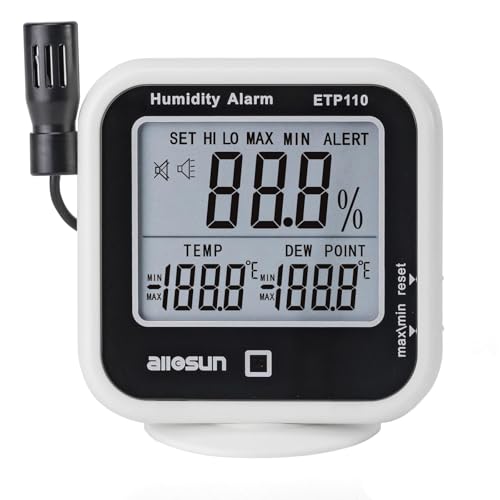
ALLOSUN Thermometer Hygrometer Review: Half a Metre of Lead and No Tolerance
A battery powered thermometer and hygrometer showing temperature, relative humidity and dew point, with a settable humidity alarm, a sensor on a lead of about 50 cm, maximum and minimum memory and a large LCD.
Read More→