As an Amazon Associate, Akermin earns from qualifying purchases. Product links on this page are affiliate links.
A hygrometer is the general term for any instrument that measures humidity. A psychrometer is a particular kind of hygrometer that measures wet bulb and dry bulb temperature and calculates relative humidity, dew point and wet bulb from those two readings. If you need a fast, low cost indoor humidity number, a simple hygrometer such as the Temtop S1+ or the Govee H5179 is enough. If you need to know how much water vapour the air can still take up, or you are working in drying, HVAC or building diagnostics, a psychrometer such as the ERAY digital psychrometer or the Triplett MS475 gives you the wet bulb and dew point figures that a basic hygrometer leaves out.
The word psychrometer describes a method, not a separate category
A hygrometer is any instrument that answers the question “how much water vapour is in the air?” That answer can be expressed in several ways: relative humidity, absolute humidity, dew point, mixing ratio or wet bulb temperature. A psychrometer is one way of getting those answers. It measures the temperature of a dry thermometer and the temperature of a wet thermometer, and uses the difference between them to calculate the humidity.
The wet bulb thermometer is wrapped in a wet wick. As water evaporates from the wick, it takes heat away from the bulb, so the wet bulb temperature drops below the dry bulb temperature. The drier the air, the faster the evaporation, and the bigger the gap between the two readings. That gap, combined with the dry bulb temperature and the local air pressure, is enough to calculate relative humidity and dew point. In a sling psychrometer you whirl the two thermometers to keep air moving over the wick; in a digital psychrometer the instrument does the arithmetic for you.
So every psychrometer is a hygrometer, but not every hygrometer is a psychrometer. Most inexpensive indoor hygrometers use a capacitive polymer sensor that changes its electrical properties as it absorbs and releases water vapour. They report a finished relative humidity number, and often temperature as well, but they do not give you wet bulb or dew point unless the firmware calculates them from the humidity and temperature.
The distinction matters when you are buying. A listing that says “hygrometer” may be a simple sensor based meter. A listing that says “psychrometer” should give you wet bulb and dew point, and often the dry bulb temperature as well. The ERAY digital psychrometer is a clear example: its bullets list humidity, temperature, wet bulb and dew point as separate functions. A basic hygrometer such as the Temtop S1+ reports temperature and humidity, but the listing does not claim wet bulb or dew point.
What a wet bulb reading tells you that relative humidity does not
Relative humidity is a ratio: the amount of water vapour in the air compared with the maximum the air could hold at that temperature. That ratio changes when the temperature changes, even if the actual amount of water vapour stays the same. A room at 20 degrees Celsius and 50 percent relative humidity holds the same water vapour as the same room at 25 degrees Celsius and about 36 percent relative humidity. The relative humidity number alone does not tell you how much water is present, only how close the air is to saturation at that moment.
Wet bulb temperature is a different kind of number. It tells you the lowest temperature that a surface can reach by evaporative cooling under those conditions. That is directly relevant to drying: if you are drying a damp wall or a floor screed, the wet bulb temperature tells you how effective evaporation will be. If the wet bulb is close to the dry bulb, the air is nearly saturated and drying will be slow. If the gap is wide, drying will be fast. A psychrometer gives you both numbers, so you can see the gap.
Dew point is the other useful figure. It is the temperature to which the air must be cooled before water vapour starts to condense. If a cold water pipe or a window pane is below the dew point, condensation will form on it. A psychrometer that reports dew point lets you compare the dew point with the surface temperature of a wall or a pipe and predict whether condensation is likely. A basic hygrometer that only reports relative humidity leaves you to calculate that yourself, and you need the temperature as well to do it.
The Triplett MS475 is a good illustration of how far a multi function meter can go: its built in humidity and temperature probe reports relative humidity, air temperature, mixing ratio, vapour pressure and dew point. That is a psychrometric function set, even though the product is sold as a moisture meter with a psychrometer built in. The Govee H5179 reports temperature and humidity and sends alerts when either goes out of range, but the listing does not publish dew point or wet bulb. That is not a fault; it is a different job.
The accuracy question: why a psychrometer is not automatically better
It is tempting to assume that a psychrometer, because it measures two temperatures and calculates the result, must be more accurate than a sensor based hygrometer. That is not necessarily true. The accuracy of a psychrometer depends on the accuracy of its two thermometers, the cleanliness of the wick, the airflow over the wick, and the air pressure used in the calculation. A digital psychrometer with a contaminated wick or a dry wick will read the wet bulb temperature too high, and the calculated humidity will be wrong. A sensor based hygrometer can drift too, but its error mode is different: the polymer sensor can become saturated or contaminated, and the reading can drift without any obvious physical sign.
The honest answer is that both types need care. The ERAY digital psychrometer listing gives a temperature range of -30 to 60 degrees Celsius and a humidity range of 0 to 100 percent relative humidity, but it does not publish an accuracy figure for either. Not stated in the listing bullets. The Govee H5179 does publish accuracy: plus or minus 0.3 degrees Celsius for temperature and plus or minus 3 percent relative humidity for humidity. That is a useful figure because it tells you the margin of error you are working with. If a listing does not publish accuracy, you cannot assume it is good.
For most indoor monitoring, a sensor based hygrometer with a published accuracy figure is the more practical choice. It is small, it runs on a battery for months, and it can send an alert to your phone. The Temtop S1+ claims up to 60 days of battery life and reports temperature, humidity, PM2.5 and AQI. That is a different product category from a psychrometer, but for a homeowner watching a damp bedroom it is the right tool. For a technician commissioning a drying system, the wet bulb and dew point from a psychrometer are worth the extra care.
Where the words get confused in product listings
Product listings often use the words loosely. A listing may call a simple sensor based hygrometer a “psychrometer” because it calculates dew point in firmware, even though it has no wet bulb thermometer and no wick. That is not necessarily dishonest, but it means you cannot rely on the word alone. Look for the functions listed. If the listing mentions wet bulb temperature, it is describing a psychrometric function. If it only mentions humidity and temperature, it is a basic hygrometer, however it is labelled.
The Triplett MS475 is an example of a multi function instrument that combines a moisture meter, a psychrometer probe and an infrared thermometer. Its humidity probe measures relative humidity, air temperature, mixing ratio, vapour pressure and dew point. That is a psychrometric set of outputs. The infrared thermometer has an 8:1 distance to target ratio and a fixed emissivity of 0.95, which is a separate function for checking surface temperatures without contact. That combination is useful for building diagnostics because you can compare the dew point with a surface temperature and see whether condensation is likely.
At the other end, the Temtop S1+ and the Govee H5179 are indoor air quality monitors with humidity sensors. They are hygrometers in the general sense, but they are not psychrometers. They do not measure wet bulb or dry bulb separately. They report a calculated relative humidity from a sensor. That is fine for their purpose, which is monitoring a room and alerting you to changes. It is not the right instrument for measuring the drying potential of air in a commercial drying job.
If you want to go deeper into the sling psychrometer, which is the manual version of the same physics, see hygrometer vs sling psychrometer. The principles are the same: wet bulb and dry bulb, and a calculation.
A table of what each instrument reports
The table below compares the outputs that the listings publish. Where a listing does not publish a figure, the cell says Not stated. This is not a ranking; it is a map of what each instrument actually gives you.
| Instrument | Relative humidity | Temperature | Wet bulb | Dew point | Other outputs | Published accuracy |
|---|---|---|---|---|---|---|
| Triplett MS475 | Yes | Yes | Not stated | Yes | Mixing ratio, vapour pressure, moisture content (pin and pinless), IR surface temperature | Not stated |
| Temtop S1+ | Yes | Yes | No | No | PM2.5, AQI, app connectivity | Not stated |
| Govee H5179 | Yes | Yes | No | No | App alerts, WiFi and Bluetooth | Temperature plus or minus 0.3 C, humidity plus or minus 3 percent RH |
| ERAY digital psychrometer | Yes | Yes | Yes | Yes | Backlight, dual display | Not stated |
Note that the Triplett MS475 does not list wet bulb in its bullets, but it does list dew point and mixing ratio, which are psychrometric outputs. The ERAY explicitly lists wet bulb and dew point. The two indoor monitors do not claim either. That difference is the practical distinction between a psychrometer and a basic hygrometer.
When a psychrometer is the wrong purchase
If your question is “is my bedroom too damp?”, a psychrometer is overkill. A simple hygrometer with an alert function, such as the Govee H5179, will tell you when humidity goes above a threshold you set. It will log the data and send a notification. You do not need wet bulb or dew point for that. The same applies to a baby room or a basement where you want a warning of high humidity. The Temtop S1+ adds PM2.5 and AQI, which may be useful if you are also concerned about air quality, but it is still a sensor based hygrometer, not a psychrometer.
A psychrometer becomes the right purchase when you need to know the drying potential of air, or when you need to compare dew point with surface temperature to predict condensation. That is why the ERAY digital psychrometer includes wet bulb and dew point in its display. It is aimed at people who need those numbers, not just a humidity percentage. The Triplett MS475 goes further by adding moisture measurement in building materials, which is useful if you are diagnosing a damp wall rather than just monitoring the air.
There is also a maintenance point that nobody mentions. A psychrometer with a wick needs the wick kept clean and wet. A contaminated wick will give a false wet bulb reading. A sensor based hygrometer needs no wick, but its sensor can drift over time and may need recalibration or replacement. Neither type is maintenance free. If you want to know whether a hygrometer is worth it at all for your situation, see is a hygrometer worth it. If you are worried about accuracy, see is a hygrometer accurate.
For a step by step guide to using a psychrometer, including the sling type, see how to use a psychrometer. And if you are comparing a moisture meter with a hygrometer, the distinction is explained in protimeter vs hygrometer.
The short answer, repeated because it is easy to lose
A hygrometer is the general tool. A psychrometer is a hygrometer that measures wet bulb and dry bulb and calculates the rest. Buy a basic hygrometer for monitoring a room; buy a psychrometer when you need wet bulb or dew point to make a decision about drying or condensation. The ERAY digital psychrometer and the Triplett MS475 are psychrometers. The Temtop S1+ and the Govee H5179 are hygrometers. Both are useful; they answer different questions.
Frequently Asked Questions
Is a psychrometer more accurate than a digital hygrometer?
Not automatically. A psychrometer's accuracy depends on its thermometers, the wick condition and the airflow. A sensor based hygrometer's accuracy depends on the sensor and its calibration. The Govee H5179 publishes plus or minus 3 percent relative humidity; the ERAY psychrometer does not publish an accuracy figure in its listing bullets. Without a published figure you cannot assume one is better.
Can I use a psychrometer to check humidity in my house?
Yes, but it is more instrument than you need for that job. A simple hygrometer with an alert, such as the Govee H5179, will tell you when humidity is high and let you set a threshold. A psychrometer gives you wet bulb and dew point, which are useful for drying and condensation analysis but not necessary for general indoor monitoring.
What is the difference between wet bulb and dew point?
Wet bulb is the temperature a wet surface reaches when evaporation cools it. Dew point is the temperature to which air must be cooled for water vapour to condense. Both are derived from the same psychrometric data, but they answer different questions: wet bulb tells you about drying potential, dew point tells you about condensation risk.
Why does my hygrometer not show dew point?
Many basic hygrometers only report relative humidity and temperature. Dew point is a calculated value that requires both humidity and temperature, and some manufacturers choose not to include it in the firmware. A psychrometer such as the ERAY digital psychrometer lists dew point as a separate function.
Do I need to calibrate a psychrometer?
The thermometers in a psychrometer should be checked against a reference, and the wick must be kept clean and wet for accurate readings. The listing for the ERAY digital psychrometer does not publish a calibration procedure. A sensor based hygrometer may also drift and need recalibration; the Govee H5179 listing does not mention calibration.
Which one should I buy for a damp basement?
For monitoring, a hygrometer with an alert such as the Govee H5179 is the practical choice. For diagnosing the cause, a psychrometer such as the ERAY digital psychrometer or a moisture meter such as the Triplett MS475 will tell you more about drying conditions and moisture in materials. If you only need to know when to run a dehumidifier, the simple hygrometer is enough.
Related Guides

Kestrel 5400 WBGT Heat Stress Tracker: A Single-Product Review
A focused review of the Kestrel 5400 WBGT Heat Stress Tracker, its waterless wet bulb method, onboard logging, and its place beside other environmental instruments on the site.
Read More→Weather Station vs Separate Instruments: Which Should You Buy?
This page explains when an integrated weather station is the better instrument and when separate sensors are, with the trade-offs that decide it.
Read More→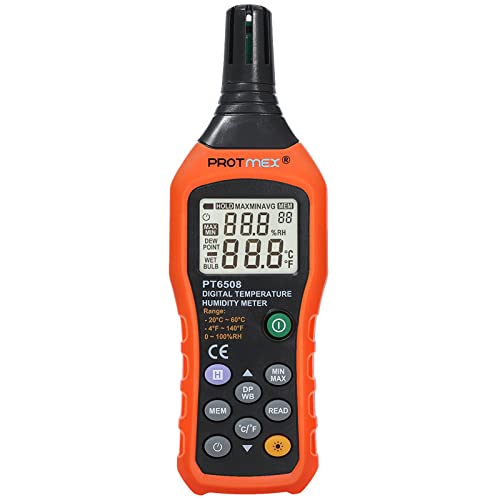
Protmex PT6508 Temperature Humidity Meter Review: One Instrument, Four Numbers
A single-product review of the Protmex PT6508, explaining what its four measurements mean in practice, where the design forces a compromise, and who should buy a different kind of instrument.
Read More→