As an Amazon Associate, Akermin earns from qualifying purchases. Product links on this page are affiliate links.
If you are growing plants under artificial light or managing a greenhouse, you need a PAR meter. A lux meter will tell you the room is bright, but it cannot tell you whether the spectrum is usable for photosynthesis. The DANOPLUS quantum PAR meter measures photosynthetic photon flux density (PPFD) in micromoles per square metre per second over the 400 to 700 nanometre waveband, which is the standard definition of PAR. The Dr.meter lux meter measures illuminance in lux or foot-candles, a human-weighted quantity. For plant work, the PAR meter is the correct instrument. For workplace lighting, photography, or general brightness checks, the lux meter is appropriate and the PAR meter would be misleading.
What each meter actually measures, and why the numbers do not convert
A lux meter measures illuminance: the amount of light falling on a surface, weighted by the sensitivity of the human eye. The eye is most sensitive to green light around 555 nanometres and almost blind to deep red and blue. Lux is a photometric unit, built for human vision. A PAR meter measures photosynthetic photon flux density (PPFD): the number of light particles (photons) in the 400 to 700 nanometre range that land on a square metre every second. That range is called photosynthetically active radiation, or PAR. Plants do not see; they absorb photons to drive photosynthesis, and they use red and blue light far more efficiently than green.
Because the two meters weight the spectrum differently, there is no fixed conversion factor. A green LED that looks bright to the eye can have a low PPFD, while a magenta grow light can have a high PPFD but look dim. The only way to know PPFD is to measure it with a quantum sensor. The DANOPLUS PAR meter specifies a cut-on wavelength of 400 nm and a cut-off of 700 nm with a tolerance of plus or minus 10 nm, which matches the standard PAR waveband. Its range is 0 to 5000 micromoles per square metre per second. The Dr.meter lux meter covers 0 to 200,000 lux and can toggle between lux and foot-candles. Those numbers are not comparable.
When a lux meter is the right tool, and when it is not
Lux meters are the correct instrument for human-centric lighting: checking office desk levels, verifying emergency lighting, assessing photography exposure, or confirming that a room meets a lighting design target. They are cheap, fast, and widely used in building surveys. The Dr.meter reads twice per second and can hold a peak value, which is useful for catching brief high-intensity pulses. For plant work, however, lux is a poor proxy. Two lamps with the same lux output can have very different PPFD because their spectra differ. A lux meter will not tell you if your grow light is strong enough for fruiting tomatoes, and it will not tell you if a greenhouse is light-limited on a cloudy day. If you are making decisions about plant growth, a lux meter is the wrong instrument.
That said, a lux meter can be a useful secondary check for human comfort or for verifying that a light fixture is switched on. But it should not be the basis for setting photoperiods or intensity for crops. For a deeper explanation of illuminance and its limits, see what a lux meter is and when it is useful.
What a PAR meter tells you that a lux meter cannot
A PAR meter gives you PPFD, the quantity that appears in horticultural research and commercial grower guidelines. For example, a lettuce crop might need 200 to 400 micromoles per square metre per second over a 16-hour photoperiod, while tomatoes might need 500 to 1000. These figures are PPFD, not lux. Without a PAR meter you cannot know where you stand. The DANOPLUS also stores up to 100 measurements and displays the last four, which helps you track changes over time or compare locations. That record function is valuable when you are adjusting lamp height or assessing light distribution across a canopy.
PAR meters are not without limitations. The standard 400 to 700 nm waveband excludes ultraviolet and far-red, which can affect plant morphology. Some advanced meters extend to 700 to 750 nm (far-red), but the DANOPLUS listing does not state that it does. Also, a PAR meter measures photon flux density, not the spectral distribution. It tells you how many photons are available, not whether the spectrum is balanced for your crop. For spectrum, you need a spectroradiometer, which is a different class of instrument. But for everyday grow-room decisions, PPFD is the key number.
The common mistake: using lux to set grow lights
The most frequent error is to buy a lux meter because it is cheaper and then try to convert lux to PPFD using a single factor found online. That factor is only valid for a specific spectrum, usually daylight or a particular lamp type. For white LEDs it might be roughly 0.02, but for red/blue grow lights it can be very different. Using the wrong factor can lead to under- or over-lighting by a factor of two or more. The result is wasted energy, poor growth, or heat damage. A PAR meter removes the guesswork by measuring the actual photosynthetic photons.
Another mistake is to assume that a PAR meter is just a lux meter with a different filter. In reality, a quantum sensor uses a carefully designed optical filter and diffuser to approximate the ideal PAR response, and it is calibrated in micromoles per square metre per second. The DANOPLUS listing states a tolerance of plus or minus 10 nm on the cut-on and cut-off wavelengths, which is typical for a mid-range quantum sensor. That tolerance means the meter may include a small amount of light just outside the 400 to 700 nm band, but for most grow-room work it is acceptable. If you need higher accuracy, you would look at a research-grade sensor, which is a different product category. For an overview of PAR meter options, see best PAR meters.
Where each instrument stops being the right answer
Neither a lux meter nor a PAR meter is a complete light measurement solution. A lux meter cannot tell you about plant-usable light, and a PAR meter cannot tell you about human comfort or color rendering. If you need to design a lighting system that serves both people and plants, you need both instruments, or a spectroradiometer that reports both photometric and radiometric quantities. Also, neither meter measures spectrum, so neither can tell you if your light is missing important wavelengths. For that, you need a spectrometer.
Additionally, a PAR meter measures instantaneous PPFD. To calculate daily light integral (DLI), the total light delivered over a day, you need to log PPFD over time and integrate. Some PAR meters have logging, but the DANOPLUS listing only mentions storing up to 100 manual measurements, not continuous logging. For DLI you would need a meter with a logging interval or a dedicated DLI meter. Finally, remember that a meter is not a controller. It does not turn lights on or off or adjust intensity. It is a diagnostic tool. If you need automated control, you need a lighting controller with a PAR sensor, which is a different product.
Practical considerations before you buy
If you are a home grower with a small tent, a PAR meter may be overkill. Many growers use a lux meter as a rough guide, accepting the inaccuracy, or they rely on manufacturer PPFD charts and a fixed hanging height. But if you are optimizing yield, comparing lamps, or diagnosing poor growth, a PAR meter pays for itself. The DANOPLUS is a dedicated quantum PAR meter with a 0 to 5000 micromole range, which covers most grow lights. The Dr.meter is a general-purpose lux meter with a 0 to 200,000 lux range, suitable for checking room brightness or verifying that a lamp is on. Neither listing states a calibration interval or accuracy specification beyond the wavelength tolerance, so you should treat absolute readings with caution and focus on relative changes.
For a broader discussion of resolution and what it means in a digital meter, see what is resolution in a digital meter. That concept applies to both lux and PAR meters: a display that shows many digits does not guarantee accuracy. Always check the stated tolerance and range. For other environmental monitoring topics, you might look at what is a sound level meter or a review like SwitchBot Meter Pro review.
The short answer, repeated
For plant lighting decisions, use a PAR meter. For human lighting or general brightness, use a lux meter. Do not try to convert between them without knowing the spectrum. If you need both, buy both, but do not expect one to substitute for the other.
Frequently Asked Questions
Can I use a lux meter to measure PAR?
No, not directly. Lux is weighted to the human eye, while PAR counts photons in the 400 to 700 nm range. A conversion factor exists only for a specific, known spectrum, and it is not reliable for arbitrary grow lights. Use a PAR meter for plant measurements.
What is the difference between PPFD and lux?
PPFD (photosynthetic photon flux density) is the number of photons in the 400 to 700 nm range hitting a square metre per second, measured in micromoles per square metre per second. Lux is a photometric measure of illuminance weighted by the human eye's sensitivity. They measure different things and have different units.
Do I need a PAR meter for a small indoor grow?
Not necessarily. For a small hobby grow, you can often rely on manufacturer PPFD charts and a fixed hanging height. But if you want to optimize or troubleshoot, a PAR meter like the DANOPLUS gives you direct PPFD readings. A lux meter will not tell you what you need to know.
Is the DANOPLUS PAR meter accurate?
The listing states a wavelength tolerance of plus or minus 10 nm on the 400 and 700 nm cut-on and cut-off, and a range of 0 to 5000 micromoles per square metre per second. It does not publish an accuracy specification or calibration interval. For most grow-room decisions, that is sufficient, but for research-grade work you would need a calibrated sensor with a certificate.
Can a PAR meter measure human light levels?
No. A PAR meter is not weighted for human vision, so its readings do not correspond to lux or foot-candles. Using a PAR meter to assess office lighting would give misleading results. Use a lux meter for human-centric lighting.
What about meters that claim to measure both lux and PAR?
Some multi-function meters exist, but they typically use separate sensors or filters. The listings here do not describe such a product. If you see a meter claiming both, check that it has a proper quantum sensor for PAR and a photometric filter for lux. A single sensor cannot accurately do both without switching filters.
Related Guides
Calibrated instrument against an uncalibrated one: what actually changes
Calibration anchors a reading to a known reference; without it you have repeatability but not accuracy, and the gap between the two is where bad decisions live.
Read More→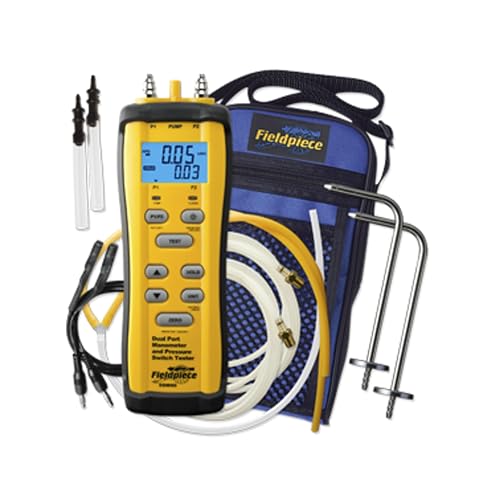
Fieldpiece SDMN6 Pressure Switch Tester Review
A focused review of the Fieldpiece SDMN6, a dual-display pressure switch tester for gas and static pressure work.
Read More→Wired Probe or All-in-One Sensor Housing: Which Fits Your Monitoring Job?
The difference between a cabled probe and a single housing, and the jobs each one suits.
Read More→