As an Amazon Associate, Akermin earns from qualifying purchases. Product links on this page are affiliate links.
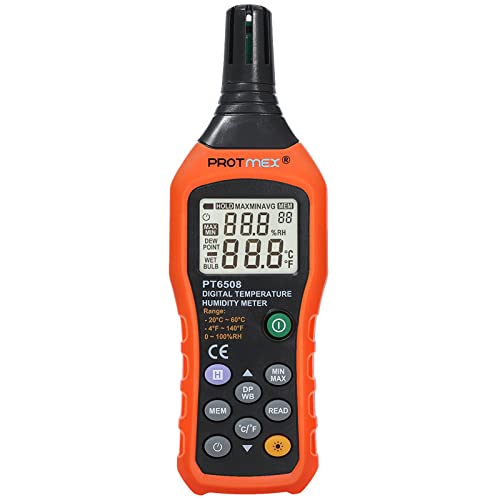
Protmex · Protmex PT6508 Temperature Humidity Meter - Wet Bulb for Indoor/Outdoor | Digital Thermometer Hygrometer Monitor with Ambient, Dew Point, MIN, MAX, Data Hold, LCD Backlight
View on AmazonPrice and availability are shown on Amazon and can change at any time.
The Protmex PT6508 is a handheld psychrometer that displays relative humidity, air temperature, wet bulb temperature and dew point temperature from the same sensor pair. The listing publishes a humidity range of 0 to 100 percent RH, an air temperature range of -20 to 60 degrees Celsius (-4 to 140 Fahrenheit), a wet bulb range of -20 to 60 degrees Celsius, and a dew point range of -50 to 60 degrees Celsius. It also states data hold, data storage, unit conversion, a backlight, a low battery indicator, automatic shutdown after 30 minutes without operation, and maximum and minimum functions. The trade-off the design forces is this: four numbers on one screen are convenient for a spot check, but the instrument is a meter, not a logger and not an alarm. If you need a continuous record or a relay output, the PT6508 is the wrong shape of tool, and the listing does not claim otherwise.
The trade-off the dual display forces on the owner
The PT6508 shows humidity and temperature together on a dual display, and it derives wet bulb and dew point from the same sensor pair. That is the whole design. The benefit is obvious: one handheld, one battery, one screen, four numbers that are related to each other. The cost is less obvious and worth stating plainly. A dual display gives you a snapshot. It does not give you a record over time, it does not give you an output that can switch a fan or a dehumidifier, and the listing does not publish a logging interval, a memory capacity in readings, or a communication interface.
For a technician checking whether a room is inside a target band, a snapshot is enough. For a museum store, a cold store, or a building-monitoring job where the question is what happened overnight, a snapshot is not enough, and the PT6508 is the wrong instrument. The listing’s own application list is broad, covering HVAC, industry, agriculture, meteorology, medicine, building engineering, wine cellars, machine rooms and data storerooms. Read that list as places where somebody carries the meter to the space and reads it, not as places where the meter is left behind to record.
If you need a record rather than a reading, the site’s guide to choosing a temperature and humidity data logger sets out what changes when the instrument has to remember rather than display.
What wet bulb and dew point add that relative humidity alone does not
Relative humidity is a ratio: the water vapour actually in the air against the maximum the air could hold at that temperature. Because the maximum changes with temperature, the same relative humidity at two different temperatures describes two different amounts of water vapour. That is why a room at 70 percent RH and 30 degrees Celsius feels and behaves differently from a room at 70 percent RH and 15 degrees Celsius, and why a relative-humidity reading alone can mislead when you are diagnosing condensation, drying, or evaporative cooling.
Dew point is an absolute measure: the temperature to which the air must be cooled for condensation to begin. The listing describes it as a measure of how much water vapour is actually in the air, which is the right way to think about it. A dew point close to the surface temperature is a warning that the surface will sweat. Wet bulb temperature is the other derived number: the lowest temperature reachable by evaporative cooling, which is why it appears in heat-stress work and in evaporative cooler commissioning. The listing publishes a wet bulb range of -20 to 60 degrees Celsius and a dew point range of -50 to 60 degrees Celsius, both wider at the cold end than the air temperature range, which is normal for derived values.
The PT6508 computes both from the same sensor pair, so the accuracy of the derived numbers is tied to the accuracy of the humidity and temperature sensors. The listing says the meter has a high accuracy sensor but does not publish an accuracy figure in percent RH or in degrees. Treat the derived numbers as useful for comparison and for spotting a trend, not as calibration references. The site’s explainer on calculating dew point from temperature and humidity shows the arithmetic the meter is doing internally.
The published ranges, and the two figures the listing withholds
The listing is specific about ranges and silent about accuracy. That is the honest summary. The table below reproduces only what the bullets state.
| Quantity | Published range | Published accuracy |
|---|---|---|
| Relative humidity | 0 to 100 percent RH | Not stated in the listing bullets |
| Air temperature | -20 to 60 degrees Celsius (-4 to 140 Fahrenheit) | Not stated in the listing bullets |
| Wet bulb temperature | -20 to 60 degrees Celsius (-4 to 140 Fahrenheit) | Not stated in the listing bullets |
| Dew point temperature | -50 to 60 degrees Celsius (-58 to 140 Fahrenheit) | Not stated in the listing bullets |
Two things a buyer would reasonably want are missing. The first is accuracy, in percent RH and in degrees. Without it you cannot say whether a reading of 55 percent RH means 55 plus or minus two, or 55 plus or minus five, and that difference matters when you are commissioning a dehumidifier against a tight target. The second is resolution, which is the smallest change the display will show. A meter can have a wide range and a coarse display, and the listing does not separate the two.
The listing also does not publish a response time, an operating temperature for the instrument itself, a battery type, or an ingress rating. Those are not minor omissions for outdoor work: an instrument without a published ingress rating should not be assumed to tolerate rain or dust. The site’s broader guide to choosing a humidity meter for indoor use explains which of these figures usually decide a purchase.
The functions that earn their place: hold, max, min, and the backlight
Data hold freezes the displayed value so you can read it after withdrawing the meter from a duct or a corner. Maximum and minimum record the extremes since the last reset, which is the closest the PT6508 comes to logging: you can leave it in a space for a period and read the highest and lowest values afterwards, but you cannot see when they occurred. Data storage is listed, but the listing does not publish how many readings it holds or how they are retrieved, so treat storage as a convenience for a handful of spot values rather than as a substitute for a logger.
The backlight is described as brighter in darker places, which is the point of it: plant rooms, ceiling voids and wine cellars are often poorly lit, and a display you cannot read is a display you do not have. Unit conversion lets you switch between Celsius and Fahrenheit, which matters when a manufacturer’s data sheet and a site’s target are in different units. The low battery indicator and the automatic shutdown after 30 minutes without operation are housekeeping features: the first stops a reading going wrong silently, the second stops the battery draining in a toolbox. None of these is a measurement feature, and none of them changes the trade-off described above.
Where the PT6508 stops being the right instrument
The PT6508 is a spot-check psychrometer. It stops being the right answer in three situations. The first is continuous monitoring: if the question is what the humidity did while nobody was in the room, you need a logger, and the site’s comparison of temperature and humidity monitors covers instruments built for that. The second is control: the PT6508 displays, it does not switch anything, and the listing publishes no alarm or relay output, so it cannot run a dehumidifier or raise an alarm. The third is regulated or contractual measurement: without a published accuracy figure, the PT6508 cannot be offered as a calibrated reference, and a job that requires a certificate needs an instrument whose listing states the accuracy and the calibration status.
There is also a category boundary worth naming. The listing mentions HVAC work, and HVAC work often needs airflow as well as humidity. The PT6508 measures temperature and humidity only; it does not measure air velocity or volume flow. If duct airflow is part of the job, a hot wire anemometer such as the one reviewed on the site is a different instrument for a different measurement, not a substitute. Buy the PT6508 for the psychrometric numbers and add an airflow meter if the job needs one.
Who the PT6508 suits, and who it does not
The PT6508 is a sensible buy for a technician or a careful homeowner who wants relative humidity, air temperature, wet bulb and dew point on one handheld screen for spot checks, and who values the hold, max, min and backlight functions. It is a poor buy for anyone who needs a continuous record, an alarm output, or a published accuracy figure, because the listing does not provide them. The single trade-off is convenience against record-keeping: the PT6508 gives you four related numbers immediately, and asks you to accept that it will not remember them for you.
Recommended Tools


Products shown because their documented specifications fit this guide. Price and availability are on Amazon and can change.
Frequently Asked Questions
Does the PT6508 measure dew point and wet bulb directly?
No. It measures humidity and air temperature, and computes wet bulb and dew point from those two readings. The listing presents all four as functions of the meter, and publishes separate ranges for each, but the derived numbers are only as good as the humidity and temperature sensors. The listing does not publish an accuracy figure for either sensor.
Can I leave the PT6508 in a room to record overnight?
Not in the sense a logger records. The listing states data storage and maximum and minimum functions, but it does not publish a logging interval, a memory capacity in readings, or a way to retrieve a time-stamped record. You can read the extremes after a period, but you cannot see when they occurred. For overnight records, a data logger is the right instrument.
Is the PT6508 accurate enough for commissioning work?
The listing does not publish an accuracy figure in percent RH or in degrees, so it cannot be assessed against a commissioning tolerance from the published information alone. It is suitable for spot checks and comparisons. If a job requires a stated accuracy or a calibration certificate, choose an instrument whose listing publishes both.
What does the 30-minute automatic shutdown do?
The listing states that the meter shuts down automatically after 30 minutes without operation. It is a battery-saving feature, not a measurement feature, and it means the meter will not stay on indefinitely if you put it down and walk away. If you are using the maximum and minimum functions over a long period, check that the meter is still on when you return.
Does the PT6508 measure airflow or carbon dioxide?
No. The listing covers humidity, air temperature, wet bulb and dew point only. It does not publish an air velocity, air volume or CO2 function. HVAC work often needs airflow as well, and that requires a separate anemometer; the PT6508 is not a substitute for one.
Is the PT6508 weatherproof for outdoor use?
The listing does not publish an ingress rating, so there is no stated protection against rain or dust. The title mentions indoor and outdoor use, but without a published ingress rating the meter should not be assumed to tolerate wet conditions. Treat outdoor use as sheltered use unless the manufacturer states otherwise.
Affiliate disclosure: Akermin earns a commission from qualifying Amazon purchases made through links on this page. Our editorial picks are based on documented specifications and owner feedback, not commissions.