As an Amazon Associate, Akermin earns from qualifying purchases. Product links on this page are affiliate links.
A UV meter measures ultraviolet radiation, usually in the UV-A or UV-B band, and is the right tool for checking sunburn risk, lamp output, or UV curing. A general light meter measures visible light in lux or foot-candles and is the right tool for checking workplace lighting, photography exposure, or plant grow lights in the visible range. They are not interchangeable: a lux reading tells you nothing about UV intensity, and a UV reading tells you nothing about how bright a room looks. If your task involves invisible radiation below 400 nm, you need a UV meter. If it involves how much visible light falls on a surface, you need a general light meter. The two products that illustrate the split here are a general illuminance meter Dr.meter digital illuminance meter and a PAR meter for plant light DANOPLUS quantum PAR meter, though neither is a UV meter; they show how meters are built around specific wavebands.
The spectrum split: what a UV meter sees that a light meter ignores
A general light meter is built to approximate the human eye. Its sensor carries a filter that shapes its response to the CIE photopic curve, which peaks around 555 nm in green light and falls to near zero at the edges of human vision. That is why a lux meter is useful for checking whether an office is bright enough to read in, or whether a camera exposure will look right. It deliberately ignores ultraviolet radiation below about 400 nm because the eye does not see it.
A UV meter does the opposite. It uses a sensor and filter combination that responds to ultraviolet wavelengths, often splitting UV-A (roughly 315 to 400 nm) from UV-B (roughly 280 to 315 nm). Some meters report UV index, which is a weighted number related to sunburn risk, while others report irradiance in milliwatts per square centimetre or microwatts per square centimetre. The important point is that the two instruments are filtered differently on purpose. A general light meter reading of 500 lux says nothing about how much UV is present, because the UV portion has been filtered out. A UV meter reading of 2 mW/cm² says nothing about visible brightness, because the visible portion has been filtered out.
This is not a marketing distinction; it is a physical one. The sensor in a general light meter may still respond slightly to UV if the filter is imperfect, but that leakage is a defect, not a feature. Manufacturers of UV meters publish the spectral response range, and you should check it. A meter that claims to measure UV but does not state its waveband is not giving you enough information to trust the number.
Why you cannot convert lux to UV index, and why nobody publishes a factor
Buyers often ask whether there is a conversion factor between lux and UV. There is not, and the reason is that the two quantities are weighted differently. Lux is a photometric unit weighted by the human eye’s sensitivity. UV index is a radiometric quantity weighted by a different action spectrum related to skin erythema. Even if you knew the full spectral power distribution of the light source, you would need to integrate it against two different weighting functions to get both numbers. A single conversion factor would only work for one specific source, such as midday summer sun at a particular elevation, and would fail for every other source.
This matters in practice because people try to use a general light meter to estimate UV risk. A bright overcast day can have high visible lux and low UV, while a hazy day can have moderate lux and surprisingly high UV because scattering changes the ratio. A light meter cannot see that difference. Similarly, a UV meter cannot tell you whether a grow light is delivering enough visible light for photosynthesis, because it is filtered to ignore the visible band.
If you need to measure both, you need two instruments or a multi-sensor meter that publishes separate UV and visible channels. Do not accept a single number that claims to cover both without a stated spectral response for each channel.
Where each instrument earns its place: curing, safety, and horticulture
UV meters are used in three main areas. First, UV curing: inks, adhesives, and coatings cured by UV lamps need a minimum dose, and a UV meter confirms the lamp is still emitting. Second, safety: checking whether a UV lamp used for disinfection or tanning is leaking beyond its enclosure, or monitoring personal UV exposure. Third, materials testing: weathering chambers and outdoor exposure sites use UV radiometers to record cumulative dose.
General light meters are used wherever visible light level matters. Workplace lighting surveys compare lux readings against guidance values for tasks. Photographers and videographers use them to set exposure. Growers use them to check that a lamp delivers enough visible light, though for plant-specific work a PAR meter is more appropriate because it measures the 400 to 700 nm band that drives photosynthesis. The DANOPLUS quantum PAR meter illustrates this: it measures photosynthetic photon flux density in micromoles per square metre per second over 400 to 700 nm, a different quantity from lux. A general illuminance meter such as the Dr.meter digital illuminance meter reports lux or foot-candles and is intended for visible light tasks, not for UV or for plant-weighted measurements.
The common mistake is buying a general light meter for a UV task because it is cheaper or more familiar. It will give a number, but that number is the visible light level, not the UV level. The reverse mistake, buying a UV meter to check office lighting, gives a reading near zero in most indoor spaces because there is little UV present, which tells you nothing about whether the room is bright enough to work in.
A comparison table: what each meter reports and what it cannot
| Question | UV meter | General light meter |
|---|---|---|
| Primary quantity | UV irradiance (mW/cm² or W/m²) or UV index | Illuminance (lux or foot-candles) |
| Spectral response | Filtered to UV band, often UV-A or UV-B; check stated range | Filtered to CIE photopic curve, roughly 380 to 780 nm |
| Typical uses | UV curing, lamp safety, personal exposure, weathering tests | Workplace lighting, photography, visible grow light checks |
| Can it measure the other quantity? | No, visible light is filtered out | No, UV is filtered out |
| What the listing must state | Waveband and calibration source | Accuracy and cosine correction |
| Example product | Not stated in the listing bullets for the Dr.meter Illuminance Light or the DANOPLUS 400-700nm; neither is a UV meter | Dr.meter Illuminance Light reports lux and foot-candles; the DANOPLUS 400-700nm reports PPFD over 400 to 700 nm |
The table makes the split clear: each instrument is blind to the other’s quantity by design. If a listing does not state the waveband for a UV meter, treat the reading as indicative only. If a general light meter does not state its accuracy or cosine correction, treat it as a comparison tool rather than a survey instrument.
Buying advice: match the waveband to the task, then check the certificate
Start by writing down the waveband your task involves. If it is below 400 nm, you need a UV meter. If it is visible light for human vision, you need a general light meter. If it is visible light for plants, you need a PAR meter, which is a third category. Do not let a seller talk you into a general light meter for a UV job, and do not accept a UV meter that does not publish its spectral response range.
Second, check calibration. A UV meter’s sensor degrades with exposure to UV, so it needs periodic recalibration. A general light meter’s sensor is more stable but still benefits from a check against a reference. Neither product listing here publishes a calibration interval, so ask the seller. If you are doing compliance work, you need a meter with a traceable calibration certificate, not just a handheld display.
Third, consider the display and logging. A UV curing process may need peak or dose readings, while a lighting survey may need averaging. The Dr.meter illuminance meter offers a peak hold function for brief high-intensity sources, which is useful for visible light pulses but does not make it a UV meter. The DANOPLUS PAR meter stores up to 100 values, which suits grow-room monitoring but again is not UV. For guidance on general light meter features, see how to choose a light meter and the best light meters roundup. For a deeper look at one model, the General MMD7NP review covers a general-purpose meter.
The short answer, repeated because it matters
A UV meter and a general light meter are not alternatives to each other; they are instruments for different parts of the spectrum. Buy the one that matches the waveband your task involves, and do not expect a conversion between them. If you need both, budget for both or for a multi-channel meter that publishes separate calibrations.
Frequently Asked Questions
Can I use a general light meter to measure UV from a lamp?
No. A general light meter is filtered to approximate the human eye and deliberately suppresses UV. It will give a reading, but that reading is the visible light level, not the UV level. You need a UV meter with a stated UV waveband.
Is there a formula to convert lux to UV index?
No reliable general formula exists. Lux is weighted for human vision and UV index is weighted for skin erythema, and the ratio depends on the light source's spectrum. Any single factor would only work for one specific source and would mislead for others.
What does a UV meter actually report?
Most report UV irradiance in milliwatts per square centimetre or watts per square metre, and some report UV index. The listing should state the waveband, typically UV-A or UV-B, and the calibration source. If it does not, the number is not fully specified.
Do I need a UV meter for indoor plant grow lights?
Usually not. Plants use photosynthetically active radiation from 400 to 700 nm, which is visible light. A PAR meter is the appropriate instrument. UV-A and UV-B can affect plant morphology, but most grow light checks focus on PAR, not UV.
Why is my UV meter reading zero indoors?
Most indoor lighting, including LED and fluorescent sources, emits very little UV. A reading near zero is expected and does not mean the meter is broken. If you need to check UV lamp output, measure close to the lamp and confirm the meter's waveband matches the lamp's emission.
Can one meter measure both UV and visible light?
Some multi-channel meters can, but they must publish separate spectral responses and calibrations for each channel. A single sensor with one filter cannot measure both quantities accurately. Check the listing for separate UV and visible specifications before buying.
Related Guides
Single point reading against a logged average: which number should you trust?
This page explains when a single point reading is the honest answer, when an average is, and how to tell which your instrument is actually giving you.
Read More→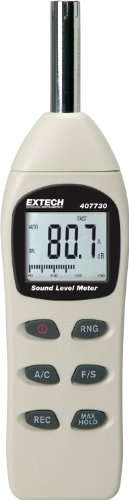
Extech 407730-NIST Sound Level Meter Review: Who It Is For, and Who Should Walk Away
This review explains what the Extech 407730-NIST measures, what its specifications mean in practice, and which buyers should choose a different instrument.
Read More→Calibrated instrument against an uncalibrated one: what actually changes
Calibration anchors a reading to a known reference; without it you have repeatability but not accuracy, and the gap between the two is where bad decisions live.
Read More→