Best Formaldehyde Detectors: 8 Sensitive Picks for Safer Indoor Air
Formaldehyde comes out of new furniture, laminate flooring, adhesives and some insulation, and it fades over months rather than days. Two instruments here are built specifically to measure it and publish a range; the other six carry a formaldehyde channel inside a wider air quality monitor. This hub separates the two groups and explains why the difference matters.
As an Amazon Associate, Akermin earns from qualifying purchases. Product links on this page are affiliate links.
Our Top Picks
Instruments were sorted by whether formaldehyde is the primary measurement or one channel among many, the range and resolution each manufacturer publishes, any calibration claim, and the units used. We did not run laboratory tests and publish no measurements of our own. Where a listing gives no figure the entry reads Not stated.
Best Overall
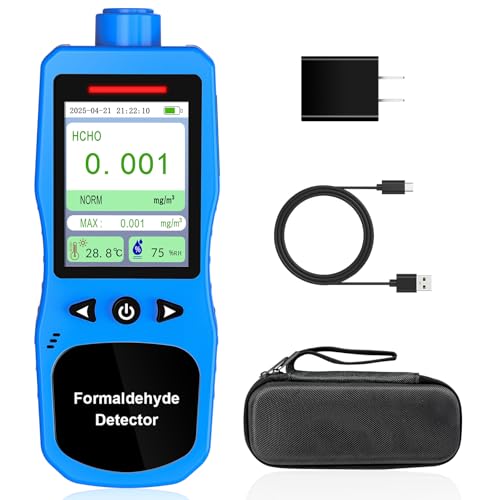
Forensics Detectors Formaldehyde Detector (HCHO)
A dedicated HCHO instrument with a published range, resolution and calibration certificate.
Every figure here is taken from the manufacturer listing for that product at the time of research. Only two listings in this group publish a formaldehyde range, so the remaining cells read Not stated rather than an estimate. Nothing on this page is a measurement of ours.
How to Choose a Formaldehyde Detector
Four questions settle the purchase:
Dedicated or One Channel of Many
Two listings here publish a formaldehyde range. The other six report HCHO as one number among six to sixteen and publish nothing about how it is measured.
Units Decide the Comparison
Guidance is usually written in milligrams per cubic metre, some instruments read parts per million. Converting between them depends on temperature and pressure, so matching units to your reference saves an error.
Is There a Calibration Claim?
Only the Forensics Detectors listing states a NIST calibration with a certificate. Without one, a reading is an indication rather than a measurement.
Know the Cross-Sensitivity
Electrochemical formaldehyde cells respond to alcohols and some other compounds. Measure before cleaning, not after, and keep hand sanitiser away from the sensor.
Mostly from products made with urea formaldehyde resins: particleboard and MDF furniture, some laminate and engineered flooring, plywood, certain insulation products, adhesives and some fabrics and finishes. Emission is highest when the product is new and falls over months, and it rises with temperature and humidity, which is why a warm room reads higher than a cool one.
Does a 16-in-1 monitor really measure formaldehyde?
Sometimes it does and sometimes it derives the figure from a general volatile organic compound sensor. None of the multi-parameter listings here publish a formaldehyde range, resolution or sensor type, with one exception: the Temtop listing names a Dart sensor. If an HCHO reading always moves in step with the TVOC reading, the two are probably coming from the same sensor.
Why did my reading jump after cleaning?
Electrochemical formaldehyde cells cross-respond to alcohols, and most sanitisers, sprays and surface cleaners contain them. A spike immediately after cleaning is usually the cleaner, not the furniture. Take readings before cleaning, keep the instrument away from freshly sprayed surfaces, and let a room settle before judging a number.
What do ppm and mg per cubic metre mean here?
Parts per million is a ratio of gas molecules to air molecules; milligrams per cubic metre is a mass in a volume. Converting between them depends on temperature and pressure as well as the molecular weight of the gas, so two instruments quoting different units cannot be compared by eye. Match your instrument to whichever unit the guidance you are using is written in.
How long does new furniture keep off-gassing?
Longer than most people expect. Emission decays over months rather than days and never quite reaches zero while the product exists, which is why a monitor with logging or an alarm threshold is more useful than a single reading. Ventilation and lower room temperature both reduce the concentration you experience.
Reviews
Forensics Detectors Formaldehyde Detector (HCHO) Best Overall
Formaldehyde is the one indoor pollutant where a specific number is genuinely worth having, because guidance figures exist, because the source is usually identifiable and because the level falls over a period of months in a way that can be tracked. That only works with an instrument that publishes what it measures.
This listing does. It states formaldehyde measurement from 0 to 10 ppm with a resolution of 0.01 ppm, a USA NIST calibration with a certificate, and a turn on and go operation. Three of those four facts are absent from every multi-parameter monitor further down the table, and the certificate in particular is what separates an instrument from an indicator. Knowing the device was calibrated against a traceable reference on a known date lets a reading be quoted rather than merely mentioned.
The honest caveat applies to the sensing technology rather than to this product. Electrochemical formaldehyde cells cross-respond to other substances, alcohols in particular, so a reading taken while cleaning with an alcohol based product or immediately after painting can be high for the wrong reason. The listing also does not state a sensor life, a recalibration interval or an operating humidity range, and electrochemical cells are consumable items with a finite life. Ask the manufacturer about the replacement interval before buying.
Strengths
Range and resolution both published
NIST calibration certificate stated
Formaldehyde is the primary measurement, not a derived channel
ZYKYCX Rechargeable HCHO Monitor Best for Fine Resolution
Most guidance on formaldehyde in homes is written in milligrams per cubic metre rather than parts per million, and having an instrument that reads in the same units as the advice removes a conversion step and the mistakes that come with it. This listing states a measuring range of 0 to 5 mg per cubic metre with a stated precision of 0.001 mg per cubic metre.
The three alarm modes are a practical detail rather than a gimmick. A vibrating alert is useful in a noisy workshop, an audible one in a bedroom at night, and a visual one where neither is welcome. For tracking a new floor or a new piece of furniture over the weeks it takes to off-gas, an alarm threshold does more than a display, because it means you are told when the level crosses a line rather than having to remember to look.
What the listing does not publish is the sensor technology, an accuracy figure, a calibration claim or a certificate, and 0.001 mg per cubic metre is a resolution rather than an accuracy. A display that steps in thousandths tells you nothing about how close the reading is to the truth. Treat it as a strong relative instrument for watching one room change over weeks, and reserve absolute claims for something with a certificate behind it.
Temtop 7-in-1 Air Quality Monitor with Dart Sensor Best Value
Naming a sensor is rare in this part of the market, and it is the reason this takes the value slot rather than one of the sixteen index monitors. The listing states an upgraded Dart sensor for formaldehyde alongside a laser particle sensor, tracking PM2.5, PM10, HCHO, VOCs, humidity, temperature and AQI.
Dart is a recognised name in electrochemical formaldehyde sensing, which suggests a dedicated cell rather than a formaldehyde figure inferred from a general volatile compound sensor. That distinction is the single most important thing to know about any multi-parameter monitor claiming an HCHO channel, because the inferred version will respond to perfume, cleaning products and cooking in ways that formaldehyde itself does not.
The listing does not publish a formaldehyde range, a resolution, an accuracy figure or a calibration method, and it makes no traceability claim. That is the trade against the dedicated instruments above: you get a broader picture of the room and a weaker basis for quoting any single number. For a household wanting to watch a new floor settle down while also keeping an eye on cooking particles, it is a sensible compromise.
Strengths
Formaldehyde sensor named rather than left unstated
Short answer: the Forensics Detectors HCHO detector is the instrument to buy if a number has to be quoted, because it states a 0 to 10 ppm range, 0.01 ppm resolution and a NIST calibration certificate; the ZYKYCX HCHO monitor reads in the milligram per cubic metre units most guidance uses and adds three alarm modes; and the Temtop 7-in-1 is the value pick, and the only multi-parameter unit here that names its formaldehyde sensor.
Two dedicated instruments and six monitors with a channel
The single most useful division on this page is between the products for which formaldehyde is the measurement and the products for which it is one entry on a list. The Forensics Detectors unit and the ZYKYCX monitor both publish a formaldehyde range and a resolution, which means the manufacturer is describing a sensor built for the job. The Extech VFM200 sits between the two groups, naming VOCs and formaldehyde in its title while publishing no range for either. The remaining five are general air quality monitors that display an HCHO number among six to sixteen others, with no range, no resolution and, in four cases out of five, no named sensor. That is not an accusation of dishonesty. It is a statement about what you can and cannot conclude from the reading.
Why the sensor type is the whole question
There are two common ways to produce a formaldehyde figure. An electrochemical cell reacts with formaldehyde specifically and produces a current proportional to concentration, which is what a dedicated instrument uses. A metal oxide semiconductor sensor responds to a broad family of reducing gases and is the usual basis for a TVOC reading; software can label part of that response HCHO, but the sensor cannot actually distinguish formaldehyde from the dozens of other compounds it reacts to. The tell is behavioural: if the HCHO and TVOC channels rise and fall together in perfect step, they are one sensor reported twice. The Temtop listing naming a Dart sensor is the one exception here, and it is the reason that unit takes the value slot.
Cross-sensitivity is real even on the good instruments
Electrochemical formaldehyde cells are specific, not exclusive. They respond to alcohols in particular, and that has a practical consequence in an ordinary home: hand sanitiser, surface sprays, glass cleaner, perfume and alcohol based wipes will all lift the reading. People discover this by cleaning a room, measuring immediately afterwards and concluding that their new flooring is dangerous. The discipline is straightforward. Measure before cleaning rather than after. Keep sanitiser away from the instrument. Let a room stand undisturbed for an hour before believing a number. And measure repeatedly over days rather than drawing a conclusion from a single reading, since formaldehyde levels rise with temperature and vary through the day.
Units, and why they trip people up
The two dedicated instruments in this group use different units. The Forensics Detectors unit states parts per million, 0 to 10 ppm with 0.01 ppm resolution. The ZYKYCX states milligrams per cubic metre, 0 to 5 with 0.001 resolution. Both are legitimate and they are not directly interchangeable, because converting between a volume ratio and a mass concentration depends on temperature and pressure as well as the molecular weight of the gas. Most residential guidance is written in milligrams per cubic metre and most occupational exposure limits in parts per million, so the sensible approach is to buy the instrument that speaks the same language as whatever reference you intend to compare against. Understanding ppm, LEL and volume in gas detection covers the arithmetic.
Watch a trend, not a number
Formaldehyde emission from a new product decays over months, and that is the shape you are trying to see. A single reading on the day a wardrobe arrives tells you almost nothing, because you have no baseline and no idea whether the figure is falling. Two approaches work. The BLATN Smart 126s states data storage with a one minute logging interval and export, which produces a record you can plot. The ZYKYCX states adjustable alarms with vibration, visual and audible modes, which means you are told when a threshold is crossed rather than having to remember to look. Either beats a display checked occasionally, and both make ventilation experiments meaningful: open the room up for a day, close it, and see what the numbers do.
Listings were compared on whether formaldehyde is the primary measurement, the range and resolution published, the units used, any named sensor or calibration claim, and the other parameters sharing the display. Owner feedback was reviewed for recurring reports of readings that respond to cleaning products and units that drift. We did not run laboratory tests, we publish no measurements of our own, and no figure appears on this page unless the manufacturer published it. Amazon data supplies images, availability and links only.
A handheld particle counter can indicate whether a room is likely to be within a guideline but cannot demonstrate compliance, because published limits are averages over hours or classifications with defined sampling plans and traceable instruments.
Most disagreement between two particle monitors in the same room comes from the two instruments sampling different air, different calibration aerosols and different humidity response, rather than from one of them being broken.
A smallest channel of 0.3 micron is an optical limit rather than a physical one, and the particles below it are invisible to the instrument while often outnumbering everything it does count.