Best Moisture Meters for Wood: Picks for Lumber, Flooring and Firewood
Wood is the one material a moisture meter reads as a real percentage, and the right meter depends on whether the wood is finished flooring that cannot be marked, rough lumber, or a firewood pile. This guide sorts the listings by pin or pinless sensing, stated depth and the correction features the manufacturers describe.
Independent Research
Verified Specifications
Honest Recommendations
Species Matters
Read the Core
Split Firewood First
As an Amazon Associate, Akermin earns from qualifying purchases. Product links on this page are affiliate links.
Our Top Picks
These meters were compared for wood on sensor type, stated reading depth, wood moisture range, species or density correction, calibration check and data features, all taken from manufacturer listings. We did not run laboratory tests or oven-dry comparisons; figures are the manufacturers' own and blanks are marked as not stated.
Best Overall
Wagner Meters Orion 950 Pinless Wood Moisture Meter
Dual-depth pinless wood meter with Bluetooth, EMC and dew point calculations.
Pinless, non-damaging sensor with dual depth at 1/4 in and 3/4 in
Built-in temperature and humidity sensor; automatic EMC, GPP/GPK and dew point calculations
Bluetooth to the Floor Smart and WoodShop MC apps; manual or automatic data collection
On-Demand Calibrator included; relative mode for engineered wood and drywall; 7-year warranty
All figures are taken from the manufacturers' Amazon listings at the time of research. Wood percentages depend on the species correction applied and are not comparable between meters without it. Where a listing gives no value the cell reads Not stated.
How to Choose a Wood Moisture Meter
Four checks decide the purchase:
Finished or Rough
Flooring, furniture and trim need a pinless meter. Framing, rough lumber and firewood tolerate pin holes and get a direct reading.
Depth for the Stock
Thin veneer and engineered flooring want a 1/4 in setting so the substrate does not skew the reading; solid boards want 3/4 in.
Species Correction
Density changes the reading. A meter with species or density settings, or at least a hardwood and softwood switch, is more useful than a bare number.
Acclimation Context
A board is dry when it matches the room. The Orion 950 calculates equilibrium moisture content from its own humidity sensor; the others need a separate hygrometer.
Why do two moisture meters give different readings on the same board?
Usually species correction and depth. A pin meter reads resistance between the pins at whatever depth they reach; a pinless meter reads capacitance across a volume down to its stated depth, 1/4 or 3/4 in on the Wagner units. If one meter is set for a different density than the other, or one reads a wet core while the other reads a dry surface, the numbers will diverge even though both are working.
Which meter is right for checking firewood?
A pin meter, because firewood is rough, often dirty and never finished, and the holes do not matter. Split a piece and take the reading on the fresh inside face rather than the weathered surface; the RDINSCOS listing notes that extremely dry wood may read 0%. The General MMD4E and the RDINSCOS firewood meter both suit the job.
Can a pinless wood meter be used on engineered flooring?
The Wagner Orion 950, 930 and 910 listings each state a relative mode for engineered wood, drywall and other non-solid materials, which gives a comparative reading rather than a percentage. Use the 1/4 in depth on the dual-depth models so the reading stays in the wear layer rather than the core.
Does the temperature of the wood change the reading?
It can, on both meter types. Wagner describes its IntelliSense pinless sensor as virtually unaffected by surface temperature of the wood or the environment. Pin meters and other pinless meters do not state temperature handling on their listings, so let cold lumber come to room temperature before trusting a reading close to a threshold.
Reviews
Wagner Meters Orion 950 Pinless Wood Moisture Meter Best Overall
The Orion 950 is the wood meter for flooring installers and furniture makers who cannot leave a mark and need the reading to relate to the room. Wagner states a pinless sensor with two depths, 1/4 in for veneers and thin stock and 3/4 in for solid boards, and describes its IntelliSense technology as reading moisture inside the wood rather than at the surface, largely unaffected by surface temperature.
The feature that sets it apart is context. A built-in temperature and humidity sensor lets the meter calculate equilibrium moisture content for the space automatically, along with grains per pound and dew point, so the installer can see whether a board has acclimated to the room without a separate hygrometer and a chart. Readings transfer over Bluetooth to the Floor Smart and WoodShop MC apps for reports.
The listing does not state a wood moisture range or a species setting, so both come from the manual; it does state a relative mode for engineered wood, drywall and other materials, an On-Demand Calibrator for field checks and a 7-year warranty.
Wagner Meters Orion 930 Pinless Wood Moisture Meter Best Dual-Depth Value
The Orion 930 keeps what most woodworkers use daily and drops what most do not. Wagner states the same dual-depth pinless sensor as the 950, reading at 1/4 in and 3/4 in, the same IntelliSense description of measuring inside the wood rather than at the surface, and the same On-Demand Calibrator so the meter can be checked on the bench without being sent away.
What is missing is the climate side: no built-in temperature and humidity sensor, no automatic EMC or dew point calculation and no Bluetooth. For a cabinet shop with a wall hygrometer and a chart, that is a fair trade; for a flooring contractor who has to document acclimation on site, the 950 earns its place.
The listing states a relative mode for engineered wood, drywall and other materials, an adjustable backlit screen for dim garages and a 7-year warranty. As with the 950, the wood moisture range and species handling are not on the listing. The Orion 910, one step down, reads at 3/4 in only.
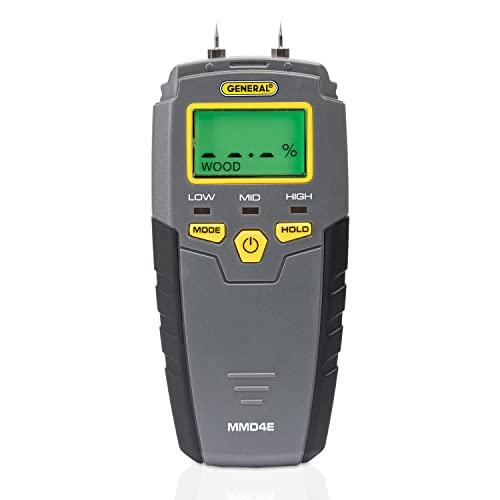
General Tools MMD4E Pin-Type Moisture Meter Best Value
The MMD4E is the pin meter for firewood, rough lumber and framing, where a pair of pin holes does not matter and a direct reading does. General Tools states a wood range of 5 to 50% and a building materials range of 1.5 to 33%, with low, medium and high tones and on-screen icons so the reading can be judged without looking down at the display.
The practical details are right for a shop or a woodpile: 0.3 in digits on a backlit LCD, a hold button, spare 8 mm stainless steel pins in the box and a protective cap that doubles as a calibration checker, so a bent pin or a flat 9V battery shows up before the reading is trusted.
It has no species setting on the listing, no depth beyond the pin length and no data features, and the marketing leans on mold, which a moisture meter cannot detect directly. For firewood, drive the pins into a freshly split face rather than the weathered outside, and expect a dry piece to read at the bottom of the range.
Short answer: the Wagner Orion 950 is the wood meter to buy for flooring and furniture work, with a pinless dual-depth sensor at 1/4 and 3/4 in, Bluetooth reporting and an automatic equilibrium moisture content calculation from its own humidity sensor; the Wagner Orion 930 keeps the same sensor and calibrator without the app and climate features for a shop that already has a hygrometer; and the General MMD4E is the pin meter for firewood, rough lumber and framing where a 5 to 50% direct reading matters more than an unmarked surface.
Why wood is the easy case for a moisture meter
Wood is the material that moisture meters were built around, and it is the only one here that gives a true percentage rather than a relative scale. Both sensor types work on it: a pin meter reads electrical resistance between two pins driven into the surface, and a pinless meter reads capacitance through a flat sensor pad to a stated depth, about 3/4 in on most units, without leaving a mark. The catch is density. Oak and pine at the same true moisture content read differently, which is why a species or density correction matters and why the guide to using a moisture meter on wood spends most of its length on setup rather than on the reading itself.
Pinless for anything finished
Flooring, cabinet stock, furniture and trim cannot take pin holes, so the pinless Wagner Orion meters are the natural fit. The Orion 950 and 930 state two depths, 1/4 in and 3/4 in; the Orion 910 states 3/4 in only. The shallow setting keeps the reading inside a veneer or a thin wear layer instead of reading the plywood or subfloor beneath it, and the deep setting reads the core of a solid board. All three describe an On-Demand Calibrator, a reference the meter is checked against on site, and a relative mode for engineered wood and drywall. The 950 adds the context that flooring work needs: its own temperature and humidity sensor, automatic equilibrium moisture content, grains per pound and dew point, and Bluetooth to the Floor Smart and WoodShop MC apps. The Extech MO257 is the lower-cost pinless alternative, stating a relative mode and a 0.75 in depth in its bullets, though its title lists 0.78 to 1.6 in, a discrepancy the manual would need to settle. The FNIRSI WMT-10 is a rechargeable pinless meter with hardwood, softwood, plaster wall and brick wall modes and no stated depth. The pin versus pinless comparison covers the sensing difference in depth.
Pin meters for lumber, framing and firewood
Where the surface does not matter, a pin meter gives a direct reading at the point of contact and costs less. The General MMD4E states 5 to 50% for wood and 1.5 to 33% for building materials, ships with spare 8 mm pins and uses its cap as a calibration checker. The compact General MMP100 is the same idea in a pocket size with a tri-color display, though its listing gives no range. The RDINSCOS firewood meter states a hardwood and softwood switch, an audio alert and a 0.5% accuracy claim, and its own listing warns that very dry wood may read 0%. For firewood the technique matters as much as the meter: split the log and read the fresh face, because the outside of a seasoned-looking piece dries long before the core does.
The limits: species correction and pin damage
Every reading on this page carries two caveats. First, wood readings need a species correction. Only the RDINSCOS and FNIRSI listings state a hardwood and softwood setting; the Wagner and General listings do not describe species handling, so the manual has to supply it. A meter set for the wrong density can be several points off, which is the difference between a board that is ready and one that will cup after installation. Second, pins damage what they touch. Two holes in framing are invisible; two holes in a finished floor are a callback. Pins also read only as deep as they reach, so a thick timber with a wet core can pass a pin test on a dry surface, which is where a 3/4 in pinless reading or longer pins on a hammer probe earn their place. Drywall and concrete readings from the same meters are relative unless a material mode is stated, so do not carry a wood percentage over to a wall.
Acclimation: the reading only means something against the room
A board is not dry at some fixed number; it is dry when it has reached equilibrium with the air it will live in. That is why the Orion 950 calculates equilibrium moisture content from its built-in humidity sensor and why a flooring installer with any other meter needs a hygrometer and a chart alongside it. Take readings on several boards from different parts of the bundle, log them, and compare them to the EMC of the space rather than to a rule of thumb.
Related guides
For the sensing question on its own, the pinless moisture meter guide and the pin-type moisture meter guide compare each class across more materials. The general moisture meter buying guide is the starting point if wood is only one of the materials you will check.
How We Research
Products were compared on manufacturer listing text: sensor type, stated reading depth, wood moisture range, species or density settings, calibration provisions, connectivity and warranty. Owner feedback was reviewed for recurring reports of disagreement between meters and pin breakage. We did not run laboratory tests or oven-dry comparisons and publish no moisture measurements of our own. Amazon data supplies images, availability and links only.
Compact articulating borescopes whose listings name aircraft work: the DXZtoz dual-lens 0.25 in, the four-way Teslong TF600 3.9 mm and the DXZtoz 3.9 mm.
Borescopes whose listings state a 3.9 mm probe: the two-way Teslong TD500, the four-way Teslong TF600 and the plain NIDAGE, plus DXZtoz, Dearsee and Anykit.